Analisi esperta di Pomegranates in the Wind di Andre Masson
Stile: Surrealism · Genere: flower painting
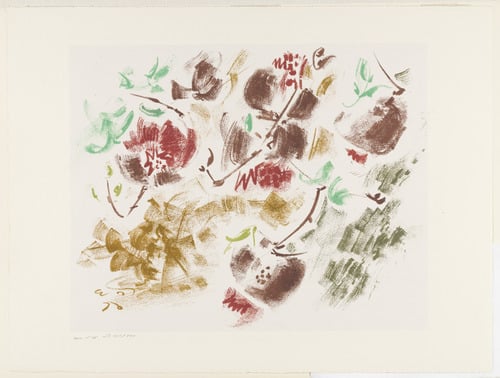
Expert Analysis: "Pomegranates in the Wind" by André Masson
André Masson’s Pomegranates in the Wind is a compelling example of Surrealist flower painting, a genre the artist radically transformed by infusing it with the movement’s core principles of automatism, psychological symbolism, and the disruption of stable reality. While still life and floral subjects are traditionally static and decorative, Masson subverts these conventions, making the work significant for its dynamic, almost violent expression of subconscious energy.
Break with Tradition: The painting’s title itself signals a departure from conventional flower painting. The “wind” introduces an element of natural, unpredictable force, suggesting that the pomegranates are not passively arranged but caught in a moment of agitation. This aligns with Surrealism’s fascination with chance and the unconscious—Masson often used automatic drawing and dripped paint to capture raw, unmediated gestures, lending the fruit a turbulent, almost organic motion. The pomegranates become living organisms in flux, their seeds (a recurring Surrealist motif for hidden desires or fragmentation) possibly spilling or trembling.
Symbolic Depth: The pomegranate, a fruit rich in mythological and psychological associations (fertility, death, the myth of Persephone), is rendered here not as a botanical specimen but as a charged symbol. In Surrealist hands, such objects serve as bridges between the conscious and the unconscious. Masson’s treatment—likely featuring disjointed or contoured forms, fluid lines, and a palette that evokes both vitality and threat—transforms the fruit into an emblem of eroticism, decay, or rebirth, amplified by the wind’s invisible presence.
Significance within Surrealism: Masson’s work is crucial because he pushed still life into the realm of abstract, psychic drama. Unlike the meticulous dreamscapes of Dalí, Masson favored spontaneity and the visceral quality of line and color. Pomegranates in the Wind exemplifies his belief that even a humble subject could be a conduit for the irrational, the violent, and the sublime. The painting thus stands as a testament to Surrealism’s ability to reinvent tradition through the lens of the subconscious, making the familiar strange and the static alive with tension.
Visivamente simili
20 opere con composizione e palette affini
Chrysanthemum and loquat
Qi Baishi
Pomegranates
John Singer Sargent
Lay Down and Travel
Shen Zhou
Untitled
Dilek Demirci
Pomagranates
Mihnea Cernat
Pomegranates, Majorca
John Singer Sargent
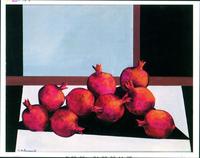
Untitled
Bahman Mohasses
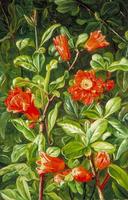
Flowers of the Pomegranate, Painted in Teneriffe
Marianne North
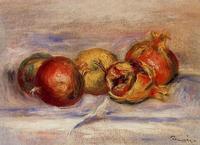
Three Pomegranates and Two Apples
Pierre-Auguste Renoir
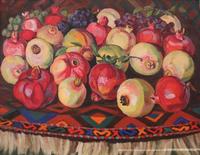
Meghri Pomegranates
Mariam Aslamazian
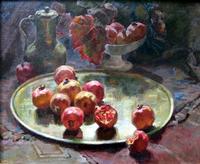
Still life with pomegranates
Ilya Mashkov
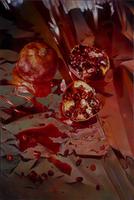
Threads of Scarlet, Pieces of Pomegranate
Mary Pratt
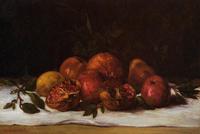
Still Life
Gustave Courbet
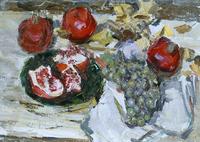
Still life with pomegranates and grapes
Serhij Schyschko
Still Life with Bowl of Pomegranates
Morris Graves
MEMORIA D'EVORA I
Joan Hernandez Pijuan
Still LIfe with Pomegranates
Tom Roberts
Pomegranates and quince
Sattar Bahlulzade
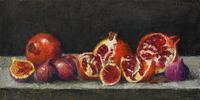
Pomegranates and Figs
Alexander Roitburd
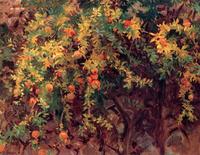
Pomegranates
John Singer Sargent