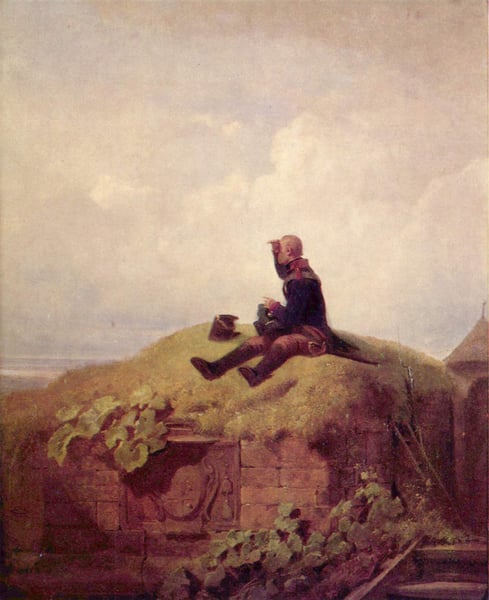
Once upon a time (the knitting outpost)
Dettagli
Analisi esperta di Once upon a time (the knitting outpost) di Carl Spitzweg
Stile: Biedermeier · Genere: genre painting
Expert Analysis: "Once upon a time (the knitting outpost)" by Carl Spitzweg
Carl Spitzweg’s Once upon a time (the knitting outpost) is a quintessential example of Biedermeier genre painting, a style that flourished in Central Europe between 1815 and 1848. The work’s significance lies in its masterful encapsulation of the Biedermeier spirit—a celebration of domestic tranquility, modest industriousness, and quiet, often nostalgic, observation of everyday life. Spitzweg, a trained pharmacist turned painter, excelled at capturing the gentle humor and subtle irony embedded in middle-class existence.
In this painting, the title itself suggests a fairy-tale whimsy, while the scene portrays a solitary figure—likely a guard or sentry—engaged in knitting at his post. This juxtaposition of duty and leisure is a hallmark of Spitzweg’s gentle satire: the outpost, typically a symbol of vigilance, becomes a cozy corner of domesticity. The knitter’s focused, unhurried activity transforms a mundane, even absurd, situation into a moment of serene self-sufficiency. The detail-rich composition—the careful rendering of textures, the warm, muted palette, and the intimate, slightly claustrophobic setting—reflects the Biedermeier fascination with order, comfort, and the private sphere.
The work’s significance also stems from its role in elevating genre painting during a period when history and religious subjects dominated academic art. Spitzweg, along with his Biedermeier contemporaries, championed the ordinary person’s quiet dignity. Here, the knitting outpost becomes a metaphor for the Biedermeier ideal: finding fulfillment in simple, honest labor, even within the constraints of a rigid social or professional structure. The painting invites viewers to smile at the incongruity while respecting the character’s contentment—a balance that makes Spitzweg’s oeuvre enduringly charming and historically valuable.
Visivamente simili
20 opere con composizione e palette affini
The Sunday walk
Carl Spitzweg
Market by the Seashore
Salomon van Ruysdael
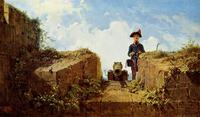
The knitting outpost
Carl Spitzweg
View on Mousehold Heath, near Norwich
John Crome
The soldier on the field of battle or, the last grenadier of Waterloo
Horace Vernet
A hunter looking to a young girl
Carl Spitzweg
Shrimp Boys at Cromer, Norfolk
William Collins
Fisher Families on the Coast
Rudolf Jordan
The Collapse of the St Anthonis Dyke in 1651
Jan Asselijn

Return from Fishing
Pierre Duval Le Camus
Beach scene
Adriaen van de Velde
Strand Met Vissers Rijksmuseum SK A 1777
Simon de Vlieger
Rose scent memory
Carl Spitzweg
Resting on the Vine
Carl Spitzweg
Returning from the Haunts of the Seafowl
William Collins
Rykonty, 3 July 1812
Albrecht Adam
Portrait of a young boy in front of an alpine panorama
Pierre Duval Le Camus
The Sentry
Gerolamo Induno
Walk With the Institute
Carl Spitzweg
On The South Coast
William Shayer