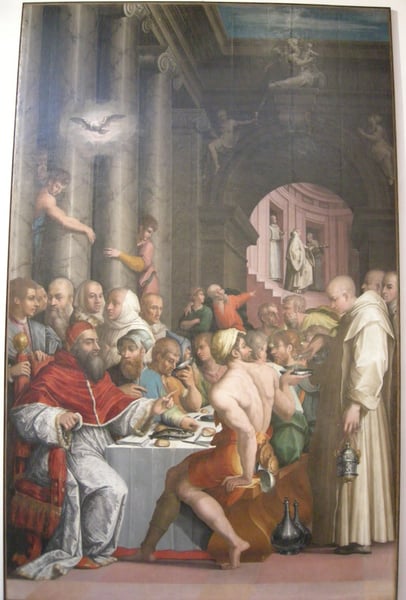
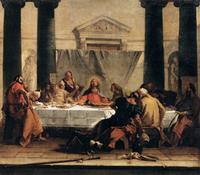
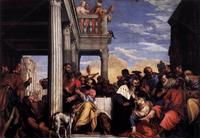
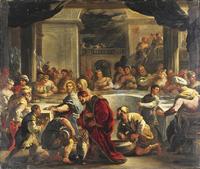
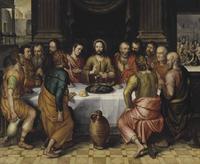
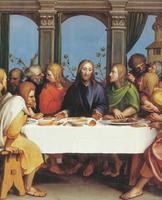
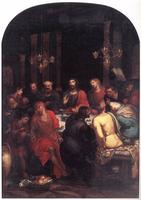
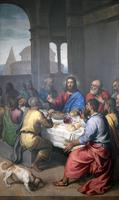
Giorgio Vasari's “Dinner of St. Gregory the Great (Clement VII)” is a prime example of Mannerist religious painting, notable for its sophisticated fusion of sacred narrative with contemporary political identity. The work’s significance lies in how it epitomizes Mannerism’s departure from High Renaissance naturalism toward deliberate artifice and intellectual conceit: the composition conflates the 6th-century saint with Pope Clement VII, a Medici pontiff. By portraying a living pope as St. Gregory, Vasari engages in a typical Mannerist strategy—blurring historical and temporal boundaries to assert papal authority and divine favor. The style’s characteristic elongated figures, crowded and asymmetrical arrangement, and heightened emotional tension serve to elevate the scene beyond mere illustration into a complex allegory. Vasari, best known as the author of Lives of the Artists, here demonstrates the self-conscious, art-historical awareness that defines Mannerism: the painting is both a devotional image and a coded statement on the artist’s own role in shaping artistic legacy.