
Expertenanalyse zu Giorgio Vasaris The Temptation of St. Jerome
Stil: Mannerism (Late Renaissance) · Genre: religious painting
Expert Analysis: "The Temptation of St. Jerome" by Giorgio Vasari
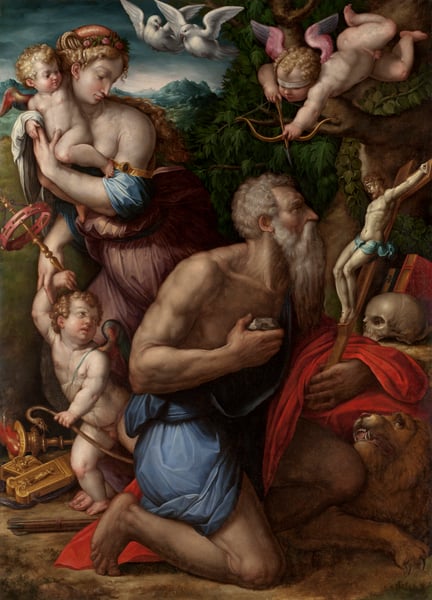
As a defining work of Italian Mannerism, Vasari’s The Temptation of St. Jerome exemplifies the stylistic departures that mark the late Renaissance’s shift away from High Renaissance naturalism. Executed within the religious genre, the painting focuses on the hermit saint’s spiritual struggle—a subject that allowed Vasari to explore the Mannerist preoccupation with psychological tension and artificial elegance.
Significance within Mannerism:
- Emotional and Compositional Complexity: Mannerist artists deliberately subverted the balanced, harmonious compositions of Raphael and Leonardo. Vasari’s scene is crowded with allegorical figures—demons, angels, and symbolic temptations—arranged in overlapping, serpentine forms that create a sense of unease and movement. The figure of St. Jerome is often elongated and contorted in a pose of ecstatic or agonized prayer, a hallmark of Mannerist figural distortion meant to convey spiritual intensity over physical realism.
- Color and Artificiality: Instead of the atmospheric chiaroscuro of earlier Renaissance, Vasari employs jarring, acidic hues (sharp greens, pinks, and yellows) and strong outlines, flattening the space and emphasizing the painting’s status as a constructed, intellectual image rather than a window onto reality. This artificial palette heightens the drama of the saint’s temptation.
- Vasari’s Dual Legacy: As the author of Lives of the Most Excellent Painters, Sculptors, and Architects, Vasari was both a practitioner and theorist of Mannerism. His own work, including this painting, serves as a self-conscious demonstration of the maniera (style)—a sophisticated, courtly art that prioritizes grace, invention, and virtuoso technique over direct imitation of nature. The painting’s religious theme is thus filtered through an artistic agenda that celebrates the artist’s skill in orchestrating a complex, emotionally charged narrative.
In summary, The Temptation of St. Jerome is significant as a prime example of Vasari’s Mannerist synthesis: a religious subject rendered with deliberate artifice, spatial compression, and expressive exaggeration that reflects the late Renaissance’s turn toward intellectualism and stylistic self-awareness.
Museum / Gallery
Visuell ähnlich
20 Werke mit ähnlicher Komposition und Farbpalette
St. Jerome in meditation
Giorgio Vasari

The Alliance of Jacob and Laban
Pietro da Cortona
St Jerome
Paolo Veronese

Madonna with Saint Zacharias
Parmigianino

St Jerome
Guido Reni

Sarah Presenting Hagar to Abraham
Bartholomeus Spranger
Hercules and Omphale
Luca Giordano
The Sacrifice of Abraham
Andrea del Sarto
Apollo and Daphne
Nicolas Poussin

The Judgement of Midas
Jacob Jordaens

Heilige Familie
Giulio Cesare Procaccini

Sacra Conversazione
Palma Vecchio

Original sin and expulsion from the Garden of Eden
Giovanni Battista Piranesi
The Holy Family of the Oak Tree
Raphael

The Judgement of Paris
Luca Giordano

St Jerome near a Cave
Maarten de Vos

Saint Jerome in Penitence
Bernardino Luini
The Sacrifice Of isaac
Mariotto Albertinelli

Suzanne et les vieillards
Ludovico Carracci
The Baptism of Christ
Bartholomeus Spranger