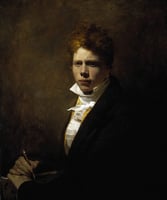
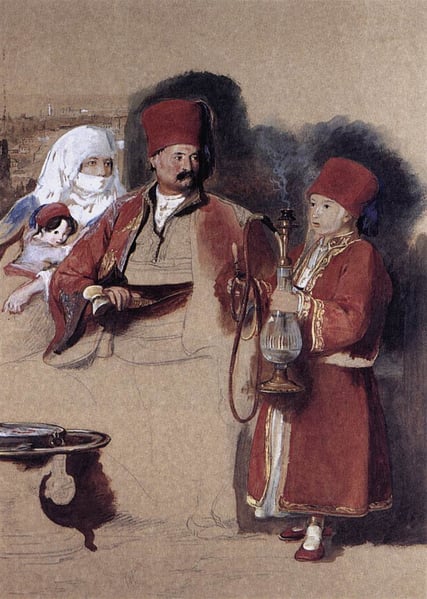
Analisi esperta di Portrait of Sotiri di David Wilkie
Stile: Romanticism, Orientalism · Genere: portrait
Analysis of Portrait of Sotiri by David Wilkie
David Wilkie’s Portrait of Sotiri (c. 1840) occupies a distinctive position at the intersection of Romanticism and Orientalism, capturing the era’s fascination with “exotic” subjects while transcending mere stereotype. Painted during Wilkie’s travels to Constantinople and Smyrna, the work reflects his turn from anecdotal genre scenes toward a more direct, ethnographic portraiture—a shift that marks a significant moment in 19th-century British art.
Romantic Emphasis on Individuality and Drama
True to Romantic ideals, Wilkie invests the portrait with psychological depth and a sense of narrative. The subject—identified as Sotiri, likely a Greek or Levantine figure—is not a generalized “type” but a specific individual, rendered with careful attention to facial structure, expression, and costume. The dramatic lighting and rich, earthy palette evoke a mood of quiet dignity and inner life, typical of Romantic portraiture’s focus on the sitter’s character rather than mere social status.
Orientalist Authenticity and Ambiguity
Wilkie’s Orientalism is notable for its ethnographic curiosity. Unlike many contemporary Western artists who idealized or fantasized Eastern subjects, Wilkie painted from direct observation during his Near Eastern journey. The turban, embroidered coat, and hooked nose are rendered with precision, avoiding the overt caricature found in some Orientalist works. Yet the portrait also carries an air of romanticized otherness—the half-lit face and distant gaze create an aura of mystery, appealing to Western viewers’ fascination with the “Orient.”
Significance in Wilkie’s Oeuvre and Art History
This painting exemplifies Wilkie’s late style, where he synthesized his earlier narrative skills with a newfound interest in portraiture as a record of cross-cultural encounter. Portrait of Sotiri is significant because it demonstrates how Romanticism and Orientalism could coexist in a single work: the Romantic celebration of the individual meets the Orientalist desire to document and possess the foreign. Moreover, Wilkie’s approach—sympathetic but still invested in difference—foreshadows later 19th-century debates about representation, authenticity, and the ethics of depicting non-Western subjects.
In sum, Portrait of Sotiri is a key artifact of Romantic Orientalism, notable for its fusion of intimate character study with broader cultural curiosity, and for its role in redefining British portraiture during an age of imperial expansion.
Museum / Gallery
Visivamente simili
20 opere con composizione e palette affini
Slave bringing Sherbert to a Persian Prince (Halicoo Mirza)
David Wilkie
The arms dealer's shop
Gustavo Simoni
Two Turkish merchants conversing
Jacob Toorenvliet
The jewellery seller
Joaquín Agrasot
Markos Botsaris
Jean-Leon Gerome
Tavla Playing Zeybek
Osman Hamdi
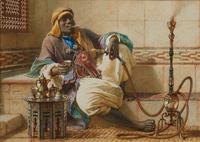
The happy smoker
Carl Haag
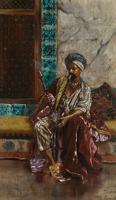
The Nargilah Smoker
Rudolf Ernst
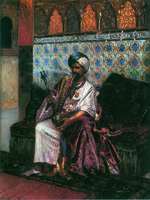
Le Fumeur De Narghilé
Rudolf Ernst
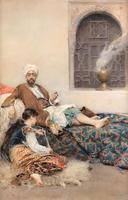
The favourite
Gustavo Simoni
Guard Corps in Orient
Alexandre-Gabriel Decamps
Child
John Frederick Lewis
A Man in Oriental Costume
Horace Vernet
The carpet makers
Rudolf Ernst
The Dying Turk
Eugene Delacroix
The Draught Players
Jean-Leon Gerome
A North African interior
Gustavo Simoni
The Turk
Giorgio de Chirico
Zaporizhzhya Cossack
Konstantin Makovsky
Interview with the Viceroy of Egypt at His Palace in Alexandria
David Roberts