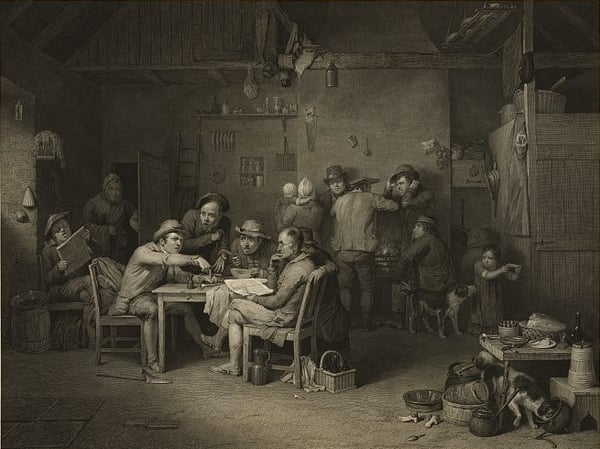
Village Politicians
Expertenanalyse zu David Wilkies Village Politicians
Stil: Romanticism · Genre: genre painting
Artwork Analysis: "Village Politicians" by David Wilkie (1806)
Context and Significance
David Wilkie’s Village Politicians is a cornerstone of British genre painting and a vivid expression of Romanticism’s turn toward the everyday lives of common people. Painted when Wilkie was only twenty-one, the work catapulted him to fame and established a new direction for narrative art in Britain. Rather than depicting heroic or mythological scenes—common in academic painting of the period—Wilkie focused on the intimate, humorous, and socially revealing moments of rural life. This shift aligns with the Romantic fascination with national identity, folk culture, and the authenticity of ordinary experience.
Narrative and Observation
The painting captures a group of villagers gathered in a humble inn, animatedly debating politics—a topic then charged with meaning in the wake of the French Revolution and the Napoleonic Wars. Wilkie’s genius lies in his ability to render a multi-layered story through gesture, expression, and detail. Each figure embodies a distinct type—the earnest reader, the skeptical listener, the wheezing smoker—and their interactions create a microcosm of public discourse. The work is simultaneously comedic and serious, celebrating the dignity and intelligence of rural folk while gently mocking the pretensions of those who engage in politics without full understanding.
Stylistic and Thematic Importance
Wilkie’s technique marries the observational precision of Dutch Golden Age genre painting (particularly the works of Jan Steen and David Teniers) with the Romantic emphasis on emotional truth and national character. The rich, warm palette and meticulous attention to textures—pewter mugs, weathered faces, tattered clothing—ground the scene in palpable reality. Yet the composition, with its circular grouping and dramatic lighting, directs the viewer’s eye like a stage play, heightening the sense of immediacy and psychological depth.
Village Politicians also marks a key moment in the British art world: it was acquired by Sir George Beaumont, a major patron, and helped shift public taste toward homegrown subject matter. Wilkie’s success paved the way for later narrative painters such as William Hogarth (though Hogarth preceded him) and the Victorian genre painters. The work remains significant as a landmark of Romanticism’s democratic impulse—elevating the village debate to the level of epic, and proving that the drama of everyday life could be as compelling as any history painting.
Visuell ähnlich
20 Werke mit ähnlicher Komposition und Farbpalette
Figures Gambling in a Tavern
David Teniers the Younger
Lean Kitchen
Jan Steen
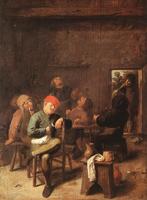
Peasants Smoking And Drinking
Adriaen Brouwer
a Domestic Interior in Which a Peasants Family Drink, Eat and Entertain Themselves with Music. in the Centre, is a Table Covered by a White Linen on Which Food Items Had Been Displayed, Before It is a Dog and Tow Men on the Far Left are Lighting Their Pipes by the Fireplace
Jan Miense Molenaer
The master of drinking
Adriaen Brouwer
Interior of a Tavern
Adriaen van Ostade
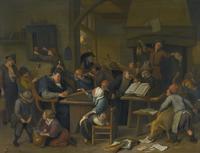
A Riotous Schoolroom with a Snoozing Schoolmaster
Jan Steen
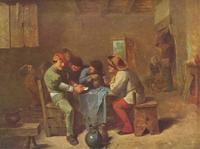
Peasants playing cards in a tavern
Adriaen Brouwer
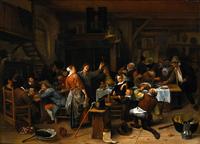
Prince`s day
Jan Steen
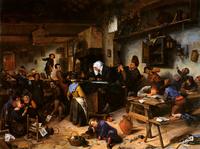
Village school
Jan Steen
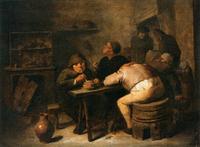
Interior with Smokers
Adriaen Brouwer
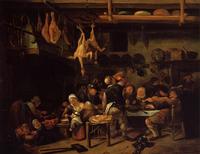
Fat Kitchen
Jan Steen
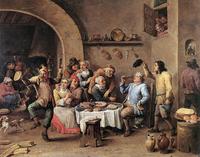
Carnival: 'The King Drinks'
David Teniers the Younger
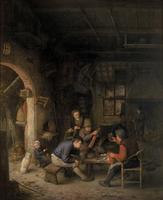
Peasants in an Inn
Adriaen van Ostade
Tavern scene
Johann Baptist Pflug
Barber Extracting of Tooth
Adriaen van Ostade
The Counterfeiters
Eastman Johnson
Scène d'auberge
David Rijckaert III
Peasants in an Interior
Adriaen van Ostade
Smokers in an Interior
David Teniers the Younger