Expertenanalyse zu Vela Zanettis Still Life of the Earth
Stil: Muralism · Genre: still life
Expert Analysis: "Still Life of the Earth" by Vela Zanetti
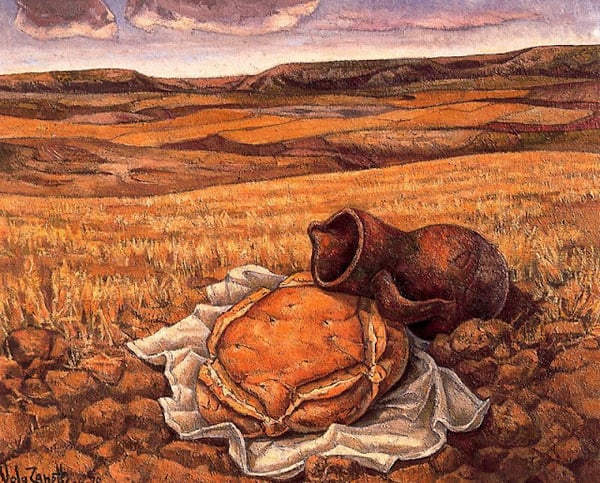
Vela Zanetti, a master of the Muralist tradition, is best known for sweeping, large-scale public works that fuse social realism with lyrical symbolism. In "Still Life of the Earth," he adapts the monumental spirit of Muralism to the intimate genre of still life—a bold and significant move that redefines the boundaries of both styles.
What makes this work significant:
-
Elevating Still Life to a Muralist Scale and Purpose
Muralism, as a movement, typically privileges narrative, history, and collective struggle. Still life, by contrast, is often domestic and private. Zanetti bridges this divide by treating the objects of the earth—perhaps fruits, grains, tools, or soil—as monumental icons of sustenance and labor. Each element is rendered with the same gravity and compositional weight one would find in a fresco depicting revolution or rural life. -
Symbolism of the Earth and Human Connection
The title, "Still Life of the Earth," suggests the earth itself is both subject and provider. Zanetti likely imbues ordinary organic forms (ripened harvests, rough-hewn vessels) with a near-sacred intensity. This reflects the Muralist commitment to honoring the common worker and the land that sustains them. The still life becomes a quiet manifesto: even in stillness, the earth remains vibrant, alive, and worthy of monumental portrayal. -
Formal Tension Between Intimacy and Monumentality
While the genre is still life, the execution draws on Muralist techniques: strong, sculptural modeling, a limited but forceful palette, and a composition that pushes toward the edges as if it could expand into a full wall. This tension between the humble genre and the grand style challenges the viewer to reconsider what deserves to be monumentalized. -
Place Within Zanetti’s Oeuvre
Zanetti’s murals (such as those at the United Nations or in the Dominican Republic) often celebrate peace, labor, and agrarian life. "Still Life of the Earth" can be seen as a distilled, intimate version of that same philosophy—a microcosm of his larger public narratives, proving that even a solitary tabletop arrangement can carry the weight of a mural’s message.
In essence, the artwork is significant because it expands the vocabulary of Muralism: it demonstrates that the movement’s core values of dignity, earthiness, and accessibility can inhabit a still life just as powerfully as a historical epic. Zanetti reminds us that the smallest objects, when painted with conviction, can speak for the entire world.
Visuell ähnlich
20 Werke mit ähnlicher Komposition und Farbpalette
Still Life with a Cabbage
Andre Dunoyer de Segonzac
Bread on the blue
Pyotr Konchalovsky
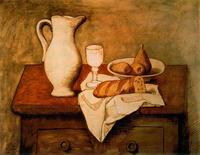
Still life with jug and bread
Pablo Picasso
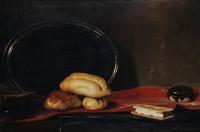
Still Life / Breads
Nikolaos Gyzis
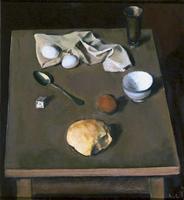
Still Life
Corneliu Baba
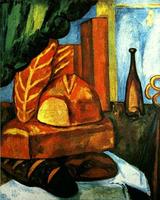
Bread
Mikhail Larionov
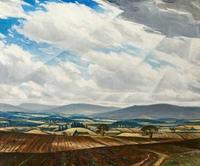
Welsh Hills
C. R. W. Nevinson
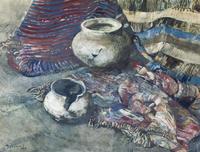
Still Life with Armenian Carpet
Petros Malayan
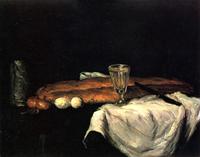
Still Life with Bread and Eggs
Paul Cezanne
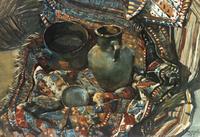
Still Life with Armenian Carpet
Petros Malayan
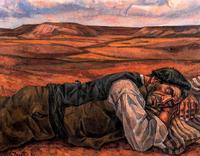
The Land of Castile
Vela Zanetti
Barény Róbert, Csendélet 1932
Berény Róbert
Berény Róbert, Fekete Macska
Berény Róbert
Neskuchnoye. Field.
Zinaida Serebriakova
The Moon
Mary Fedden
Berény Róbert, Csendélet Kenyérrel
Berény Róbert
Jars of clay and glass found in Pompeii
Giovanni Battista Piranesi
Breads and the tray
Pyotr Konchalovsky
Pots
Petros Malayan
Stilleben mit Spiegeleiern
Theodule Ribot