Description
Style: Baroque · Genre: portrait, tronie
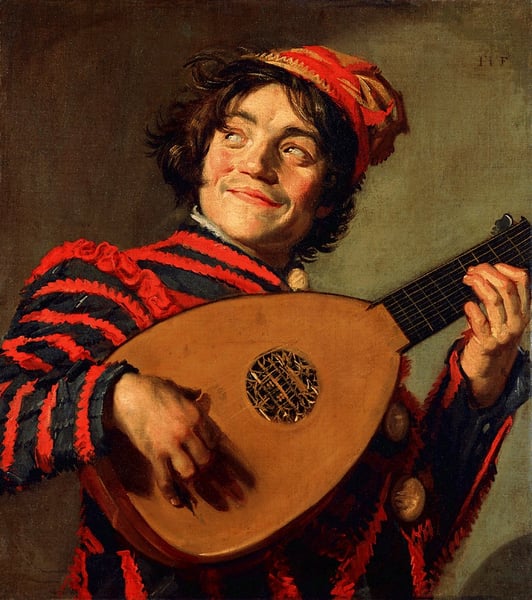
Portrait of a Jester with a Lute (ca. 1623-1624) is an example of 17th-century Dutch genre painting. This term refers to paintings that depict occurrences of everyday life, ordinary people engaged in daily activities. At times, the portrayal of lower classes in genre paintings, such as peasants, musicians, merry drinkers, and promiscuous women, had a didactic dimension. The moral judgment focused on sensory pleasures and the dangers associated with these pleasures. Thus, Portrait of a Jester with a Lute may be an allegorical portrait, which speaks about the vanity of music as fleeting pleasure. The choice of subject was likely influenced by the Utrecht Caravaggisti, a group of Dutch Baroque painters profoundly influenced by the art of Italian painter Caravaggio. Depictions of lute players by the Utrecht Caravaggisti include The Lute Player (1622) by Dirck van Baburen and A Man playing Lute (1624) by Hendrick Terbrugghen. Hals, like many painters throughout Holland, emulated some of these models and gestures.
Throughout his life, Hals painted both genre portraits and commissioned portraits, reserved for members of the upper classes. Сommissioned portraiture conveyed the social status and prominence of its subjects. For this reason, Hals painted these two types of portraits in two different styles. This contrast is evident when comparing Portrait of a Jester with a Lute to a commissioned portrait by Hals from the same period, Portrait of Jacob Pietersz Olycan (1625). In Olycan’s commissioned portrait, Hals’s brushwork is fine and smooth, and each detail is meticulously executed. The articles of Olycan’s garment, such as the lace collar, are produced with special care and precision. But when painting the jester, Hals exhibited rougher and looser brushwork. In the garment, especially, red dabs of paint created the effect of a frill on the sleeve, while the bottom was constructed through blotches of red and gray paint. The painting reveals traces of the artist’s brush, which gives it a vivid expressive quality. When Olycan’s pose is serious and static, the portrait of the jester captures a fleeting moment of his spontaneous movement.
The Louvre acquired Portrait of a Jester with a Lute in 1984. A copy of the painting, The Jester (1625) is part of Rijksmuseum Museum collection in Amsterdam. At first, the copy was considered to be executed by Hals; later, it was established that one of his followers painted it. Most likely it was Judith Leyster, a Dutch painter who might have been Hals’s pupil in 1629, and later was married to painter Jan Miense Molenaer. The copy is similar to the original in dimension, and it emulates the painting in its composition, handling of light, and the unrestrained brushwork. The painter David Bailly also paid homage to Hals’s painting in Self-portrait with Vanitas Symbols (ca. 1651). In the self-portrait, the artist surrounds himself with objects that reflect his artistic identity and interests. A sketch of Portrait of a Jester with a Lute is hanging in the background, featured as an object significant to Bailly.
Museum / Gallery
Visually similar
20 works with related composition and palette
The Jester
Judith Leyster
The Serenade
Judith Leyster
Lute Player
Nicolas Tournier
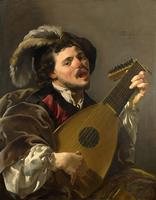
The Singing Lute Player
Hendrick Terbrugghen
Duet
Hendrick Terbrugghen
Lute Player
Bernardo Strozzi
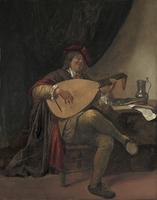
Self-portrait with a lute
Jan Steen
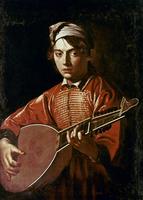
The lute player
Caravaggio
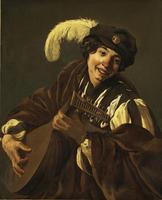
A Boy Playing the Lute. Hearing
Hendrick Terbrugghen
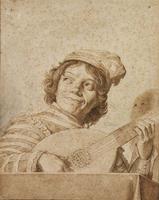
The Lute Player, After Frans Hals
David Bailly
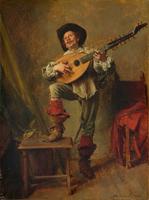
Soldier Playing the Theorbo
Ernest Meissonier
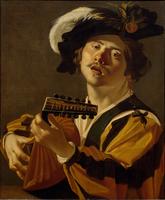
The Lute Player
Dirck van Baburen
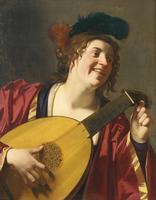
Femme Jouant Du Luth
Gerard van Honthorst
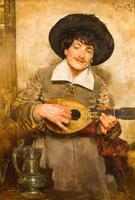
Young man with mandolin
Roman Ribera Cirera
A lute player
Caravaggio
Woman Playing a Lute
Artemisia Gentileschi
Portrait of a Man Playing a Lute
Bartolomeo Passerotti
A Lady Playing the Lute
Ferdinand Bol
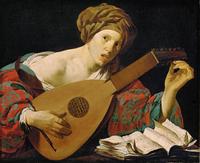
Woman Playing the Lute
Hendrick Terbrugghen
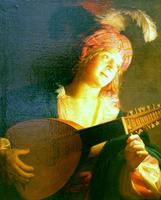
Woman with Lute
Gerard van Honthorst