Expert analysis of Eugene de Blaas’s A Portrait Of A Young Lady
Style: Academicism · Genre: portrait
Expert Analysis of "A Portrait Of A Young Lady" by Eugene de Blaas
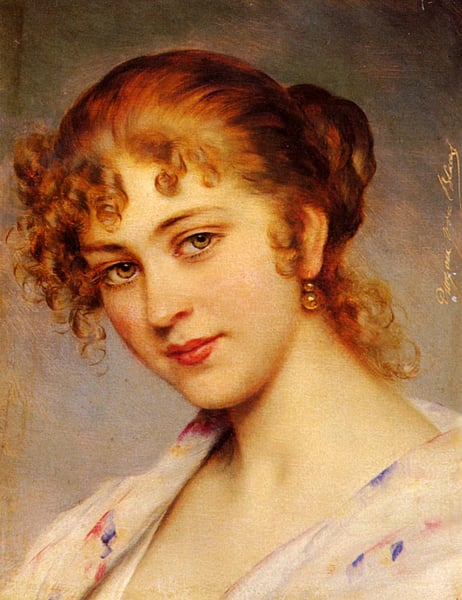
Eugene de Blaas (also known as Eugen von Blaas) was a leading figure of the late 19th‑century Academicism movement, and this portrait stands as a quintessential example of the style’s technical mastery and idealized sensibilities. Academicism, which dominated European art academies from the 17th through the 19th centuries, prized flawless draftsmanship, smooth brushwork, and a polished finish derived from classical and Renaissance traditions. De Blaas’s work, especially in portraiture, embodies these ideals with exceptional delicacy.
What makes this work significant within its style and period:
-
Technical virtuosity and idealized realism – De Blaas renders the young lady with a silk‑smooth surface and subtly modulated flesh tones, demonstrating the Academic hallmark of finish that conceals the artist’s hand. The careful modeling of light and shadow across the face and fabric creates an almost photographic verisimilitude, yet the features are refined to an idealized standard of beauty characteristic of 19th‑century salon painting.
-
Emphasis on feminine grace and sentiment – The subject’s gentle, inward expression, soft gaze, and elegant pose align with Academicism’s preference for conveying virtue, modesty, and bourgeois refinement. De Blaas avoids overt narrative in favor of a timeless, decorative charm that appealed to Victorian and European art buyers who collected works that celebrated domestic ideals.
-
Influences from Italian Renaissance portraiture – As an Austrian‑Italian painter trained in Venice and Rome, de Blaas merges Northern European precision with the warm tonalities and compositional clarity of High Renaissance masters such as Raphael or Titian. The young lady’s three‑quarter turn, the subtle play of fabric textures, and the atmospheric background all echo Renaissance portrait conventions while updating them with 19th‑century Academic polish.
-
Representative of the late Academic tradition – By the time de Blaas painted this portrait, Impressionism and other avant‑garde movements were challenging Academicism. Yet his work remains significant precisely because it sustained the academic ideal of beauty as truth through meticulous technique. This portrait exemplifies how Academicism continued to thrive in official salons and among private collectors, preserving a centuries‑old tradition of refined portraiture even as modernism emerged.
In sum, “A Portrait Of A Young Lady” is significant not only as a perfect specimen of de Blaas’s personal style but also as a Late Academic portrait that synthesizes Renaissance harmony, Victorian sensibility, and uncompromising technical skill. It captures the core of Academicism: the pursuit of an idealized, timeless beauty rendered with flawless craft.
Visually similar
20 works with related composition and palette
Lost in Thought
Ludwig Knaus
Head of the Girl
Konstantin Makovsky
Portrait of Gabrielle Cot
William-Adolphe Bouguereau
A Young Beauty
Eugene de Blaas
A young beauty
Eugene de Blaas
Woman in black turban
Albert Lynch
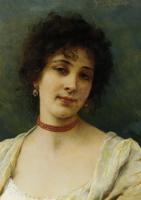
Elegant Lady
Eugene de Blaas
A young beauty
Léon Bazile Perrault
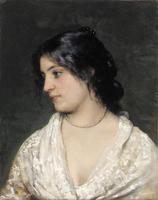
The Pearl Necklace
Eugene de Blaas
Springtime
Joan Brull
Eleanor Parke Custis Lewis(Washington’s granddaughter)
Gilbert Stuart
Female Portrait
Konstantin Makovsky
Frances Anne Kemble as Beatrice
Thomas Sully
Young Beauty
Eugene de Blaas
A Young Beauty With Flowers In Her Hair
Albert Lynch
Sketch of a Female Head
George Romney
Portrait of the Woman with Coral Beads
Konstantin Makovsky
Young woman with pearl necklace
Vittorio Tessari
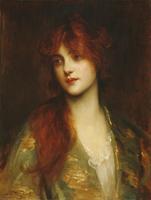
Woman, Portrait
Luke Fildes
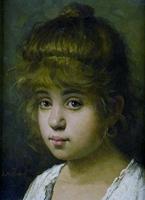
Portrait of a Young Girl
Alexei Harlamoff