Dante in Exile
Подробности
Экспертный разбор работы «Dante in Exile» художника Frederic Leighton
Стиль: Academicism · Жанр: history painting
Expert Analysis: "Dante in Exile" by Frederic Leighton
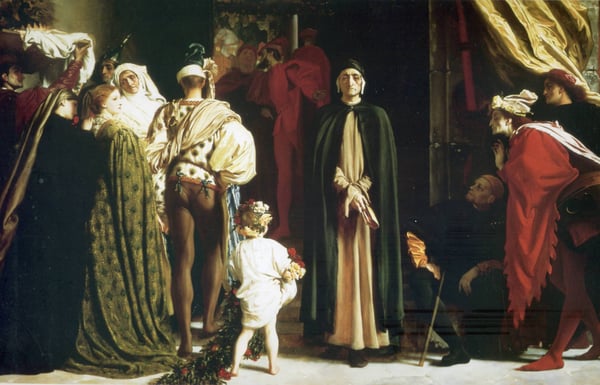
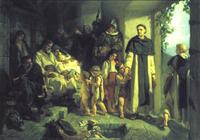
Frederic Leighton’s Dante in Exile stands as a quintessential example of Academicism in the late 19th century, a period when history painting was considered the highest form of artistic endeavor. As a history painting, the work situates the great poet Dante Alighieri within a specific, emotionally charged moment of his life—his banishment from Florence in 1302. Its significance lies in how Leighton masterfully combines rigorous academic technique with a deeply humanist, narrative-driven composition, elevating both the subject and the genre.
Within the Style of Academicism: Academicism prized flawless draftsmanship, balanced composition, and classical ideals of beauty, often drawing from historical, mythological, or literary sources. Leighton, a leading figure of the British academic tradition and later President of the Royal Academy, embodies these principles in Dante in Exile. The painting’s careful attention to anatomical precision, the dignified contrapposto of Dante’s pose, and the harmonious arrangement of figures against an architectural backdrop reflect the academic training rooted in Renaissance and neoclassical models. Yet Leighton goes beyond mere technical skill: he infuses the scene with a solemn, poetic atmosphere through muted earth tones and soft, diffused light, avoiding the theatricality of earlier history painting in favor of a more inward, contemplative mood.
Significance as a History Painting: History painting traditionally aimed to convey moral or philosophical lessons through grand narratives. Dante in Exile achieves this by focusing not on a dramatic event, but on a moment of isolation and righteous sorrow. Dante stands apart, his gaze averted, surrounded by symbols of his loss—the distant city of Florence, the book of his works, and the figures of fellow exiles. Leighton emphasizes the poet’s intellectual and moral integrity rather than his despair, aligning with the academic ideal of art as a vehicle for noble sentiment. The work thus redefines history painting by prioritizing psychological depth over action, making it a bridge between traditional academicism and the emerging symbolist and pre-Raphaelite sensibilities.
Period Significance: Painted in 1855, at the height of the Victorian era’s fascination with Dante, Leighton’s work resonated with contemporary debates about exile, identity, and the role of the artist in society. It asserts the enduring power of classical academic values—clarity, order, human dignity—while addressing modern themes of alienation. For its synthesis of technical mastery, literary refinement, and emotional restraint, Dante in Exile remains a landmark of Academic history painting, demonstrating how the style could achieve profound narrative and symbolic resonance without abandoning its formal foundations.
Museum / Gallery
Визуально похожие
20 работ с близкой композицией и палитрой
Solon Before Croesus
Gerard van Honthorst
The Burghers of Calais
Benjamin West
The Eve of St. Agnes
William Holman Hunt
The Eve of Saint Agnes
William Holman Hunt
King Matthias Receives the Papal Legates
Gyula Benczur
Ladislaus Hunyadi's Farewell
Gyula Benczur
Episode Of The Conquest Of Malaga
Rafael Tegeo
Claudio, Deceived by Don John, Accuses Hero
Marcus Stone
Christ Before Herod Antipas
Nikolaus Knüpfer
Difficult Negotiations
Konstantin Makovsky
Charles VI and Odette de Champdivers
Eugene Delacroix

Woman Taken in Adultery
Gabriel Metsu
Othello in front of the Doge in Venice
Karl Becker
Alberico da Romano
Francesco Hayez
Columbus Before the Queen
Emanuel Leutze
Ecce Homo
Luca Giordano
The election of George of Poděbrady as King of Bohemia
Vaclav Brozik
Presentation of the model of the Pavia Cathedral in Ascanio Sforza
Federico Faruffini
François I and Charles V Visiting the Church of Saint Denis
Antoine-Jean Gros
Counter-Reformation
Jaroslav Čermák