Analisi esperta di Portrait of Mrs. Leigo di Thomas Eakins
Stile: Realism · Genere: portrait
Expert Analysis of "Portrait of Mrs. Leigo" by Thomas Eakins
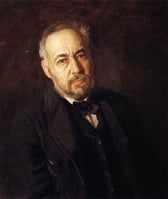
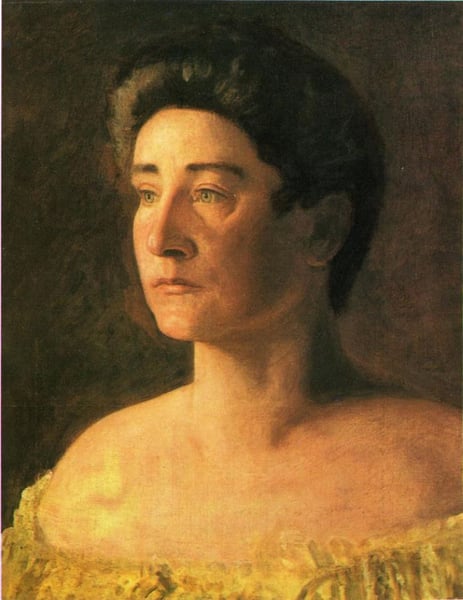
Thomas Eakins’ Portrait of Mrs. Leigo stands as a compelling example of American Realism, a movement that rejected the sentimentality and idealization of earlier academic portraiture in favor of unflinching truthfulness. Eakins was a master of psychological depth, and this portrait is significant for its subtle yet penetrating characterization.
Key Elements of Significance:
- Psychological Authenticity: Unlike conventional portraits that emphasized social status or decorative beauty, Eakins presents Mrs. Leigo with a quiet, introspective gravity. Her expression is neither forced nor flattering; it suggests a life of inner resilience. This focus on the sitter’s interiority—rather than outward ornament—was a radical shift in American portraiture.
- Mastery of Light and Form: Eakins’ training in anatomy and perspective is evident in the sculptural modeling of Mrs. Leigo’s face and hands. The light falls naturally across her features, creating soft transitions that reveal the bone structure without harsh idealization. This technical rigor reflects Eakins’ belief that truth in art required precise observation.
- Restrained Palette and Composition: The subdued earth tones and dark background direct the viewer’s attention entirely to the sitter’s face and hands. The composition is simple and unadorned, a deliberate choice that avoids distracting narrative details. This minimalism underscores the Realist commitment to depicting everyday existence with dignity.
- Challenging Gender Norms: In an era when women were often portrayed as passive or decorative, Eakins depicts Mrs. Leigo with a direct, steady gaze and a posture of quiet self-composure. The portrait grants her an agency and seriousness rarely afforded to female subjects in nineteenth-century portraiture.
Within the Context of Realism and Eakins’ Oeuvre:
Eakins’ Portrait of Mrs. Leigo exemplifies the core Realist principle: art should be a mirror held up to life, not an embellishment of it. Where contemporaries like John Singer Sargent sought to flatter their sitters through elegant brushwork and aristocratic flair, Eakins insisted on a rigorous honesty that could be disconcerting—yet deeply human. This portrait, though intimate in scale, participates in that larger mission: to elevate ordinary people and their unadorned truth to the level of serious art. It stands as a testament to Eakins’ belief that the highest purpose of portraiture is not to please but to reveal.
Museum / Gallery
Visivamente simili
20 opere con composizione e palette affini
Portrait of Mrs. W.H. Bowden
Thomas Eakins
Portrait of Florence Einstein
Thomas Eakins
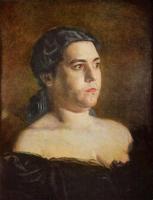
Maybelle
Thomas Eakins
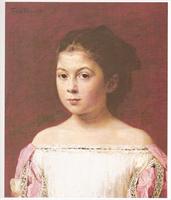
Marie Yolande de Fitz James
Henri Fantin-Latour
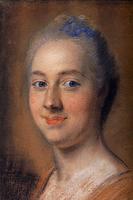
Study for portrait of unknown woman
Maurice Quentin de La Tour
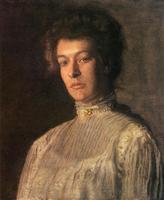
Portrait of Mrs. Kern Dodge (Helen Peterson Greene)
Thomas Eakins
Princess Alexandra of Denmark, later Queen Alexandra (1844-1925)
Elisabeth Jerichau-Baumann
Study for portrait of unknown woman
Maurice Quentin de La Tour
Mary Turner Austin
John Singer Sargent
Portrait of Actress Aura Fotino
Ion Tuculescu
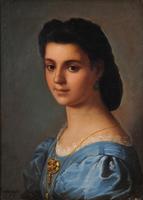
Portrait of a young girl in a blue dress
Michele Cammarano
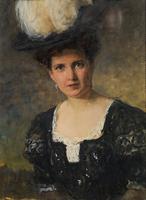
Portrait of Countess Gisela Kinsky von Wchinitz und Tettau, née Zwonek
John Quincy Adams
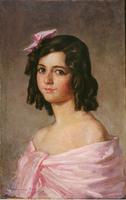
Hija De D Jacinto Pico N
José Garnelo
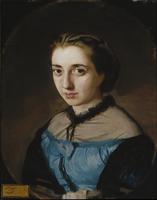
Maximina Martínez de la Pedrosa, the Artist's Wife
Eduardo Rosales
Portrait of Frances Mary Vickers
John Singer Sargent
Head of an Italian Woman
John Singer Sargent
Mrs Arthur Sassoon
George Frederick Watts
Portrait of Madame Cordier
Mary Cassatt
Beautiful girl from Zuylen
Maurice Quentin de La Tour
Portrait of Mrs. William Chase
William Merritt Chase