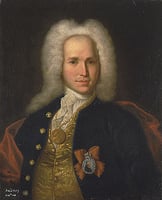
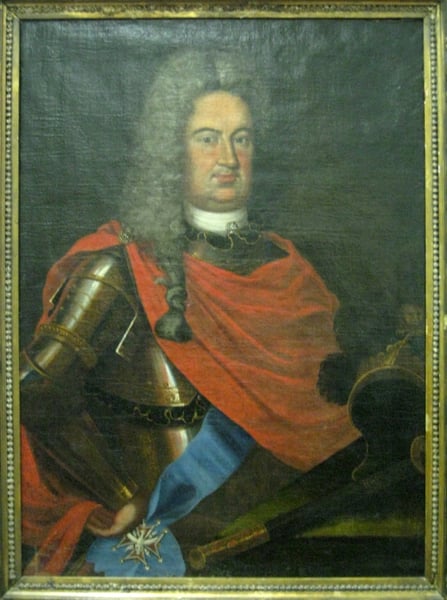
Analisi esperta di Boris Sheremetev di Ivan Nikitin
Stile: Baroque · Genere: portrait
Artwork: Boris Sheremetev
Artist: Ivan Nikitin
Style: Baroque
Genre: Portrait
Ivan Nikitin’s portrait of Count Boris Sheremetev stands as a landmark in the history of Russian art, marking the decisive shift from the stylized, spiritualized icons of medieval Russia to the secular, naturalistic portraiture of the modern era. Painted during the reign of Peter the Great, this work embodies the Baroque emphasis on dynamism, psychological depth, and theatrical grandeur, while simultaneously serving as a visual manifesto of the new, Western-oriented Russian aristocracy.
Significance within the Baroque style:
The painting exhibits classic Baroque traits: a strong chiaroscuro that sculpts Sheremetev’s face and armor, a rich, dark background that thrusts the figure forward, and a confident, three-quarter pose that conveys both authority and approachability. The sitter’s direct gaze and slightly parted lips suggest a moment of speech – a rhetorical device used by Baroque portraitists to animate the subject and imply intellectual engagement. The handling of textures – the gleam of metal, the softness of fur, the sheen of silk – demonstrates Nikitin’s mastery of illusionistic detail, a hallmark of Baroque naturalism.
Art-historical significance:
Nikitin, often called the “father of Russian portraiture,” was among the first native artists to receive formal training in Europe (in Italy and the Netherlands). His Boris Sheremetev represents a pivotal break from the Russian iconographic tradition, which emphasized flatness, gold backgrounds, and symbolic abstraction. Instead, Nikitin adopts the Baroque grand manner – a style reserved for monarchs and military heroes – to depict a trusted field marshal of Peter the Great. This portrait is not merely a likeness but a statement of new values: individual achievement, secular honor, and the integration of Russia into European cultural norms.
Genre and historical context:
As a portrait of a high-ranking nobleman, the work functions as both a personal record and a political tool. Sheremetev, a commander in the Great Northern War, is shown in armor, a symbol of his martial service to the state. The inclusion of the blue ribbon of the Order of St. Andrew (Russia’s highest chivalric order) directly links him to Peter’s reformed meritocracy. Thus, the painting celebrates not just the man but the Petrine ideal: the loyal, capable servant of the empire.
In summary, Boris Sheremetev is significant because it encapsulates the transformation of Russian visual culture under Peter the Great, demonstrating how Baroque portraiture could serve both artistic innovation and state ideology. Nikitin’s work remains a touchstone for understanding the arrival of European Renaissance and Baroque conventions in Russia, and it marks the beginning of a continuous tradition of secular Russian painting.
Visivamente simili
20 opere con composizione e palette affini
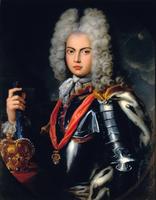
Portrait of John V of Portugal
Pompeo Batoni
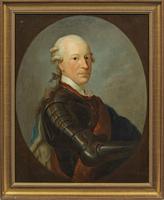
Portrait of a man
Anton Graff
Retrato De D. Luís Carlos Inácio Xavier De Menezes
Pompeo Batoni
Portrait d'un jeune prince du Danemark en cuirasse et portant l'ordre des éléphants
Constantijn Netscher
François Marie De Broglie
Hyacinthe Rigaud
Duke of York
John Riley
Jakob von Keith
Antoine Pesne
Portrait of Grand Duke Peter Fedotovich (later Peter III),
Aleksey Antropov
Portrait of Christian August, Prince of Anhalt Zerbst, father of Catherine II of Russia.
Antoine Pesne
Portrait of Ferdinand I of the Two Sicilies
Angelica Kauffman
Portrait of Adolf Frederick, King of Sweden
Gustaf Lundberg
Porträt von Herzog Ferdinand von Braunschweig-Lüneburg
Johann Heinrich Tischbein the elder
Portrait of Frederick William I of Prussia
Antoine Pesne
Gian Francesco II Brignole Sale
Hyacinthe Rigaud
Heinrich von Podewils, Prussian statesman
Antoine Pesne
Portrait of Stanislav Leshchinsky , King of Poland and Grand Duke of Lithuania
Jean-Baptiste van Loo
Portrait of a nobleman in armour
Nicolas Tournier
Portrait de Louis III de Condé
Jean-François de Troy
Charles III of Spain
Anton Raphael Mengs
Prince George of Denmark (1653–1708)
Michael Dahl