Expertenanalyse zu Ivan Nikitins Catherine I of Russia
Stil: Baroque · Genre: portrait
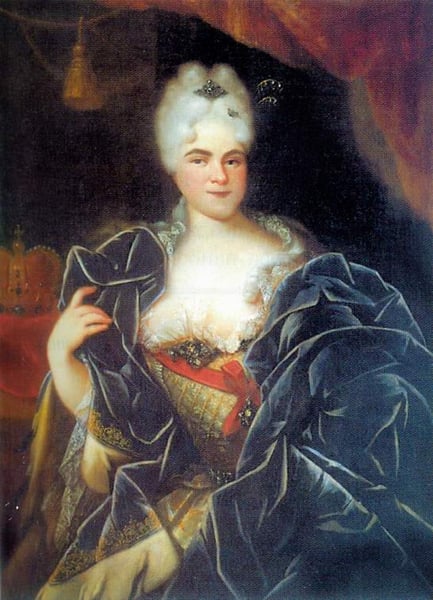
Expert Analysis: "Catherine I of Russia" by Ivan Nikitin
Ivan Nikitin’s portrait of Catherine I stands as a landmark in early Russian Baroque portraiture, representing a pivotal moment when Russian art began to consciously adopt Western European conventions while asserting its own imperial identity. As one of the first Russian painters to study abroad under Peter the Great’s reforms, Nikitin brings a distinctly Baroque sensibility to this work.
Significance within Baroque style: The portrait embodies key Baroque qualities: a commanding sense of presence, rich textural contrasts (fine fabrics, jewelry, lace), and a dynamic play of light and shadow that imbues the sitter with both regal authority and human warmth. Nikitin’s handling of Catherine’s expression—confident yet approachable—aligns with the Baroque interest in capturing psychological depth alongside public persona.
Significance within the portrait genre: This painting marks a shift from the stiff, icon-like representations of earlier Russian rulers to a more naturalistic, individualized likeness. Nikitin departs from medieval conventions by emphasizing Catherine’s actual features and status as a living empress, not merely a symbolic figure. The work thus functions as both a state portrait, asserting her legitimacy as Peter the Great’s successor, and a personal study reflecting the empress’s character.
Art-historical importance: As a product of Peter’s Westernization campaign, the portrait signals Russia’s integration into European artistic trends. Nikitin’s training in Italy and the Netherlands is evident in the confident brushwork and subtle modeling of form. Catherine I here becomes a symbol of Russia’s new alignment with Baroque grandeur, foreshadowing the opulent court portraiture that would define 18th-century Russian art. The painting is therefore significant not only for its aesthetic qualities but for its role in legitimizing a new artistic language that merged Russian iconographic traditions with Baroque dynamism—a fusion that would influence later Russian artists like Rokotov and Levitsky.
Visuell ähnlich
20 Werke mit ähnlicher Komposition und Farbpalette
Portrait of Maria Anna from Austria
Pompeo Batoni
REPRESENTATIVE PORTRAIT OF THE QUEEN AND ARCHDUCHESS MARIA THERESIA OF AUSTRIA
Marten van Mytens the Younger
Portrait of a lady, seated, three quarter length, resting her left arm upon a blue cushion lying on a giltwood console table
Jean-François de Troy
The Countess of Lathom
John Singer Sargent
Portrait of the Countess Maria Benedetta Di San Martino
Pompeo Batoni
Mrs Mary Lutwyche, Nee Thomas
George Romney
Portrait de Madame Desbarres
Jean-Baptiste Oudry
Madame de La Porte
Jean-Marc Nattier
Anne Weston
John Riley
Maria Theresia Kaiserin von Österreich Ganzfigurenbildnis in blauem dekolletiertem, mit Brokatstickereien und Edelsteinen verziertem Gewand
Marten van Mytens the Younger
Portrait Of Princess Ekaterina Alexandrovna Lobanova Rostovskaya
Ivan Argunov
Portrait of a Lady
Nicolaes Maes
Queen Henrietta Maria Of England
Anthony van Dyck
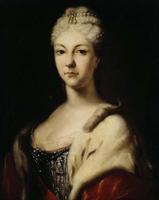
Tzarina Natalia Alekseevna
Ivan Nikitin
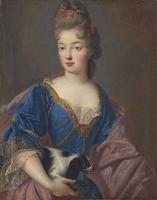
Portrait de femme au chien
Jean-François de Troy
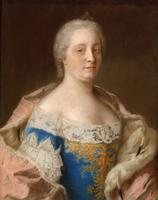
Empress Maria-Theresa of Austria
Jean-Étienne Liotard
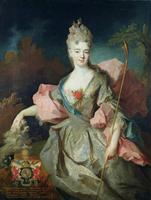
Lady Mary Josephine Drummond, Gräfin von Castelblanco
Jean-Baptiste Oudry
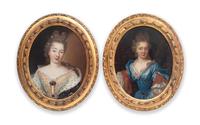
A PAIR OF PAINTINGS OF NOBLEWOMEN
Constantijn Netscher
Portrait of a young lady, half-length, in a gold embroidered red velvet dress and white chemise
Abraham Mignon
Portrait of Barbarina Campani
Rosalba Carriera