Expertenanalyse zu Auguste Toulmouches An Afternoon Idyll
Stil: Academicism · Genre: genre painting
Expert Analysis: "An Afternoon Idyll" by Auguste Toulmouche
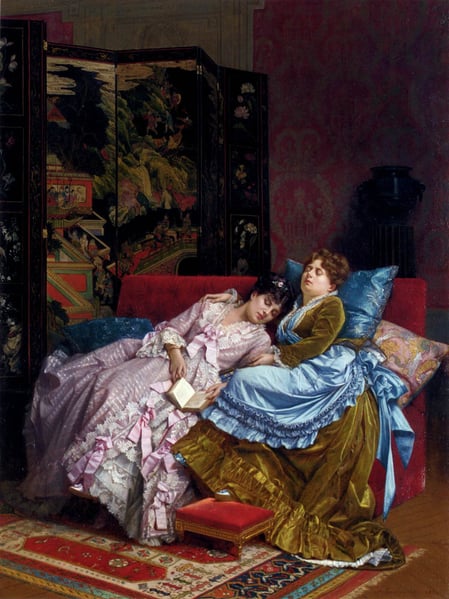
Auguste Toulmouche’s An Afternoon Idyll stands as a refined exemplar of Academicism—the dominant, institutionally sanctioned art style of 19th-century France. As a genre painting, it captures a moment of leisurely, idealized domestic life, a subject that Toulmouche mastered with exceptional technical polish and narrative charm.
Significance within Academicism and its Period
-
Embodiment of Academic Ideals
The work demonstrates the core tenets of Academic painting: meticulous draftsmanship, smooth brushwork, and a balanced, harmonious composition. Every element—from the rendering of luxurious fabrics to the subtle play of light on skin—reflects the rigorous training of the École des Beaux-Arts. The scene is carefully staged to evoke an effortless elegance, removing any trace of the mundane or the imperfect. -
Genre Painting as a Vehicle for Sentiment
In the 19th-century academic hierarchy, genre painting (scenes of everyday life) held a prestigious place when it conveyed moral or sentimental truths. An Afternoon Idyll does this by presenting an idealized vision of bourgeois leisure—serene, refined, and removed from the social upheavals of the age. The title itself (“idyll”) signals a pastoral, almost dreamlike quality, celebrating quiet contentment and romanticized femininity. -
Toulmouche’s Distinctive Contribution
Toulmouche was particularly known for his elegant depictions of women in fashionable interiors, often engaged in reading, music, or quiet contemplation. In An Afternoon Idyll, he elevates a simple afternoon moment into a tableau of cultured grace, using costumes, props, and setting to create a cohesive, aesthetically pleasing whole. His work appealed to the tastes of the Parisian bourgeoisie and the Salon jury, who prized such technical mastery and refined subject matter. -
Historical Context and Influence
While Toulmouche’s art is firmly rooted in Academicism, it also reflects a broader cultural fascination with the “private” and the “picturesque” in the mid-to-late 1800s. Notably, Toulmouche was an early teacher of Claude Monet, who would later rebel against academic conventions; thus, An Afternoon Idyll represents the very tradition that Impressionism sought to challenge, making it a valuable benchmark for understanding the stylistic shifts of the era.
Conclusion
An Afternoon Idyll is significant not only as a masterfully painted genre scene but as a document of Academicism’s core values: technical precision, idealized beauty, and narrative restraint. It captures a fleeting, perfect moment—a hallmark of Toulmouche’s oeuvre—and reminds us why such works dominated the Salons and defined period taste before the advent of modernism.
Museum / Gallery
Visuell ähnlich
20 Werke mit ähnlicher Komposition und Farbpalette
Sweet Doing Nothing
Auguste Toulmouche
The Letter
Auguste Toulmouche
Young woman in pink with her child
Pascal Dagnan-Bouveret
The toilet
Raimundo de Madrazo
Good news
Gustave Jacquet
Watering the Flowers
Auguste Toulmouche
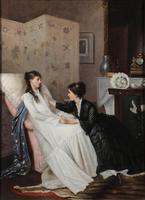
The comforting words
Gustave Léonard De Jonghe The Japanese Fan
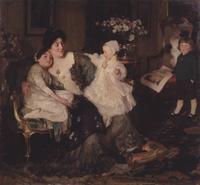
A Family Group, The Artist's Wife and Children, 'Papa Painting!'
Solomon Joseph Solomon
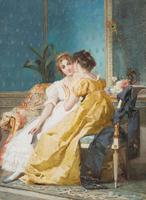
The conversation
Francesco Didioni
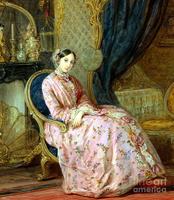
Portrait of Grand Duchess Elena Pavlovna Christina Rob
Christina Robertson
Portrait
Konstantin Makovsky
Portrait of a Woman in a Blue Gown
Cesare Agostino Detti
Two Girls Singing
Giovanni Costa
The Reluctant Mistress
Raimundo de Madrazo
The reluctant bride
Auguste Toulmouche
Woman Drinking A Hot Chocolate
Raimundo de Madrazo
The letter
Wladyslaw Czachorski
Charlotte Blanche Shaw (1864–1897)
Herbert Arnould Olivier
Two elegant young ladies in an interior perusing a magazine
Vittorio Reggianini
The Sisters
Laslett John Pott