Expertenanalyse zu Jean-Leon Geromes A Roman Slave Market
Stil: Academicism · Genre: genre painting
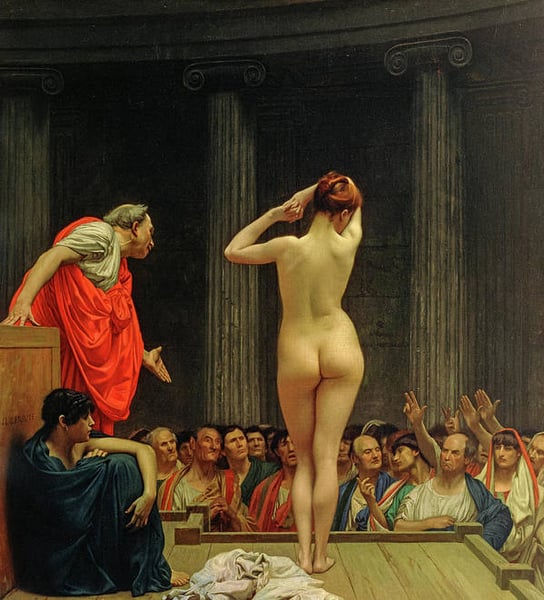
A Roman Slave Market (circa 1884) by Jean-Léon Gérôme stands as a quintessential example of Academicism at its most technically polished and morally ambiguous. The painting depicts a scene from antiquity—a public auction of enslaved people—with the hyper-realistic precision that made Gérôme the most commercially and critically successful academic painter of his era.
Significance within Academicism Gérôme’s work embodies the core tenets of the French Academic tradition: flawless draughtsmanship, smooth finish, meticulous attention to historical costume and architecture, and a composition that reads like a frozen theatrical tableau. Every surface—from the sheen of marble columns to the texture of silks and the gloss of young skin—is rendered with almost photographic clarity. Yet the painting also reveals the Academy’s fascination with morally charged, exotic, or erotic subjects, handled with a detached, clinical eye. The scene is neither overtly sentimental nor critical; it observes the transaction of human flesh as a dispassionate historical fact, a stance that both delighted and disturbed 19th-century audiences.
Genre Painting with a Voyeuristic Edge Though classified as genre painting (scenes of everyday life), Gérôme elevates the ordinary into the spectacular. The composition forces the viewer into the role of a potential buyer, standing among the Roman bidders, gazing at the central nude figure whose back is turned—anonymizing her and emphasizing her status as merchandise. This voyeuristic framing was controversial even in its own time, yet it is precisely what makes the work so potent. The painting does not simply illustrate an ancient custom; it implicates the viewer in the act of looking, commodification, and judgment.
Historical and Cultural Impact Gérôme’s A Roman Slave Market became a touchstone for debates about the limits of realism, the ethics of historical re-creation, and the role of sensation in art. It exemplifies Academicism’s final great phase before Impressionism and modernism challenged its authority. For art historians, the painting is a key document of 19th-century Orientalist and classical fantasies, merging archaeological accuracy with a soft-focus eroticism that catered to a bourgeois audience eager for vicarious encounters with the past. It remains significant as a masterclass in technical virtuosity—and as a troubling reminder of how art can aestheticize human suffering.
Museum / Gallery
Visuell ähnlich
20 Werke mit ähnlicher Komposition und Farbpalette
Slave Market in Rome
Jean-Leon Gerome
Phryne before the Areopagus
Jean-Leon Gerome
Apelles chooses his model
Fyodor Bronnikov
The Roman Baths
Fyodor Bronnikov
Greek Interior (Gyneceum)
Jean-Leon Gerome
Private baths in Pompeii
Fyodor Bronnikov
Tepidarium
Theodore Chasseriau
The Tepidarium
Theodore Chasseriau
Funeral Wake
Jean-Leon Gerome
The knuckle players
Albrecht Anker
Ulysses at the court of Alcinous
Francesco Hayez
Feast of Belshazzar
Ivan Tvorozhnikov
Socrates seeking Alcibiades in the House of Aspasia
Jean-Leon Gerome
Venus and Vulcan
Giovanni Battista Tiepolo
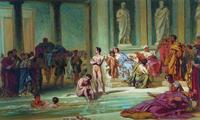
In the Roman Baths
Fyodor Bronnikov
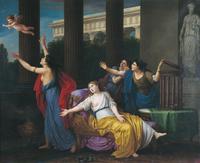
L'amour Fuyant L'esclavage
Joseph-Marie Vien
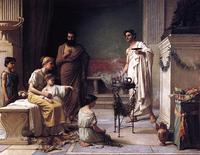
The Visit of a Sick Child to the Temple of Aesculapius
John William Waterhouse
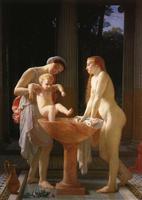
The Bath
Charles Gleyre
Greek Interior (Gyneceum)
Jean-Leon Gerome
El Suicidio De Séneca
Manuel Dominguez Sanchez