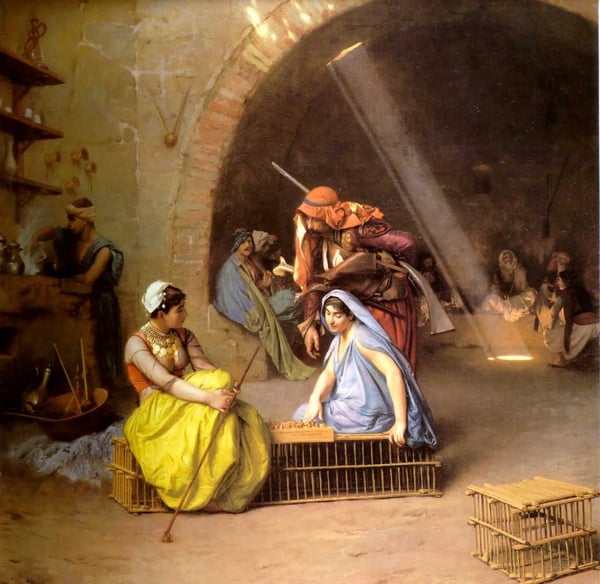
Amehs Playing Chess in a Café
Expertenanalyse zu Jean-Leon Geromes Amehs Playing Chess in a Café
Stil: Orientalism · Genre: genre painting
Expert Analysis of "Amehs Playing Chess in a Café" by Jean-Léon Gérôme
Style: Orientalism
As a hallmark of 19th-century Orientalism, Gérôme's work embodies the Western fascination with an imagined "exotic" East. This painting operates within a visual tradition that constructed the Orient as a timeless, sensuous space—removed from the industrial modernity of Europe. The café setting, with its leisure activity of chess, serves as a stage for ethnographic spectacle, where every detail (costumes, architecture, props) is rendered with painstaking accuracy to convey authenticity. Yet this authenticity is filtered through a colonial lens: the scene is static, idealized, and devoid of contemporary political or social realities. Gérôme’s significance lies in his ability to blend academic precision with theatrical composition, creating a seductive but ultimately constructed vision that reinforced European stereotypes.
Genre: Genre Painting
As a genre painting, the work elevates an everyday moment—men playing chess in a café—to a subject worthy of fine art. Gérôme treats this mundane activity with the same rigorous detail he would a history painting, lending it an air of documentary authority. The chess players are not anonymous types but carefully individualized figures, their gestures and expressions capturing a quiet tension. This focus on daily life within an Orientalist context was subversive in its own way: it presented the "Other" not as savage or chaotic, but as engaged in refined, intellectual pastimes. However, the very act of painting such a scene for a Western audience underscores the power imbalance—the viewer is invited to observe from a safe distance, reinforcing the notion of the East as a spectacle to be consumed.
Significance
This painting is significant as a prime example of Gérôme’s technical mastery and his role in shaping the Orientalist canon. His use of smooth, almost photographic finish, combined with dramatic light and shadow, creates a believable, window-like space that draws the viewer in. The chess game itself can be read as a metaphor for strategic encounter—between East and West, tradition and modernity, reality and fantasy. More critically, the work represents the complex legacy of Orientalism: it is a product of cultural appropriation, yet it also preserves details of material culture and social rituals that might otherwise be lost. In art historical terms, “Amehs Playing Chess in a Café” stands as a testament to the allure and the ideological weight of 19th-century academic painting, forcing us to appreciate its beauty while questioning its embedded narratives.
Visuell ähnlich
20 Werke mit ähnlicher Komposition und Farbpalette
A Café in Cairo
Jean-Leon Gerome
The Fortune Teller
Nikolaos Gyzis
Coffee House in Cairo
Konstantin Makovsky
At the fountain in Taormina
Ferdinand Georg Waldmüller
The soup eaters
Alexandre Antigna
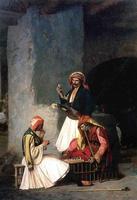
The Draught Players
Jean-Leon Gerome

La diseuse de bonne aventure (The Fortune Teller)
Jacques Sablet
The betrothal of the children
Nikolaos Gyzis
Sword Dancer
Jean-Leon Gerome
Winding the wool
Noè Bordignon
Decorating of the Bride
Paja Jovanovic
At the Souk
Eugène Girardet
The Occupied Mother
Jean-Baptiste Charpentier the Elder
Turkish Bashi Bazouk Mercenaries Playing Chess in a Market Place
Jean-Leon Gerome
Peasants at the fountain said before
Ernest Hébert

First Steps
Giovanni Battista Torriglia
Italian market scene
Ernest Hébert

Searching for Fleas
Giuseppe Maria Crespi
The mouse trap
Hendrick Joseph Dillens

Interior scene with a young woman scrubbing pots while an old man makes advances
David Teniers the Younger