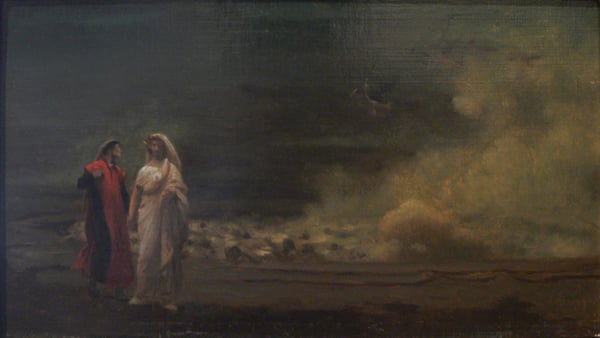
Dante and Virgil in Hell
Analisi esperta di Dante and Virgil in Hell di Jean-Leon Gerome
Stile: Romanticism · Genere: literary painting
Expert Analysis: "Dante and Virgil in Hell" by Jean-Léon Gérôme
While Jean-Léon Gérôme is most often celebrated for his academic precision and Orientalist scenes, this painting—Dante and Virgil in Hell—positions him firmly within the Romantic tradition through its intense emotionalism, theatrical chiaroscuro, and sublime horror. As a literary painting, it translates Dante Alighieri’s Inferno into a visceral, almost photographic tableau, blending narrative fidelity with Romantic obsessions: the macabre, the grotesque, and the struggle between human reason and damnation.
Significance within Romanticism:
Romantic art prized the dramatic, the irrational, and the emotionally overwhelming. Here, Gérôme captures a pivotal moment from Canto V of the Inferno—the doomed lovers Paolo and Francesca, swept forever in a tempest of lust and punishment. The artist departs from the more idealized, classical treatments of Dante (such as those by Delacroix or Blake) by rendering the scene with hyper-realistic detail: the contorted muscles of the damned, the fiery glow of the infernal landscape, and the haunting, blurred motion of the sinners’ bodies. This photographic precision heightens the Romantic sublime, making the viewer feel both the terror and the tragic beauty of eternal suffering.
Literary Painting as a Genre:
Gérôme’s work is a masterclass in ekphrastic translation. He condenses Dante’s poetic imagery into a single, frozen moment: Virgil, the guide, points with stern authority while Dante recoils, clutching his head in horror. The composition mirrors the text’s moral journey—reason (Virgil) confronting human pity (Dante) in the face of divine justice. The literary allusion lends the painting intellectual weight, appealing to a 19th-century audience steeped in Dante revivalism.
Technical and Thematic Innovations:
- Dramatic Lighting: The infernal glow emanates from the background, casting long, sinister shadows and illuminating the flesh of the sinners with a ghastly, phosphorescent sheen. This use of chiaroscuro amplifies the Romantic tension between revelation and darkness.
- Psychological Depth: Unlike many contemporaries who emphasized physical torment, Gérôme focuses on psychological anguish—the lovers’ faces express not just pain but a lingering, forbidden intimacy, complicating the viewer’s moral response.
- Historical Hybridity: Though Romantic in spirit, the painting’s precise anatomy and smooth finish reflect Gérôme’s academic training, bridging the gap between Romantic emotionality and Neoclassical discipline.
Why It Endures:
Dante and Virgil in Hell remains significant because it synthesizes literary tradition with the Romantic ethos of exploring extreme human states—love, guilt, punishment. It demonstrates that Romanticism need not be loose and brushy; it can be crystalline and terrifying. Gérôme forces us to read the painting through Dante, making the visual narrative as layered and unsettling as the poem itself. In doing so, he elevates the literary painting from mere illustration to a profound meditation on sin, compassion, and the limits of human understanding.
Visivamente simili
20 opere con composizione e palette affini
Natives Viewing the Hilo Flow, May 18, 1881
Charles Furneaux
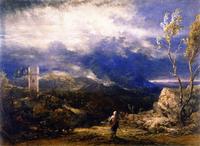
Christian Descending into the Valley of Humiliation
Samuel Palmer
Val d'Aosta: Snowstorm, Avalanche and Thunderstorm
J.M.W. Turner
Eruption of Vesuvius arrived on August 24 of the year 79
Pierre-Henri de Valenciennes
The Eruption of the Soufrière Mountains in the Island of St Vincent, 30 April 1812
J.M.W. Turner
Scene of the Deluge
Théodore Géricault
The birth of Aphrodite
Ivan Aivazovsky
The Opening of the Sixth Seal
Francis Danby
Follow me, Satan (Temptation of Jesus Christ)
Ilya Repin
Rest on the Flight to Egypt
Rembrandt
Thunderstorm with the Death of Amelia
William Williams
Eruption
Pierre-Jacques-Antoine Volaire
Shade and Darkness, The Evening of The Deluge
J.M.W. Turner
Landscape with Tobit and the Angel
Salvator Rosa
Beach in Brighton
John Constable
The Delivery of Israel out of Egypt
Francis Danby
Nude Figures at Cape Creus
Salvador Dali
The Slave Ship
J.M.W. Turner
View of the Eruption of Mount Vesuvius
Pierre-Jacques Volaire
Mer brumeuse
Constant Permeke