Benjamin West の Fidelia and Speranza の専門的な分析
スタイル:Rococo · ジャンル:literary painting
Expert Analysis of "Fidelia and Speranza" by Benjamin West
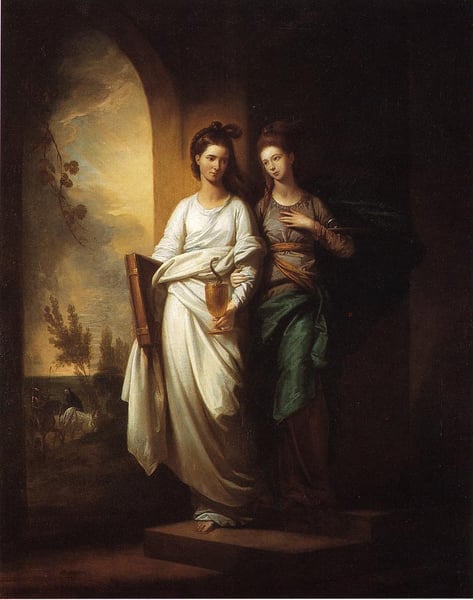
Benjamin West’s Fidelia and Speranza (c. 1760s) is a compelling example of Rococo literary painting, a genre that fuses narrative from poetry or drama with the decorative elegance typical of the 18th-century French-inspired style. The work draws directly from Edmund Spenser’s allegorical epic The Faerie Queene (Book I, Canto X), where the characters Fidelia (Faith) and Speranza (Hope) guide the Redcrosse Knight toward spiritual redemption. Although West is best known as a pioneering American-born painter who later championed Neoclassicism and history painting, this early work reveals his fluency in Rococo sensibilities and his deep engagement with English literary tradition.
Rococo Stylistic Characteristics
True to Rococo conventions, West employs a soft, pastel-toned palette dominated by pale blues, pinks, and creams, creating a atmosphere of gentle, dreamlike grace. The figures are slender and elegantly posed—Fidelia holds a chalice and a book (symbols of faith and scripture), while Speranza gazes upward with a hopeful, slightly melancholic expression, her gesture echoing the Rococo preference for delicate, elongated limbs and tilted heads. The composition is asymmetrical yet balanced, with the two women set against a lush, idyllic landscape of rolling hills and feathery trees. West uses loose, fluid brushwork in the foliage and drapery, lending the scene a light, airy quality that avoids the solemnity of later Neoclassical works.
Literary Painting and Allegorical Significance
As a literary painting, Fidelia and Speranza does more than illustrate a text; it distills the moral and emotional core of Spenser’s allegory. Fidelia’s serene authority contrasts with Speranza’s yearning, capturing the Christian virtues of steadfast belief and hopeful anticipation—themes that resonated with 18th-century audiences familiar with Spenser’s didactic romance. West’s choice to isolate these two figures from the larger narrative emphasizes their symbolic weight, turning them into personifications rather than mere characters. This aligns with Rococo’s fondness for allegorical and pastoral scenes that invite contemplation without descending into heavy moralizing.
Significance in West’s Oeuvre and Art Historical Context
This painting is significant as an early demonstration of West’s ability to synthesize Rococo elegance with serious literary content—a skill that would later inform his monumental history paintings. Created shortly after his arrival in England (1763), Fidelia and Speranza reflects his immersion in the British artistic scene, where Rococo taste (championed by artists like Francis Hayman and Thomas Gainsborough) still held sway before the full rise of Neoclassicism. More importantly, it showcases West’s talent for making an imported continental style serve a distinctly English literary heritage. The work thus stands as a bridge between the decorative lightness of the Rococo and the narrative gravity that would define West’s mature career, marking him as an artist capable of elevating genre painting through intellectual and emotional depth.
Museum / Gallery
視覚的に類似
構図やパレットが近い作品 20 件
Mary Bold (1740–1824), Mrs Thomas Hunt III
George Romney
Elizabeth (c.1760–1826), Viscountess Bulkeley, as Hebe
George Romney
Dorothy Mason, Lady Brownlow
John Riley
Hagar comforted by the Angel
Hendrik Heerschop
Self Portrait, the Artist Hesitating Between the Arts of Music and Painting
Angelica Kauffman
Allegory of poetry and music
Angelica Kauffman
Saint Catherine of Alexandria
Bartolome Esteban Murillo
Helen Brought From Paris
Benjamin West
Mrs. Thomas Scott Jackson
George Romney
Ladies Amabel and Mary Jemima Yorke
Joshua Reynolds
Santa Catalina de Alejandría
Claudio Coello
Cornelia Africana
Angelica Kauffman
The Artist in the Character of Design Listening to the Inspiration of Poetry
Angelica Kauffman
PORTRAIT OF A LADY, THREE-QUARTER LENGTH, SAID TO BE ELIZABETH D'AVENANT, DAUGHTER OF THOMAS BOOTHBY, ESQR., WITH HER DOG
Jonathan Richardson
Fame
Sebastiano Conca
Mary Lake
John Riley
Peace brings abundance
Louise Elisabeth Vigee Le Brun
Self-portrait
Angelica Kauffman
St. Domitilla with St. Nereus and St. Achilleus
Peter Paul Rubens
Mrs. John Parker
Joshua Reynolds