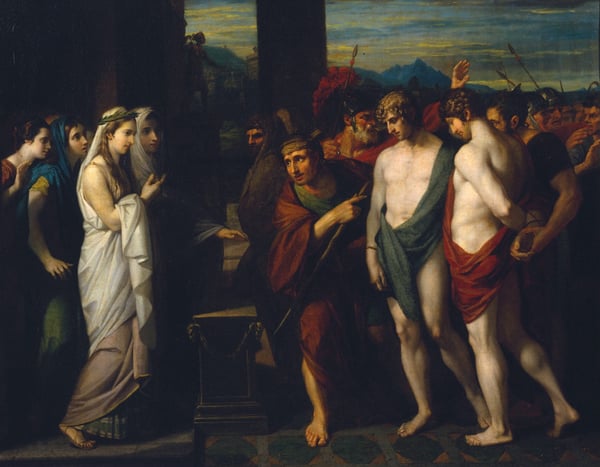
Pylades and Orestes Brought as Victims before Iphigenia
Dettagli
Description
Stile: Neoclassicism · Genere: mythological painting
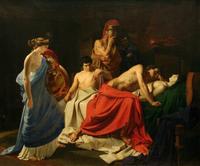
West's progression towards epic history painting was a gradual one, culminating in his first major canvas depicting a scene from the plays of ancient Greek Euripides. The dramatic setting features an empty central plinth where the fate of the two defendants rests. Pylades and Orestes stand naked on the right, while Iphigenia dressed in white observes them on the left, preparing to deliver the death sentence. The accused are charged with stealing a gold statue, barely visible in the top left of the frame. They are to be executed on the stone altar.
According to West, his work was inspired by Correggio, with its high drama, rich color, and play of dark and light. However, he also drew inspiration from the history paintings of his contemporaries and friends, Gavin Hamilton and Anton Raphael Mengs, whom he studied with in Italy. Influenced by low relief sculpture of the Classical age, West used bright colors and clear imagery to highlight the foreground. He was also inspired by the frescoes of his artistic hero, Raphael.
Produced during the Enlightenment era, this Neoclassical work reflects the era's promotion of civil society's value. The moral argument for educating the people was strong, and West, though not an intellectual, shared this belief. He saw history painting as a means to "instruct the rising generation in honorable and virtues deeds." In the 18th century, knowledge of the history and culture of classical Rome was mainly the preserve of the intellectual elite, but large works like West's aimed to reach a broader audience.
Museum / Gallery
Visivamente simili
20 opere con composizione e palette affini
Achilles Introduced to Nestor
Joseph Desire Court
Thémistocle Se Réfugie Chez Admète
Charles-Philippe Lariviere
Achilles
Charles-Philippe Lariviere
Scene
Charles Meynier
Ambassadors Sent by Agamemnon to Urge Achilles to Fight
Jean Auguste Dominique Ingres
The Death of Alcibiades
Jacques Réattu
La Justification De Suzanne
Jacques Réattu
Thetis Delivering Achilles New Armor
François Gérard
Cincinato Abandona El Arado Para Dictar Leyes a Roma
Juan Antonio Ribera
Cleombrotus Ordered into Banishment by Leonidas II, King of Sparta
Benjamin West
ÜBERGABE DES BLUTIGEN KLEIDES VON JOSEPH AN DEN ERZVATER JAKOB
Giacinto Gimignani
The Triumph of David
Nicolas Poussin
Hélène Délivrée par Castor et Pollux
Léon Cogniet
Générosité D'Alexandre
Jérôme-Martin Langlois
The Judgement of Solomon
Luca Giordano
The death of Priam
Léon Bazile Perrault
Henri Regnault, Orphée Aux Enfers
Henri Regnault
The death of Virginia
Vincenzo Camuccini
Achilles and the body of Patroclus
Nikolai Ge

Artemisia
Erasmus Quellinus the Younger