
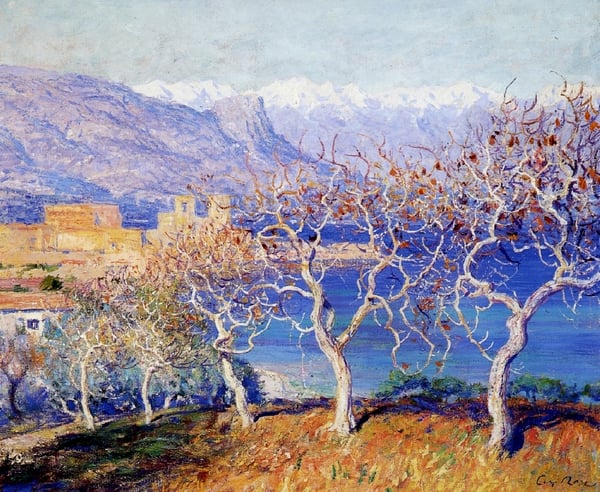
Expert analysis of Guy Rose’s Fig Trees, Antibes
Style: Impressionism · Genre: landscape
Expert Analysis of "Fig Trees, Antibes" by Guy Rose
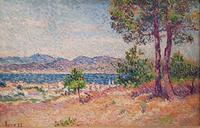
Guy Rose’s Fig Trees, Antibes stands as a luminous testament to the American Impressionist’s mastery of Mediterranean light and his ability to synthesize the core tenets of French Impressionism with a distinctly American sensibility. Painted in the South of France—a region celebrated by Monet, Renoir, and other Impressionist pioneers—the work captures the dappled, heat-soaked atmosphere of the Antibes landscape through a vibrant, broken-color palette and loose, rhythmic brushwork.
Significance within Impressionism:
-
Regional Variation: Unlike many of his French contemporaries who focused on the urban Seine or the coast of Normandy, Rose turned his eye to the sun-drenched olive and fig groves of the Côte d’Azur. This choice places the work within the broader Impressionist exploration of plein air locales, but also highlights Rose’s role as a bridge between European Impressionism and the emerging California plein air movement he would later champion.
-
Color and Light: The painting exemplifies the Impressionist obsession with capturing fleeting atmospheric effects. Rose renders the silvery green foliage of fig trees and the shimmering warmth of the Provençal afternoon by using short, unblended strokes of pure pigment—yellows, ceruleans, and soft mauves—that optically mix to create a sense of radiant, almost palpable heat. This technique, directly inherited from Monet, is infused with a softer, more tonal harmony that reflects Rose’s training in both Paris and the American West.
-
Compositional Innovation: By focusing on the gnarled forms of fig trees as the primary subject, Rose treats the landscape not as a documentary record but as a formal study of pattern and texture. The trees are both structural anchors and vehicles for painterly gesture, their branches weaving a screen through which the distant Mediterranean light filters. This approach underscores a key Impressionist goal: to find beauty and modernity in the ordinary, transforming a simple orchard into a shimmering, sensory experience.
Enduring Legacy:
Fig Trees, Antibes is significant not only as a superb example of American Impressionism at its height but also as a work that predates and informs the later California Impressionist movement (e.g., the Laguna Beach and Carmel art colonies). It demonstrates how American artists absorbed French principles while forging a personal vision—one that prized luminous atmosphere, spontaneity, and a deep reverence for nature. In its confident handling and radiant palette, the painting captures a moment of pure, unfiltered perception, the very essence of Impressionist philosophy.
Museum / Gallery
Visually similar
20 works with related composition and palette
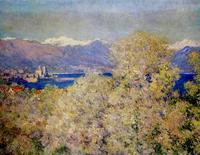
Antibes - View of the Salis Gardens
Claude Monet
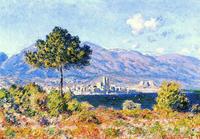
View of Antibes from the Plateau Notre-Dame
Claude Monet
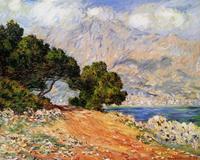
Meton Seen from Cap Martin
Claude Monet
Antibes Seen from the Salis Gardens 01
Claude Monet
Antibes in the Morning
Claude Monet
Gardener's House at Antibes
Claude Monet
Antibes Seen from the Cape, Mistral Wind
Claude Monet
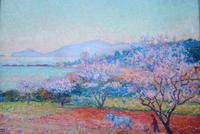
The Almond Flowers
Theo van Rysselberghe
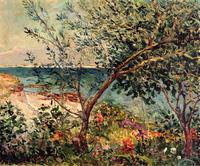
Monsieur Maufra's Garden by the Sea
Maxime Maufra
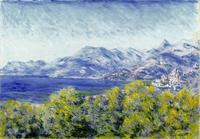
View of Ventimiglia
Claude Monet
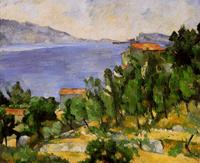
The Bay of L'Estaque from the East
Paul Cezanne
Antibes Seen from the Salis Gardens 02
Claude Monet
Capri
Edward Okuń
The Mulberry Tree
Henry Herbert La Thangue
The Red Road near Menton
Claude Monet
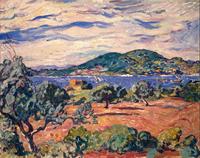
Antheor Bay
Louis Valtat
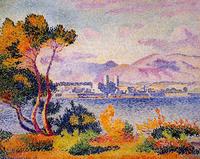
Antibes, Afternoon
Henri-Edmond Cross
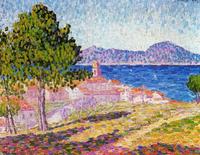
Saint-Tropez
Francis Picabia
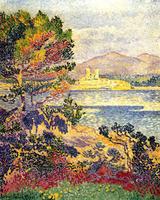
Antibes, Morning
Henri-Edmond Cross
Paysage à Saint-Tropez
Maximilien Luce