
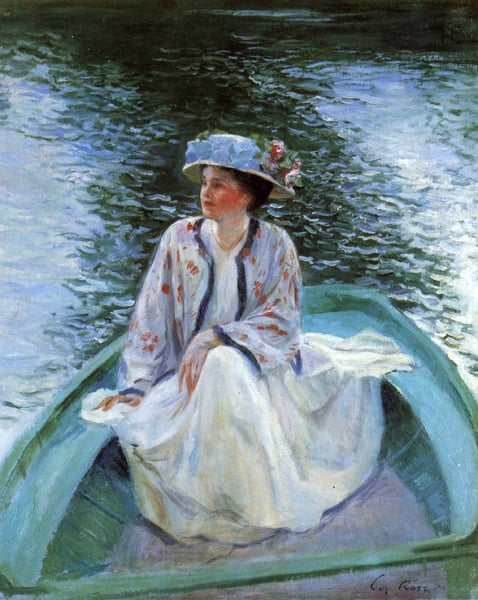
Expert analysis of Guy Rose’s On the River's Edge
Style: Impressionism · Genre: genre painting
Expert Analysis of "On the River's Edge" by Guy Rose
Guy Rose’s "On the River's Edge" stands as a quintessential example of American Impressionism, a movement that adapted the French Impressionist emphasis on light, atmosphere, and everyday life to distinctly American landscapes. Painted in the Impressionist style and categorized as a genre painting, this work captures a moment of quiet, unposed human activity along a riverbank—a subject that underscores the movement’s fascination with modern, leisurely existence and the transient effects of natural light.
Significance within Impressionism and Genre Painting
-
Mastery of Light and Atmosphere: Rose, like his French contemporaries, prioritizes the ephemeral qualities of sunlight and shadow. The river’s edge becomes a shimmering, reflective surface where dappled light filters through foliage and dances on the water. His loose, broken brushwork—a hallmark of Impressionism—dissolves outlines and merges figures with their environment, creating a harmonious, almost vibrating sense of the scene. This technique emphasizes the moment over precise detail, a core tenet of the style.
-
The Ordinary as Extraordinary: As a genre painting, "On the River's Edge" elevates a simple, everyday riverside moment to a subject worthy of fine art. Instead of grand historical narratives, Rose portrays anonymous figures engaged in quiet leisure—perhaps a woman reading, a child wading, or a couple resting. This focus on contemporary, informal life reflects the Impressionist desire to break from academic conventions and capture the poetry of the mundane.
-
American Identity within a Global Movement: Rose was a key figure in the California Impressionist school, and this work likely embodies the soft, golden light and coastal scenery of the West Coast. While adhering to French Impressionist techniques (such as plein air painting and divided color), Rose infuses the scene with a distinctly American sense of expansive nature and serene domesticity. "On the River's Edge" thus bridges European innovation and American regional identity, making it significant as a document of how Impressionism evolved beyond France.
-
Harmony of Color and Composition: Rose’s palette is typically high-key, with cool blues and greens of the river contrasting with warm touches of ochre, pink, and white in the figures and foliage. The composition draws the viewer’s eye along the river’s curve, leading into the depth of the scene, while the figures anchor the foreground. This balance between nature and human presence—never dominating, always integrated—exemplifies the Impressionist ideal of unity between subject and setting.
Conclusion
"On the River's Edge" is significant because it encapsulates the core aims of Impressionism—capturing light, momentary perception, and the beauty of ordinary life—while also reflecting Guy Rose’s role in transplanting these ideals to the American landscape. It stands as a testament to the movement’s global reach and its enduring power to transform the fleeting into the timeless.
Museum / Gallery
Visually similar
20 works with related composition and palette
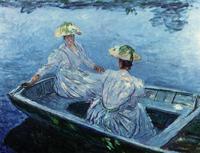
The Blue Row Boat
Claude Monet
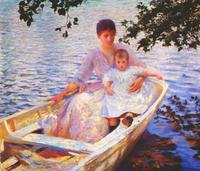
Mother and Child in a Boat
Edmund Charles Tarbell
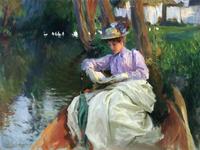
By the River
John Singer Sargent
Young Girls in a Row Boat
Claude Monet
Portrait of Mrs. Chase
William Merritt Chase
La Roche Guyon
Theodore Robinson
The White Dory
Childe Hassam
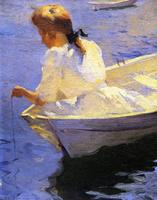
Eleanor in the Dory
Frank W. Benson
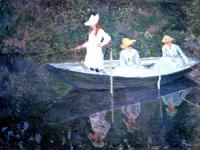
In the Norvegienne Boat at Giverny
Claude Monet
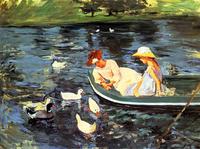
Summertime
Mary Cassatt
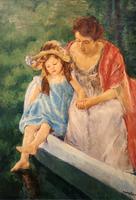
Mother And Child In A Boat
Mary Cassatt
Portrait of Elanor Hyde Phillips
Edmund Charles Tarbell
Summer Reverie
Robert Lewis Reid
Reading in the Garden
Ipolit Strambu
Through the Vines
Frederick Carl Frieseke
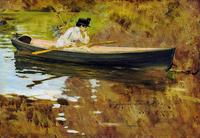
Mrs. Chase in Prospect Park
William Merritt Chase

Woman in a Boat
Pierre-Auguste Renoir
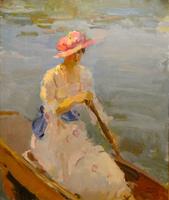
Young woman rowing on the Thames
Isaac Israels

Pond Lilies
Robert Lewis Reid
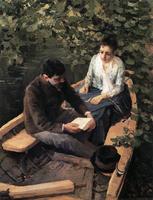
In the Boat
Konstantin Korovin