Expertenanalyse zu Guy Roses The Blue Kimono
Stil: Impressionism · Genre: genre painting
Expert Analysis of "The Blue Kimono" by Guy Rose
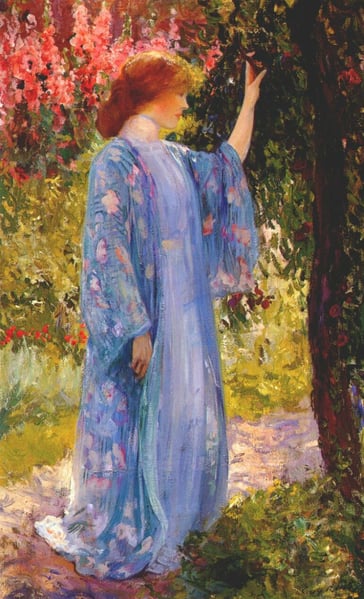
Guy Rose’s The Blue Kimono stands as a luminous example of American Impressionism while engaging with the global fascination for Japonism that swept late 19th- and early 20th-century art. As a genre painting, it captures a quiet, intimate moment—likely a woman in a blue kimono—but its significance lies in how Rose synthesizes Impressionist techniques with cross-cultural motifs.
Key Significance:
-
Mastery of Light and Atmosphere: True to Impressionist principles, Rose bathes the scene in soft, diffused light. The blue fabric of the kimono likely shimmers with varied hues—cool ceruleans, muted lavenders, and white highlights—demonstrating the Impressionist obsession with capturing the fleeting effects of natural light on color. This treatment elevates a simple genre scene into a study of atmospheric luminosity.
-
Japonism and Exoticism: The kimono itself signals the 19th-century European and American enthusiasm for Japanese art and design. Rose, who studied in France and was deeply influenced by Monet and the Giverny Impressionists, incorporates the elegant asymmetry, flat decorative patterns, and restrained palette typical of Japanese woodblock prints (ukiyo-e). This fusion marks The Blue Kimono as part of a broader dialogue between Western oil painting and Eastern aesthetics—a hallmark of Impressionist modernity.
-
California Impressionist Legacy: As a leading California Impressionist, Rose brought a distinctly American sensibility to the movement. Unlike the bustling Parisian scenes of his French counterparts, his work often emphasizes serene, domestic interiors or coastal views. The Blue Kimono reflects this quieter, more contemplative strain of Impressionism, celebrating the beauty of everyday life through a refined, contemplative lens.
-
Genre Painting as Visual Poetry: The work transcends mere documentation. By centering on a single figure in a vibrant garment, Rose invites viewers to focus on surface, texture, and mood rather than narrative. This aligns with the Impressionist goal of capturing “the impression” of a moment—the soft rustle of silk, the interplay of shadow and fabric, the meditative stillness of the sitter.
In sum, The Blue Kimono is significant not only as a testament to Guy Rose’s technical skill but as a cultural artifact that bridges Western Impressionism and Eastern decorative traditions, while exemplifying the intimate, light-infused artistry that defines American Impressionism at its finest.
Museum / Gallery
Visuell ähnlich
20 Werke mit ähnlicher Komposition und Farbpalette
Corner of the Garden in Monaco
Henri-Edmond Cross
The Garden
Abbott Handerson Thayer
On the Terrace
Robert Lewis Reid

Mrs. Hassam in the Garden
Childe Hassam

A Summer Portrait
Robert Lewis Reid
Lady in the Park (aka In the Garden)
Childe Hassam

Autumn
Robert Lewis Reid

Untitled
Daniel F. Gerhartz
Girls in the Garden
Frank W. Benson

Flowered garden. Young woman in the rose garden
Umberto Veruda
In the Garden
Theodore Robinson

Woman Cutting Roses in a Garden
Childe Hassam

Reading on the Garden Path
Albert Aublet
Sewing Scene under the Pergola at Marquayrol
Henri Martin
In the Grove
Theodore Robinson
Mrs. Hassam in the Garden
Childe Hassam
Trio fleuri
Jan Toorop
Lady in Flower Garden
Childe Hassam
In the Garden (Celia Thaxter in Her Garden)
Childe Hassam
Woman with a Black Dog
Pierre-Auguste Renoir