The Flood
Expert analysis of Agostino Carracci’s The Flood
Style: Baroque · Genre: religious painting
Expert Analysis: "The Flood" by Agostino Carracci
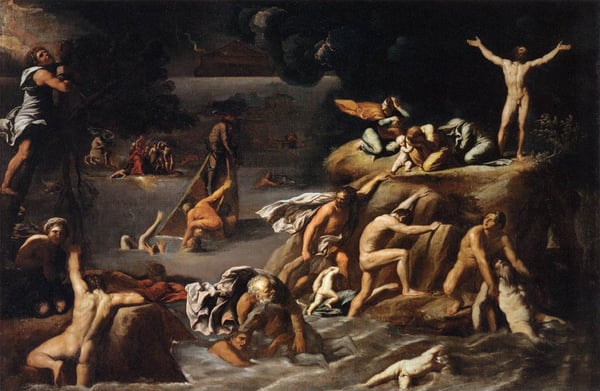
"The Flood" (c. 1588–1590) by Agostino Carracci stands as a seminal work of the early Baroque period, demonstrating the dramatic shift away from Mannerist artificiality toward a more emotionally direct and naturalistic portrayal of biblical narrative. As a religious painting, it captures the climactic moment of the Deluge from Genesis, focusing on humanity’s desperation in the face of divine judgment.
Significance within the Baroque Style
Agostino Carracci, alongside his brother Annibale and cousin Ludovico, helped define the incipient Baroque through their rejection of late Mannerist contrivance. In "The Flood," this manifests in three key ways:
-
Dramatic Narrative and Emotional Intensity – Carracci condenses the story into a single, heart-wrenching scene of survival and despair. Figures cling to rocks, raise their arms in futile prayer, or struggle against the rising water. The composition pulls the viewer into the chaos, a hallmark of Baroque engagement.
-
Dynamic Light and Shadow (Chiaroscuro) – The painting employs strong chiaroscuro to heighten the sense of emergency. Light rakes across the bodies of the condemned, emphasizing their physical agony and isolating them against a dark, turbulent sky. This use of tenebrism prefigures Carravalaggio’s later innovations.
-
Naturalistic Anatomy and Emotion – Unlike the elongated, stylized figures of Mannerism, Carracci’s bodies are solid, muscular, and anatomically credible. Their faces register terror, exhaustion, and anguish with unprecedented realism, making the biblical catastrophe feel immediate and human.
Genre and Religious Purpose
As a religious painting, "The Flood" serves both as a moral warning and an invitation to empathy. It eschews iconic, static holiness in favor of a visceral, almost cinematic depiction of sin’s consequence—and, by implication, the mercy of God in sparing Noah. Carracci’s work thus aligns with the Counter-Reformation’s call for art that moves the faithful to both fear and hope.
Legacy
Agostino’s "The Flood" marks a crucial step in the development of Baroque history painting. Its fusion of classical figuration (learned from the Carracci Academy’s study of Raphael and Michelangelo) with raw emotional power influenced later masters, including Pietro da Cortona and the Bolognese school. It remains a vivid testament to the Baroque’s ability to transform biblical stories into profoundly human dramas.
Museum / Gallery
Visually similar
20 works with related composition and palette
The Battle between Lapiths and Centaurs
Luca Giordano
Acis and Galatea
Nicolas Poussin
Diana Y Ninfas
Lorenzo Pasinelli
Allegory of the Poet
Jacob Jordaens
Apollo and Marsyas
Giovanni Battista Tiepolo
Battle between Lapiths and Centaurs
Francesco Solimena
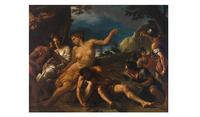
Samson and Delilah
Francesco Stringa
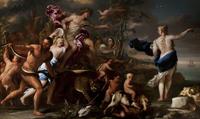
The Triumph of Bacchus and Ariadne
Luca Giordano
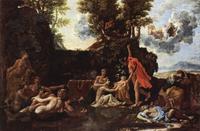
The birth of Bacchus
Nicolas Poussin
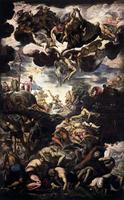
The Brazen Serpent
Tintoretto
Allegory of prosperity
Erasmus Quellinus the Younger
Le Frappement Du Rocher
Charles Le Brun
The Great Flood
Alessandro Magnasco
The Baptism of Christ
Tintoretto
Allegory of the Peace of Westphalia
Jacob Jordaens
The Disarming of Cupid, an Allegory of Chastity
Luca Giordano
The Descent into Hell
Tintoretto
Aeneas And His Family Departing From Troy
Peter Paul Rubens
Moses Striking Water from the Rock
Nicolas Poussin
The Battle Between the Gods and the Titans
Joachim Wtewael