Andrea Mantegna sanatçısının Ceiling of the Camera Picta or Camera degli Sposi eseri hakkında uzman analizi
Tarz: Early Renaissance · Tür: quadratura, trompe-l'œil
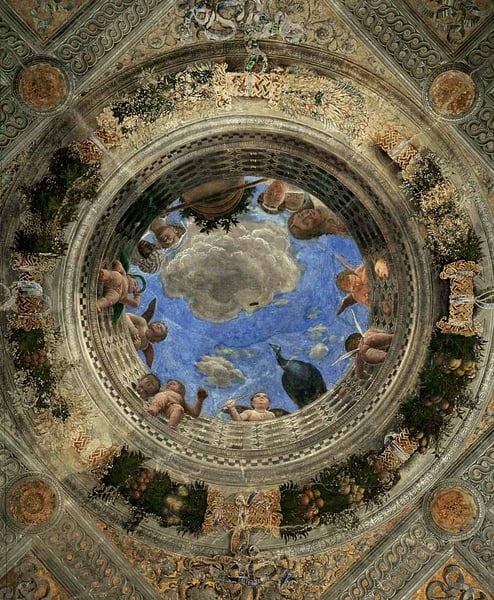
The Ceiling of the Camera Picta (Camera degli Sposi) by Andrea Mantegna (1474) is a cornerstone of Early Renaissance illusionism, marking a revolutionary leap in the use of quadratura and trompe-l’œil. Painted for the Gonzaga family’s marriage chamber in the Ducal Palace of Mantua, this ceiling embodies the period’s obsession with blurring the boundary between architecture and painting, reality and representation.
Significance and analysis:
-
Pioneering di sotto in sù perspective: Mantegna’s ceiling is among the first Renaissance works to employ extreme foreshortening from a viewpoint directly below (di sotto in sù). The central oculus—an open circular aperture—appears to puncture the actual stone ceiling, revealing a vivid blue sky populated by putti, peacocks, and courtly figures. This creates a dizzying, vertiginous effect that anticipates Baroque ceiling painting by over a century.
-
Radical trompe-l’œil integration: The painted architecture—a balustrade with simulated reliefs and classical motifs—is rendered with such precise illusionism that it appears to continue the real room’s structure. Garlands and ribbons seem to drape over the frame, and the painted figures lean and peer down into the viewer’s space, shattering the boundary between canvas and chamber. This was a deliberate demonstration of Mantegna’s mastery: he makes the solid ceiling seem to dissolve.
-
Narrative and political function: The ceiling’s iconography celebrates the Gonzaga dynasty. The oculus includes a Latin inscription linking the family to virtue and fame. The illusion of open sky and floating figures implies divine favor and timeless renown—a political statement embedded in an artistic tour de force. The room itself was used for both private and ceremonial purposes; the ceiling thus transforms a mundane chamber into a microcosm of princely power.
-
Early Renaissance synthesis: While Mantegna’s rigorous use of perspective and classical vocabulary is typical of the Early Renaissance, his quadratura (painted architecture) goes beyond mere decoration. He treats the ceiling as a permeable membrane, undermining the very solidity of architecture. This foreshadows later High Renaissance and Mannerist experiments (e.g., Correggio’s dome in Parma) and solidifies Mantegna’s reputation as a virtuoso of illusion.
In essence, the Camera Picta ceiling is not simply a decorative marvel; it is a paradigm shift. It asserts that painting can conquer space, fool the eye, and create a parallel reality—all while serving as a potent symbol of courtly ambition. Mantegna’s work here remains a benchmark for trompe-l’œil and a testament to the Renaissance faith in art’s power to transcend its medium.
Görsel olarak benzer
İlişkili kompozisyon ve renk paletine sahip 20 eser
Bacchus and Ceres
Paolo Veronese
The Separation of Land and Water
Raphael
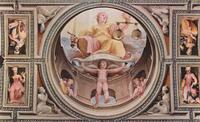
Justizia
Domenico Beccafumi
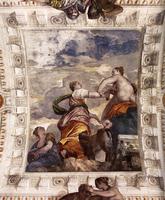
Fortune
Paolo Veronese
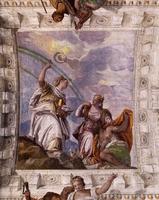
Mortal Man Guided to Divine Eternity
Paolo Veronese
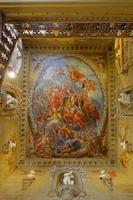
Great Staircase, Triumph of Semele, Ceiling
Antonio Verrio
Allegory of Merit Accompanied by Nobility and Virtue
Giovanni Battista Tiepolo
Hyman, Juno and Venus
Paolo Veronese
Der Sturz Des Marcus Manilius
Domenico Beccafumi
The Apotheosis of St Roch
Tintoretto
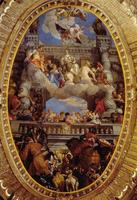
Apotheosis of Venice
Paolo Veronese
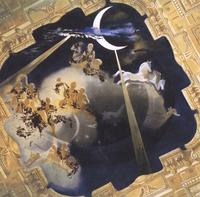
Ceiling of the Hall of Gala's Chateau at Pubol
Salvador Dali
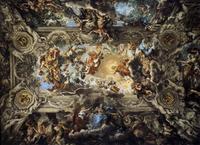
The Triumph of Divine Providence
Pietro da Cortona
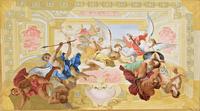
Engelssturz
Johann Peter Krafft
Concordia
Domenico Beccafumi
Landing of the Trojans at the Mouth of Tiberis
Pietro da Cortona
The Creation of the Animals
Raphael
Justizia (Detail)
Domenico Beccafumi
Capitole Toulouse. Toulouse coopérant à la défense nationale
Jean-André Rixens
Antichambre de la reine - La famille de Darius au pied d'Alexandre
Charles Le Brun