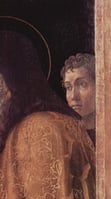
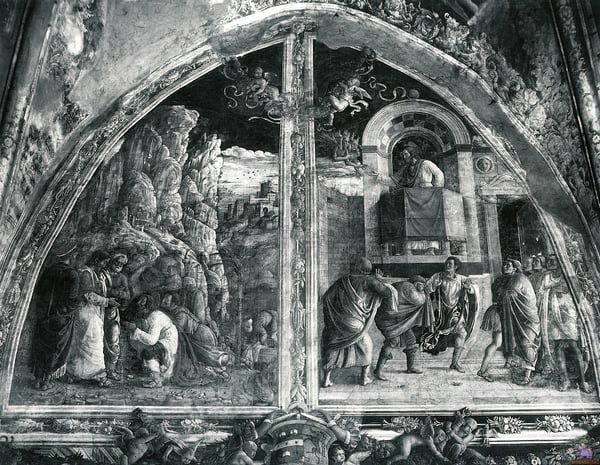
The Calling of Sts James and John; The Preaching of St James (Scenes from the Life of St. James)
Dettagli
Analisi esperta di The Calling of Sts James and John; The Preaching of St James (Scenes from the Life of St. James) di Andrea Mantegna
Stile: Early Renaissance · Genere: religious painting
Expert Analysis: "The Calling of Sts James and John; The Preaching of St James (Scenes from the Life of St. James)" by Andrea Mantegna
Andrea Mantegna’s diptych-like composition, which simultaneously depicts the calling of the Apostles James and John and the later preaching of Saint James, is a landmark of Early Renaissance religious painting. Executed with Mantegna’s characteristic rigor, the work demonstrates how the period’s artistic innovations—particularly linear perspective, classical revival, and psychological intensity—were used to elevate biblical narrative.
Significance within the Early Renaissance
-
Mastery of Perspective and Foreshortening: Mantegna was a pioneer of di sotto in su (from below upward) perspective and dramatic foreshortening. Here, the spatial arrangement—whether in the architectural setting of the calling scene or the crowd in the preaching scene—creates a convincing, measurable space that draws the viewer into the sacred story. This reflects the Early Renaissance obsession with mathematical order and naturalism.
-
Classical Aesthetics and Sculptural Figures: Mantegna’s figures are rendered with a stoic, almost marble-like solidity, recalling Roman statuary. The drapery falls in sharp, metallic folds, and the expressions convey solemn dignity. This fusion of Christian subject matter with Greco-Roman formal language was a hallmark of the period, asserting the timeless authority of the Church through the visual vocabulary of antiquity.
-
Narrative Compression and Clarity: By combining two pivotal moments from the life of Saint James—his calling by Christ and his later missionary preaching—Mantegna displays the Early Renaissance interest in didactic clarity. The juxtaposition emphasizes the transition from disciple to apostle, reinforcing the theme of divine vocation. The composition is balanced yet dynamic, with gesture and gaze guiding the viewer from one episode to the next.
-
Emotional Gravitas: Unlike the softer, more decorative tendencies of earlier Gothic art, Mantegna’s work is marked by a severe emotional intensity. The faces are etched with concentration, the hands expressive, and the overall tone is one of profound spiritual gravity. This aligns with the Early Renaissance pursuit of istoria—a narrative that moves the soul through credible human emotion.
Conclusion
This painting is significant not only as an example of Mantegna’s unflinching realism and archaeological precision but also as a synthesis of the core Early Renaissance ideals: perspective, classical form, and narrative power. It stands as a testament to how religious art of this period became a vehicle for both intellectual innovation and heartfelt devotion.
Museum / Gallery
Visivamente simili
20 opere con composizione e palette affini
Scenes from the Life of St.Christopher
Andrea Mantegna
Cappella Rinuccini
Giovanni da Milano
Exaltation of the Cross: Heraclius enters Jerusalem with the Cross
Piero della Francesca
View of east wall of the chapel
Fra Angelico
Cappella Rinuccini
Giovanni da Milano
Scenes from the Life of Magdalene
Giovanni da Milano
St John on Patmos
Giotto
Flood
Paolo Uccello
Cappella Rinuccini
Giovanni da Milano
Madonna and Child Surrounded by Saints
Benozzo Gozzoli
Scenes from the Life of the Virgin
Giovanni da Milano
St Catherine's Disputation (detail)
Pinturicchio
Death of Adam
Piero della Francesca
Renunciation of Worldly Goods
Domenico Ghirlandaio
Madonna and Child Surrounded by Saints
Benozzo Gozzoli
Conversion of the Heretic
Benozzo Gozzoli
Annunciation to Zacharias
Giotto
Allegory of March – Triumph of Minerva and Sign of Aries. Frescos in Palazzo Schifanoia (detail)
Francesco del Cossa
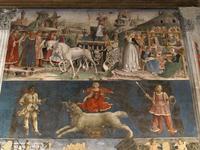
Allegory of March – Triumph of Minerva and Sign of Aries. Frescos in Palazzo Schifanoia (detail)
Francesco del Cossa
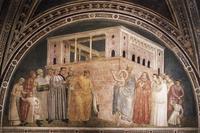
St. Francis Renouncing his Worldly Goods
Giotto