Soldiers
Expert analysis of Andrea Mantegna’s Soldiers
Style: High Renaissance · Genre: sketch and study
Analysis of "Soldiers" by Andrea Mantegna
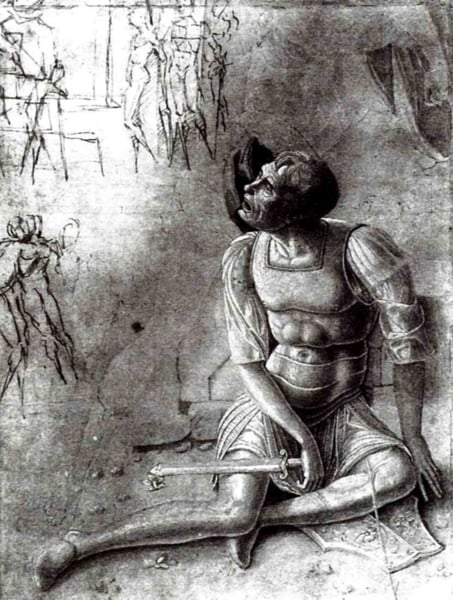
As a sketch and study from the High Renaissance, Andrea Mantegna’s “Soldiers” offers a rare, intimate window into the artist’s working process and the broader intellectual currents of the period. While Mantegna is often associated with the rigorous perspective and monumental gravity of early Renaissance Padua, this drawing exemplifies the transition toward High Renaissance ideals of naturalism, anatomy, and classical revival.
Significance within the High Renaissance:
-
Preparatory Study as Artistic Laboratory – Unlike finished altarpieces or frescoes, this sketch reveals Mantegna’s method of building form through calligraphic line and hatching. The loose, energetic handling of the soldiers’ limbs and armor demonstrates his direct observation of models, a hallmark of High Renaissance drawing practices (see Leonardo’s and Michelangelo’s studies). The work’s genre—sketch and study—emphasizes the era’s valuation of disegno (drawing as the intellectual foundation of art).
-
Classical Allusions in Dress and Pose – Mantegna, a passionate antiquarian, often infused his figures with a sculptural, Roman weight. Here, helmets and cuirasses echo ancient reliefs, while the contrapposto stances of the soldiers recall Greco-Roman statues. This blending of archaeological accuracy with dynamic, human movement foreshadows the High Renaissance obsession with reviving classical ideals.
-
Emotional and Narrative Subtlety – Even in a fragmentary study, Mantegna captures the psychological strain of battle: furrowed brows, tense shoulders, and overlapping bodies create a compressed, alert composition. This attention to expressive anatomy aligns with High Renaissance efforts to convey inner states through outward form, a principle later perfected by Raphael.
-
Perspective and Space – Though unfinished, the sketch hints at Mantegna’s signature low viewpoint and foreshortening (evident in the angled shields and forward-thrusting legs). This technique, inherited from his earlier experiments in The Ovetari Chapel, situates the viewer within the scene—a revolutionary shift toward immersive spatial realism.
In summary, “Soldiers” is not merely a rough drawing but a key document of High Renaissance artistic thought. It cements Mantegna’s role as a bridge between the linear precision of the 15th century and the monumental, humanistic figuration of the 16th, proving that even a study can bear the full weight of an era’s ambitions.
Visually similar
20 works with related composition and palette
The Flagellation of Christ in the pavement
Andrea Mantegna
St Michael Defeating Satan
Jacopo Bellini
Mercury protecting Ulysses from the charms of Circe
Annibale Carracci
The Adoration of the Magi
Maerten van Heemskerck
Alexander the Great and Porus
Vincenzo Camuccini
Four Demons with a Book
Luca Signorelli
Samson and Delila
Lucas van Leyden
The Three Horatii Brothers
Jacques-Louis David
Untitled
Hans Bellmer
Allegory of the Choleric Temperament
Maarten de Vos
Youth with executioner
Albrecht Durer
Study of an Ancient Bas Relief of the Arch of Constantine
Andrea Mantegna
Beating the fiances of Penelope returning Ulysses
Vasily Vereshchagin
Aeneas and Dido
Agostino Carracci
Study of Nudes
Luca Signorelli
Publius Horatius
Hendrick Goltzius
Don Juan Tenorio
Carlos Saenz de Tejada
Study for a Christ
Andrea Mantegna
Four illustrations to a Spanish book
Rembrandt
Study to "Pieta"
Michelangelo