Expertenanalyse zu Gwen Johns Black Cat on Blue and Pink
Stil: Post-Impressionism · Genre: animal painting
Expert Analysis: "Black Cat on Blue and Pink" by Gwen John
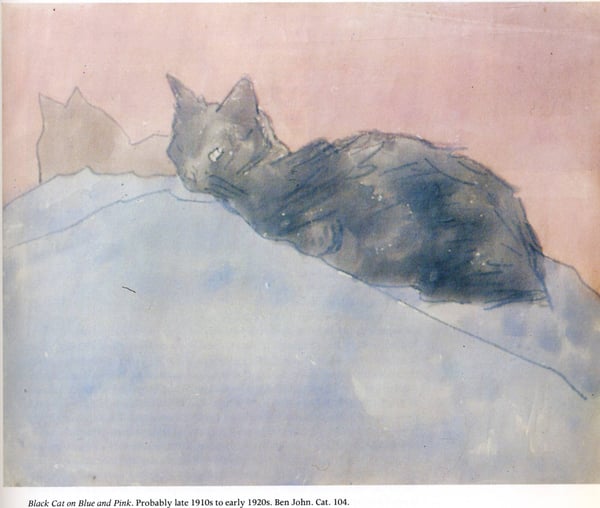
Gwen John’s Black Cat on Blue and Pink is a quietly radical example of Post-Impressionist animal painting, standing apart from the more celebrated, vigorous depictions of animals by her contemporaries (such as Henri Matisse or Franz Marc). Within John’s intimate, subdued oeuvre, this work carries significant weight for its psychological restraint and refined color harmony—hallmarks of her unique Post-Impressionist voice.
Significance within Post-Impressionism:
Post-Impressionism moved beyond naturalism to emphasize symbolic meaning, emotional resonance, and formal structure. John achieves this not through dramatic brushwork or vivid dissonance, but through a distillation of mood. The composition is stark: a black cat, rendered with minimal contour, sits against a field divided into two broad color zones—blue and pink. This flat, nearly abstract division of the canvas recalls the symbolic color fields of Paul Gauguin or the simplified forms of the Nabis, yet John’s palette is softer, more intimate. The black silhouette of the cat becomes a focal point of silent tension, a meditation on domestic stillness.
Genre and Conventions:
As an animal painting, the piece transcends mere pet portraiture. John invests the cat with a sense of autonomous presence—watchful, calm, yet emotionally opaque. The choice of black against blue and pink inverts expected color dynamics: the dark form does not absorb the light but rather anchors the composition’s lyrical balance. This aligns with the Post-Impressionist tendency to treat ordinary subjects as vehicles for formal and psychological exploration.
Art Historical Legacy:
Gwen John’s work is often overshadowed by that of her brother Augustus John, but Black Cat on Blue and Pink exemplifies her distinct contribution: a quiet, introspective Post-Impressionism that prioritizes interiority over spectacle. The painting’s significance lies in how it uses minimal means—a cat, two colors, a clean silhouette—to create a timeless, contemplative space. It demonstrates that Post-Impressionist innovation could flourish in the intimate scale of a domestic animal study, offering a subtle yet powerful counterpoint to the movement’s more bombastic experiments.
Visuell ähnlich
20 Werke mit ähnlicher Komposition und Farbpalette
Sleeping Cat
Max Gubler
Two cats
Theophile Steinlen
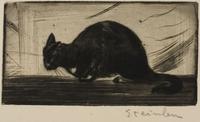
Cat Arching Its Back
Theophile Steinlen
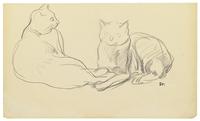
Two cats
Theophile Steinlen
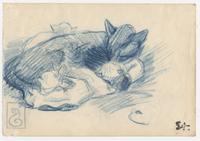
Sleeping cats
Theophile Steinlen
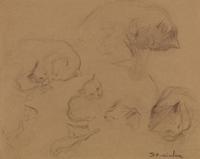
Cat Study
Theophile Steinlen
Cats
Theophile Steinlen
Mother cat
Theophile Steinlen
Cat
Valentin Khrushch
Cats
Theophile Steinlen
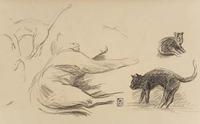
Study of cats
Theophile Steinlen
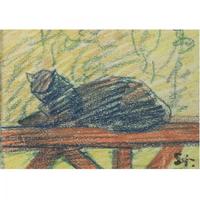
Blue Cat
Theophile Steinlen
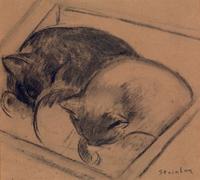
Two Sleeping Cats
Theophile Steinlen
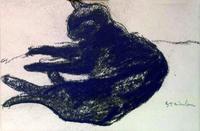
Black Cat
Theophile Steinlen
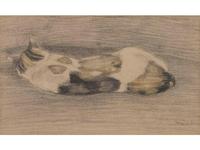
Sleeping Tricolor Cat
Theophile Steinlen
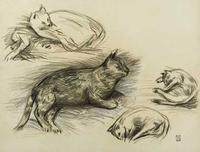
Etude des Chats
Theophile Steinlen
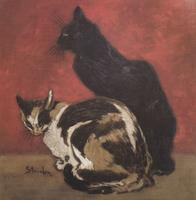
Cats
Theophile Steinlen
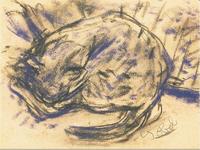
Czóbel Béla Lila Macska, Szén, Papír, 25.5x29cm
Bela Czobel
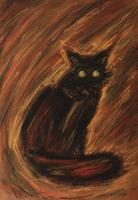
Phantom Cat
Alina Danilova
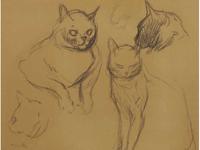
Cat Sketches
Theophile Steinlen