Analisi esperta di The Blessed di Jose Gutierrez Solana
Stile: Expressionism · Genere: genre painting
Expert Analysis of "The Blessed" by José Gutiérrez Solana
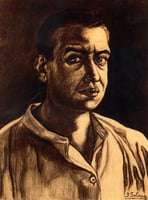
José Gutiérrez Solana’s “The Blessed” stands as a compelling example of Expressionism applied to genre painting, a combination that distinguishes the work within early 20th-century Spanish art. Solana, known for his unflinching depictions of life’s margins, transforms a seemingly ordinary subject—a gathering of the pious or the outcast—into a powerful statement on human frailty, ritual, and social critique.
Expressionist Language: In line with Expressionist principles, Solana distorts form and color to evoke raw emotional intensity. Dark, earthy tones—ochres, browns, and deep blacks—dominate the palette, creating a claustrophobic, almost funereal atmosphere. Figures are rendered with exaggerated, sometimes grotesque features: elongated faces, hollow eyes, and tense, angular postures. This is not a naturalistic portrait but a psychological one, where the artist’s subjective vision emphasizes the vulnerability, desperation, or fervor of the “blessed” (likely impoverished individuals or religious devotees). The brushwork is thick and agitated, reinforcing a sense of urgency and unease.
Genre Painting Reimagined: Traditionally, genre painting captures scenes from everyday life, often with a moral or sentimental tone. Solana subverts this convention: his “The Blessed” is not a cheerful or quaint slice of life but a stark, almost brutal look at the fringes of society. The subject—possibly a procession of the poor seeking blessings or the “blessed” as a term for the mentally ill or destitute—reflects his lifelong fascination with the marginalized. By placing such figures center stage, Solana elevates their plight, forcing viewers to confront the harsh realities behind religious or social ceremonies.
Significance: The work’s significance lies in its fusion of Expressionist distortion with genre’s accessibility. Solana uses the familiar setting (a church interior, a courtyard, or a street) to channel a deeply personal, critical view of Spanish culture—its piety, poverty, and superstition. “The Blessed” is not merely a depiction but a charged commentary, typical of his oeuvre’s role in the “Generation of ’98” movement, which sought to diagnose Spain’s decay. The painting’s raw emotional power and unflinching honesty mark it as a key example of how Expressionism could revitalize old genres, making them vehicles for modern, existential critique.
Visivamente simili
20 opere con composizione e palette affini
The Life of St. Ignatius Loyola. Plate 4. Ignatius and his friend, Francis Xavier, at the university of Paris. What does it profit a man if he gains the whole world but suffers the loss of his soul.
Carlos Saenz de Tejada
Three People Sharing a Meal
Vincent van Gogh
Old Woman Asleep after Rops
Vincent van Gogh
Two Women, Kneeling
Vincent van Gogh
Repentance
Nikolaos Gyzis
Woman Sewing
Vincent van Gogh
Dividing the inheritance in a monastery (Death of a monk)
Vasily Perov
St. Jerome kneeling
Rembrandt
Discreet (discrète)
Paul-Albert Besnard
Monk Filaret Imprisoned in the Antonievo-Siyskiy Monastery
Ilya Repin
At Sergei's #2 (In the bedroom)
Oleg Holosiy
Woman in a Dark Dress (Sien's Mother)
Vincent van Gogh
La Veillee
Theophile Steinlen
Jacob blessed two sons of Joseph. Despite Joseph, he raises his right hand on the head of the younger, Ephraim, to whom he predicted a more glorious posterity than his older brother Manasseh (Genesis, xlviii, 14-21)
Marc Chagall
Interior with Peasant Woman Sewing
Vincent van Gogh
Conspiracy
Kathe Kollwitz
Woman in Prayer
Henri de Toulouse-Lautrec
Man and Woman Sharing a Meal
Vincent van Gogh
Grandmother
Camille Pissarro
Етюд – Отец Паисий
Ivan Mrkviсka