
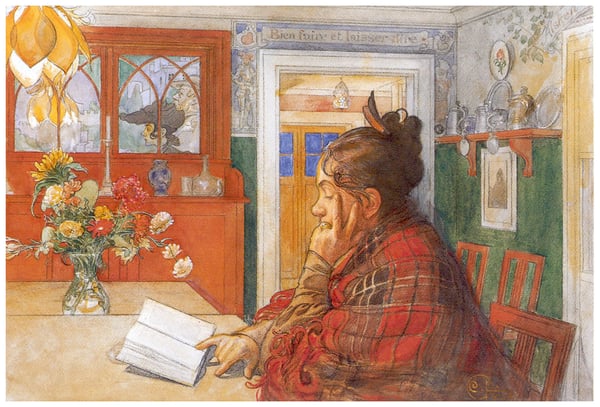
Carl Larsson sanatçısının Karin reading eseri hakkında uzman analizi
Tarz: Art Nouveau (Modern) · Tür: genre painting
Expert Analysis of "Karin reading" by Carl Larsson
Carl Larsson’s Karin reading (circa 1906) stands as a quintessential example of the domestic ideal central to Art Nouveau’s Scandinavian variant. While the style is often associated with ornate, sinuous curves and fantastical nature motifs, Larsson’s work—particularly his watercolors of his home and family—reinterprets Art Nouveau through a lens of intimate realism and folk-inspired simplicity.
Significance within Art Nouveau and Modern Genre Painting
-
Domesticity as a Modern Subject: The painting belongs to Larsson’s celebrated series documenting life at his family estate, Lilla Hyttnäs. Unlike many Art Nouveau works that favored allegorical or mythological scenes, Larsson elevated the genre of everyday domestic activity to a high-art subject. Karin reading captures a quiet, deeply personal moment: the artist’s wife, Karin Larsson—herself a skilled designer and a collaborator in their home’s aesthetic—absorbed in a book. This emphasis on the private, restful interior reflects the Art Nouveau principle of Gesamtkunstwerk (total work of art), where every object and space should be harmonious and meaningful.
-
Line, Color, and Decorative Harmony: Larsson’s watercolor technique is deliberately transparent and luminous, with soft washes of color that evoke the gentle light of a Swedish interior. The composition is structured by vertical and horizontal lines—the bookshelf, the window, the chair—but these are softened by the organic curve of Karin’s dress and the flowing lines of the foliage outside. This juxtaposition of rectilinear architecture with natural, flowing forms is a hallmark of Art Nouveau, here applied not to grand architecture but to the intimate scale of a reading corner. The palette of blues, greens, and warm whites is understated yet rich, demonstrating Larsson’s mastery of tone to create atmosphere.
-
The Artist’s Wife as Icon: Karin Larsson appears repeatedly in Carl’s work, but here she is depicted not as a muse in a studio setting, but as an autonomous individual engaged in her own intellectual world. This aligns with the Arts and Crafts movement’s respect for the handmade and the domestic, but also subtly asserts the growing role of women as cultural participants within the modern home. The painting thus bridges the decorative ideals of Art Nouveau with the emerging consciousness of personal, lived experience in modern genre scenes.
-
Legacy and Lasting Influence: Karin reading is significant because it encapsulates Larsson’s unique synthesis: the decorative elegance of Art Nouveau merged with the sincerity of Swedish folk art and the raw emotional truth of a family portrait. It helped define a distinctly Nordic version of the style—less opulent than its French or Belgian counterparts, more rooted in natural light and everyday rituals. The work remains an iconic representation of the happy, creative home that Larsson championed, influencing later Scandinavian design and the perpetuation of the “hygge” aesthetic.
In essence, Karin reading is not merely a genre painting; it is a manifesto of how Art Nouveau could be lived, breathed, and humanized. It shows that the movement’s true power lies not only in decorative extravagance, but in the ability to render the ordinary extraordinary.
Görsel olarak benzer
İlişkili kompozisyon ve renk paletine sahip 20 eser
Marie Rochegrosse Dans La Salle À Manger
Georges Rochegrosse
Between Christmas and New Aсo
Carl Larsson
Uncle Piacsek in front of the Black Sideboard
Jozsef Rippl-Ronai
Getting Ready for a Game
Carl Larsson
The Table Setting
Edouard Vuillard
A Late-Riser's Miserable Breakfast
Carl Larsson
Lisbeth reading
Carl Larsson
Phonography
Raoul Dufy
Mme. Felix Vallotton
Felix Vallotton
Sunday Rest
Carl Larsson
Morning tea
Vladimir Makovsky
The Oyster Eater
James Ensor
Family Portrait
Zinaida Serebriakova
The Red Checkered Tablecloth
Pierre Bonnard
Education
Rik Wouters
The Golden Fruit
Balthus
Filiżanka Herbaty (wizyta)
Józef Pankiewicz
Young Woman in Interior
Francisc Sirato
The violinist in love
Carl Zewy
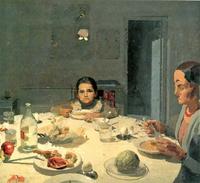
The Table
Antonio Lopez Garcia