Expert analysis of Fernando Botero’s Prima Donna
Style: Naïve Art (Primitivism) · Genre: portrait
Artwork Analysis: "Prima Donna" by Fernando Botero
Style & Period Context
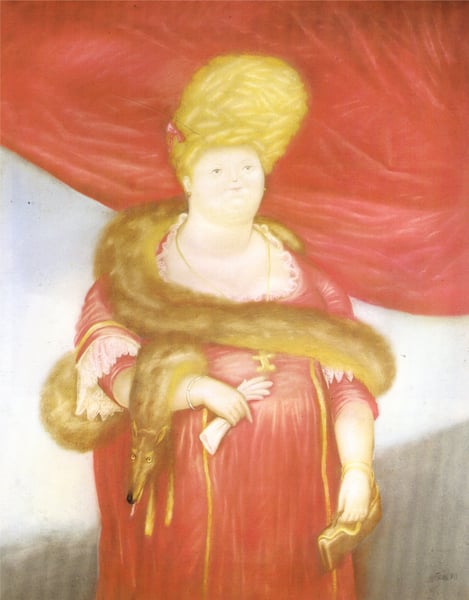
Fernando Botero’s Prima Donna is a portrait executed in the Naïve Art (Primitivism) style—a mode characterized by simplified forms, childlike directness, and a rejection of academic naturalism. Within this tradition, Botero’s work stands as a singular reinterpretation: he fuses the flat, unmodulated surfaces and folk-art qualities of primitivism with his own signature “Boterismo”—the radical inflation of volume and proportion. The portrait thus becomes a dialogue between naïve simplicity and a sophisticated, almost sculptural monumentality.
Significance of the Work
-
Volume as Identity: Botero’s figures are famously swollen to the point of caricature, yet Prima Donna elevates this central motif from mere whimsy to a statement of presence. The subject’s exaggerated roundness—the face, shoulders, and hands—saturates the canvas with a tactile, almost breathing mass. This volume does not signal grotesqueness but rather a generous, tangible fullness that asserts a quiet, dignified monumentality.
-
Colonial & Regional Echoes: The painting’s palette—often warm, earthy tones with restrained highlights—anchors the portrait in Botero’s Colombian heritage. The “prima donna” figure, a reference to a leading operatic lady, is rendered with a formal, frontal pose that recalls both colonial-era religious retablos and the stiff vernacular portraiture of Latin American folk art. Botero’s primitivism, then, is not a retreat from history but a retelling of classical European genres through a distinctly Latin American lens.
-
Subversion of Tradition: By applying naïve techniques to the traditionally grand genre of portraiture, Botero inverts expectations. The subject’s placid expression and static posture mimic the solemnity of official court portraits, yet the exaggerated proportions and simplified modeling undercut any pretense of aristocratic authority. The result is a hybrid—both respectful and ironic, both innocent and knowing—that questions the ideals of beauty, power, and representation.
-
Mastery of Restraint: Unlike many naïve artists who rely on flatness and decorative pattern, Botero retains a subtle chiaroscuro that gives his inflated forms weight without losing their naïve charm. The controlled contours and limited modeling demonstrate a deliberate balance: the portrait remains accessible and “childlike” in its directness, but the hand of a technically accomplished artist is unmistakable.
Conclusion
Prima Donna is a defining example of Botero’s ability to take the naïve-art vocabulary—simplicity, frontality, unmediated emotion—and expand it into a personal, culturally resonant idiom. The work’s significance lies in its seamless integration of the primitive aesthetic with a sophisticated meditation on volume, identity, and the politics of representation. Within the broader Naïve Art movement, Botero’s portrait stands as a master class in how a “naïve” style can convey profound, worldly depth.
Visually similar
20 works with related composition and palette
The First Lady
Fernando Botero
The Palace (1)
Fernando Botero
Emiliana Concha de Ossa
Giovanni Boldini
Portrait of Eleanor Petre
Frederick Sandys
Sensuality
Franz Stuck
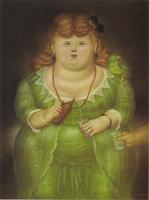
Woman with a Parrot
Fernando Botero
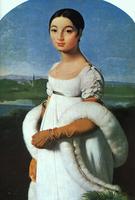
Portrait of Mademoiselle Rivière
Jean Auguste Dominique Ingres
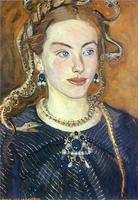
Meduza I
Józef Mehoffer
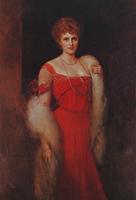
Prinzessin Marie Gabrielle Von Bayern
Wilhelm von Kaulbach
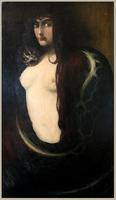
Composition
Georgi Mashev
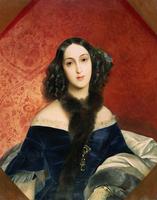
Portrait of M. A. Beck
Karl Bryullov
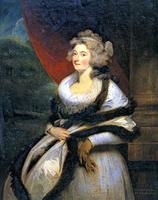
Mrs. Cholmondeley
John Hoppner
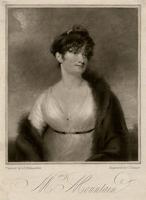
Rosoman Mountain (née Wilkinson)
Charles Turner
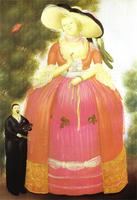
Self-Portrait with Madame Pompadour
Fernando Botero
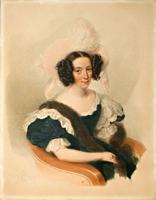
Portrait of a lady
Alexander Clarot
A portrait of Helena Modjeska Chlapowski
Carolus-Duran
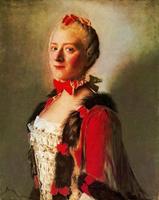
Portrait of a Woman
Jean-Étienne Liotard
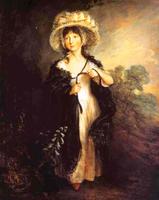
Miss Elizabeth Haverfield
Thomas Gainsborough
Portrait of Princess M.Orlova-Davydova
Konstantin Makovsky
Archduchess Sophie of Austria, Princess of Bavaria
Josef Kriehuber