Analisi esperta di The President di Fernando Botero
Stile: Naïve Art (Primitivism) · Genere: portrait
Expert Art Historical Analysis: "The President" by Fernando Botero
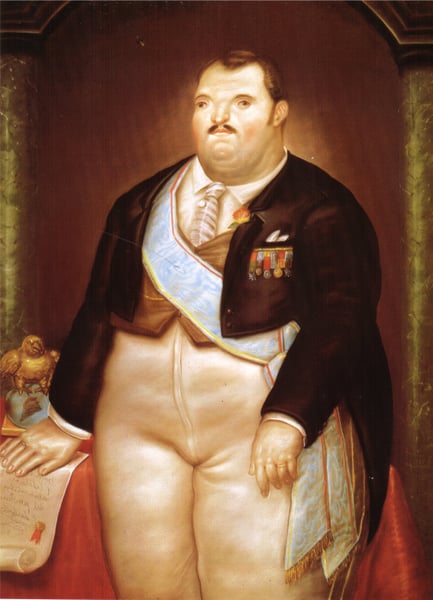
While often categorized under the broad umbrella of Naïve Art or Primitivism, Fernando Botero’s “The President” is a quintessential example of his highly individualistic style—often called Boterismo. The work’s significance lies not in the innocence commonly associated with naïve art, but in Botero’s deliberate, satirical distortion of form to critique power and authority.
Stylistic Significance: The Politics of Volume
Botero’s signature is the inflated, monumental volume he gives to every figure and object. In “The President,” this hypertrophy is not mere whimsy. The subject’s exaggerated rotundity—puffed cheeks, swollen torso, and diminutive hands—creates a visual metaphor for bureaucratic bloat and self-importance. Unlike traditional portraiture, which seeks to dignify a sitter, Botero’s approach imbues the president with a pompous, almost cartoonish grandeur. The scale of the figure overwhelms the canvas, mirroring how political office can dominate public space and discourse.
The Naïve/Primitivist Connection: A Deliberate Paradox
Botero’s work is often linked to Naïve Art because of its simplified forms, flattened perspective, and bright, unmodulated color. However, this is a calculated choice. By adopting a faux-naïve manner—a “primitive” directness—Botero strips away the realistic veneer of statesmanship. The viewer is not asked to admire a likeness but to confront a symbolic archetype: the leader as an absurdly inflated creature of ceremony. This paradox—childlike rendering applied to adult themes of power—is central to Botero’s critical edge. The president becomes a folk-tale figure, equally comic and menacing.
Genre Treatment: Portraiture as Social Commentary
As a portrait, “The President” subverts the genre’s traditional purpose. Instead of celebrating the subject, Botero lampoons the trappings of office: the tight collar, the formal suit, the static pose. The portrait isolates the figure against a minimal background, focusing all attention on the absurd bulk. This is characteristic of Botero’s portraiture, where physical exaggeration becomes a moral commentary—on vanity, corruption, or the disconnect between rulers and the ruled. In this, the work is significant as a key example of how figurative art can critique political structures through visual humor rather than overt symbolism.
Conclusion: The Enduring Force of Boterismo
“The President” is significant because it demonstrates how a style rooted in naïve simplicity can be repurposed for sophisticated political satire. Botero transformed the visual vocabulary of primitivism into a sharp, recognizable critique of authority. The painting stands as a powerful reminder that in Botero’s hands, volume is never innocent—it is always a statement about the weight of power itself.
Visivamente simili
20 opere con composizione e palette affini
Charles Whitworth, 1st Earl Whitworth
Charles Turner
Retrato de D. João VI
Domingos Sequeira
Don Luis Jaime Antonio De Borbon Y Farnesio Infante
Anton Raphael Mengs
Portrait of Adam Vasilevich Olsufyev
Carl-Ludwig Johann Christineck
Retrato de D. João VI, Rei de Portugal
Domingos Sequeira
Portrait of Charles IV of Spain
Francisco Goya
Charles IV
Francisco Bayeu y Subias
Portrait of Infante Don Luis De Borbón
Anton Raphael Mengs
Kaiser Leopold II
Joseph Kreutzinger
Portrait of Count Alexander Kurakin
Vladimir Borovikovsky
Ivan Abramovich Gannibal
Dmitry Levitzky
King Charles IV in Hunting Costume
Francisco Goya
Joaquín José Melgarejo Y Saurín
Rafael Tegeo
Louis Philippe D'Orléans
Charles-Philippe Lariviere
Charles Cornwallis, First Marquis of Cornwallis
John Singleton Copley
Ivan Vorontsov-Dashkov
Charles de Steuben
Portrait of Count Alexander Suvorov
Joseph Kreutzinger
Melgunov, Alexei Petrovich, Governor-General Yaroslavl and Vologda
Dmitry Levitzky
Portrait of José Antonio, Marqués de Caballero
Francisco Goya
Count Ivan Grigoryevich Chernyshov
Dmitry Levitzky