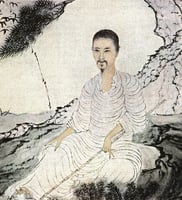
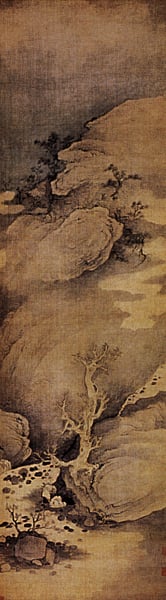
Analisi esperta di In anticipation of spring di Shitao
Stile: Ink and wash painting · Genere: landscape
Expert Analysis of "In Anticipation of Spring" by Shitao
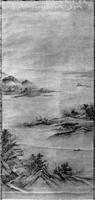
Shitao (1642–1707), a Ming loyalist turned Chan Buddhist monk, stands as one of the most radical individualists in Chinese painting history. His work In Anticipation of Spring (ink and wash landscape) exemplifies the revolutionary spirit of early Qing dynasty literati painting—a period when artists sought to reconcile personal expression with centuries-old tradition.
Significance within Ink Wash Landscape
-
Breaking the "Orthodox" Mold
Unlike the dominant Orthodox School (e.g., the Four Wangs), who revered copying Song and Yuan masters, Shitao championed spontaneity and subjective vision. In Anticipation of Spring likely rejects standardized brush formulas. Instead, its composition may appear asymmetrical, with abrupt spatial leaps—a hallmark of Shitao’s "method without method" philosophy, where nature is not replicated but recreated through the artist’s spirit. -
The "One Brush" Theory in Action
Shitao’s theoretical treatise Huayu Lu (Sayings on Painting) centers on the "single brushstroke" that embodies both cosmic energy (qi) and personal essence. In this work, the transition from winter’s starkness to spring’s renewal would be rendered not through delicate gradations but through forceful, variegated brushwork—dry, flying-white strokes for barren branches alternating with wet, swelling dots for budding life. The ink wash itself becomes a metaphor for seasonal transformation: dense blacks (residual cold) dissolving into pale, moist grays (awakening warmth). -
Existential and Political Undertones
As a Ming loyalist living under Manchu rule, Shitao often imbued landscapes with concealed melancholy. Spring here is not merely a season but a longing—for dynastic restoration, for spiritual rebirth. The typical hortatory title "In Anticipation…" suggests a pregnant pause: rocks may appear unstable, trees contorted, as if the land itself strains toward an uncertain thaw. This tension between stillness and motion, hope and resignation, is quintessentially Shitao. -
Legacy as Pioneer of Modernism
This painting prefigures the expressive ink experiments of later literati and even 20th-century modernists. By prioritizing emotional truth over technical perfection, In Anticipation of Spring asserts that landscape is not a mirror of the external world but a vehicle for the artist’s inner life—a concept that would echo centuries later in abstract expressionism.
In summary, the significance of In Anticipation of Spring lies in its audacious departure from tradition, its philosophical depth (Buddhist impermanence blended with Daoist naturalism), and its revolutionary view of brush and ink as direct conduits of the soul. It is not a painting of spring, but spring becoming—in the mind of the painter and the eye of the beholder.
Visivamente simili
20 opere con composizione e palette affini

Snow Mountain
Guo Xi
Landscape with a Precipitous River-bank with Gnarled Pines and Three Men
Lan Ying
Landscape after Dong Yuan
Lan Ying
Landscape
Lan Ying
The drunk poet
Shitao
The picture of a man in the landscape
Owon
Landscape of Four Seasons: Winter
Sesshu Toyo
Fisherman Hermit
Qiu Ying
Early Spring
Guo Xi
Fishing in Springtime
Ike no Taiga
Autumn Mountains after Wang Meng
Lan Ying
Travelers in a Wintry Forest
Li Cheng
Untitled
Lan Ying
White Clouds and Red Trees
Lan Ying
Waterfall
Kanō Motonobu
Pines and the Waterfall
Lan Ying
琴棋書画図屏風
Kanō Motonobu
Peach Forest
Lan Ying
Untitled
Qiu Ying
Scroll
Kanō Motonobu