Analisi esperta di The lake Cao di Shitao
Stile: Ink and wash painting · Genere: landscape
Expert Analysis of "The Lake Cao" by Shitao
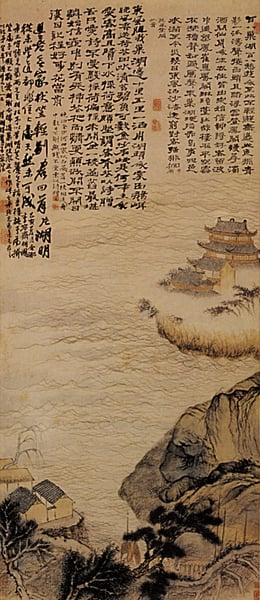
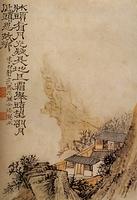
Shitao’s The Lake Cao stands as a masterful example of ink and wash landscape painting from the early Qing dynasty, a period marked by bold individualism and a departure from orthodox literati conventions. While the artwork’s composition depicts a serene lakeside scene, its true significance lies in Shitao’s revolutionary approach to the medium.
Significance within Ink and Wash Painting:
Shitao, a Ming loyalist turned Chan Buddhist monk, rejected the rigid copying of old masters in favor of what he called the "One-Stroke" method—a philosophy where each brushstroke embodies the artist’s inner vitality and the spontaneous energy of nature. In The Lake Cao, this manifests through seemingly effortless yet highly expressive ink washes. The lake is not merely a topographical feature; it becomes a living, breathing entity through layered, translucent ink tones that suggest depth, mist, and fluctuating light. The brushwork alternates between dry, sketchy lines for distant mountains and wet, saturated pools for foreground foliage, demonstrating his mastery of xieyi (freehand expression) over meticulous detail.
Significance within Landscape Genre:
During Shitao’s era, landscape painting was often tied to Confucian ideals of moral cultivation or nostalgic retreat. The Lake Cao transcends these conventions by introducing a deeply personal, almost existential viewpoint. The composition avoids the traditional "three distances" (high, deep, level) formula; instead, it presents a flattened, almost abstract perspective that draws the viewer’s eye along diagonal paths of ink, challenging spatial logic. This aligns with Shitao’s famous treatise Huayu Lu (Comments on Painting), where he argued that the artist must "take heaven and earth as my guest"—a radical declaration of creative autonomy.
Why It Matters:
The Lake Cao is significant not despite its apparent simplicity, but because of it. Shitao reduces landscape to its essential elements—water, rock, tree, and sky—while imbuing each with emotional weight. The painting exemplifies how ink and wash could break free from narrative or didactic purposes to become pure sensory experience. For centuries, it has inspired artists to see landscape not as a fixed subject, but as a mirror of the artist’s mind, making Shitao a pivotal figure in the evolution of Chinese painting from imitation to individual expression.
Visivamente simili
20 opere con composizione e palette affini

Landscape (Dong Yuan and Juran Style)
Bada Shanren
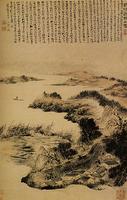
Autumn on the outskirts of Yangzhou
Shitao
楼台殿阁图
Qian Xuan
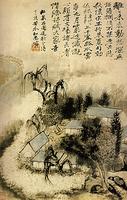
Hamlet in the autumn mist
Shitao
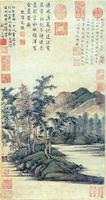
Water and Bamboo Dwelling
Ni Zan
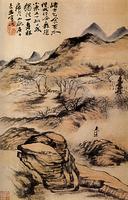
Go by the cold paths
Shitao
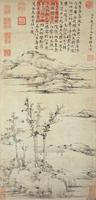
The Rongxi Studio
Ni Zan
The lonely Mountain
Shitao
The Distant Cold Flow Pine
Ni Zan
Boats to the door
Shitao
A pavilion below Mt. Seongsan
Jeong Seon
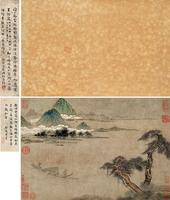
青山白云图
Qian Xuan
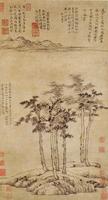
Six Gentlemen
Ni Zan
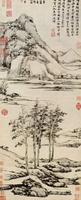
Trees in a River Valley in Yü shan
Ni Zan
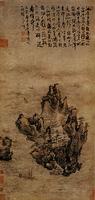
One remains at large
Shitao
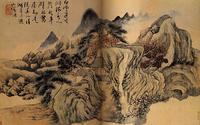
Autumn the mountain
Shitao
柳汀灵禽
Qian Xuan
Banquet by Lantern Light
Ma Yuan
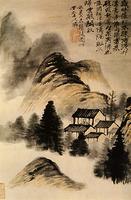
The Hermit lodge in the middle of the table
Shitao
Moonlight on the cliff
Shitao