Analisi esperta di The Source in the hollow of the Rock di Shitao
Stile: Ink and wash painting · Genere: landscape
Expert Analysis: "The Source in the hollow of the Rock" by Shitao
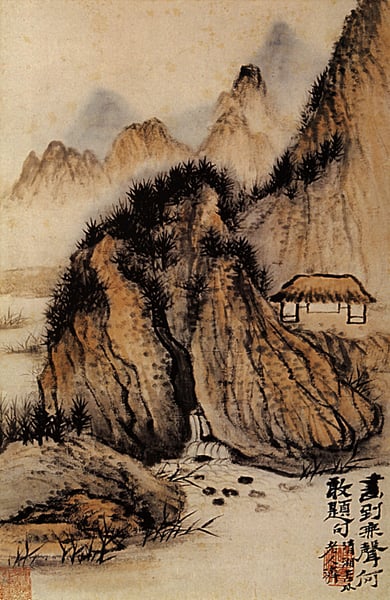
Shitao (1642–1707) was a Ming loyalist turned Chan Buddhist monk who radically reimagined Chinese landscape painting. “The Source in the hollow of the Rock” (hanging scroll, ink on paper) exemplifies his revolutionary approach to the ink‑and‑wash tradition and stands as a manifesto of his individualist philosophy.
Significance within Style and Period
-
Individualism vs. Orthodoxy: In an era dominated by the Orthodox School (e.g., the Four Wangs), Shitao insisted that painting must spring from personal vision. He famously declared, “I use my own method to create a method.” This work embodies that credo: no formulaic brushstrokes or predictable compositional templates are followed. Instead, Shitao invents a rugged, almost improvised landscape that mirrors his inner spiritual state.
-
“One‑Stroke” Brushwork: Shitao’s treatise Huayu Lu (Remarks on Painting) champions the “single brush‑stroke” (yi hua) as the primal act of creation. In this painting, every stroke—whether a dry, jagged line for rock faces or a wet, cascading wash for water—feels immediate and organic. The hollow of the rock is rendered with abrupt, twisting strokes that suggest erosion and time, while the spring (the source) emerges as a delicate, almost calligraphic ribbon of ink.
-
Spatial Inversion: Where traditional landscapes often lead the eye along a receding path into deep space, Shitao compresses the view. The rocky hollow dominates the lower half, creating a claustrophobic, intimate pocket. The source of water trickles from a dark crevice, drawing attention not to a distant vista but to a hidden, almost secret natural event. This shifts the viewer’s focus from panoramic grandeur to micro‑cosmic discovery—a Zen‑like concentration on the essential.
-
Spiritual and Political Subtext: Shitao, as a Ming refugee, often encoded resistance in his works. The “hollow of the rock” can be read as a symbol of retreat and survival—a place where purity (the spring) endures despite upheaval. The precarious, unbalanced forms evoke the instability of his world, while the life‑giving source echoes Chan insights about finding the wellspring of enlightenment amidst chaos.
Why It Matters
“The Source in the hollow of the Rock” is a pivotal work that bridges late Ming individualism and early Qing artistic autonomy. Its significance lies in its assertive break from convention: by prioritizing raw expression over polished technique, Shitao opened the door for later “eccentric” painters and influenced the modern Chinese ink‑painting revival. The painting remains a touchstone for understanding how landscape can become a vehicle for profound personal and philosophical statement.
Visivamente simili
20 opere con composizione e palette affini
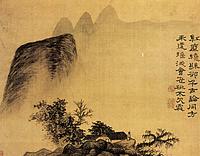
The Hermitage at the foot of the mountains
Shitao
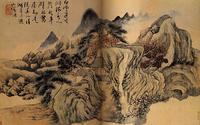
Autumn the mountain
Shitao
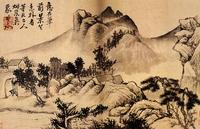
Village at the foot of the mountains
Shitao
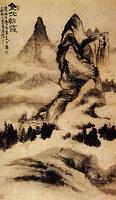
Light of dawn on the monastery
Shitao
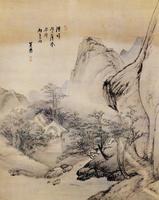
Keimyung Gok Amdo
Shin Yoon-bok
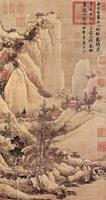
Clearing after Snow on a Mountain Pass
Tang Yin
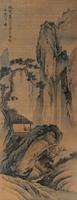
Watching Waterfall
Lan Ying
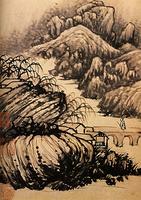
Hiking in the area of the Temple of the Dragon
Shitao
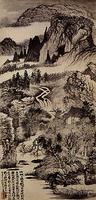
Jinting Mountains in Autumn
Shitao
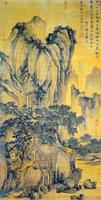
Sound of Pines on a Mountain Path
Tang Yin
Untitled
Guo Xi
The drunk poet
Shitao
Between mountain and river, not far from Mount Huang
Shitao
Gathering in Mountains
Fu Baoshi
Lofty Mount Lu
Shen Zhou
Dancing and Singing (Peasants Returning from Work)
Ma Yuan
Nostalgic walk
Shitao
Landscape
Sesshu Toyo
Poet on a Mountaintop
Shen Zhou
Untitled (Mountains)
Ike no Taiga