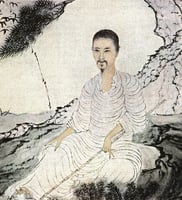
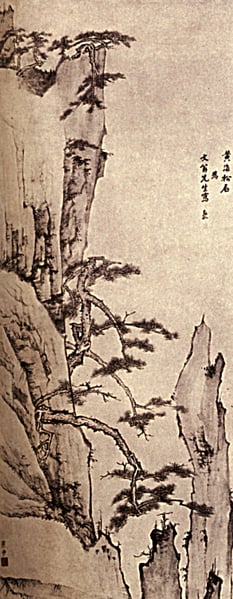
Expert analysis of Shitao’s Terrace of Cinnabar
Style: Ink and wash painting · Genre: landscape
Expert Analysis: "Terrace of Cinnabar" by Shitao (1642–1707)
Style: Ink and wash painting | Genre: Landscape
Shitao’s Terrace of Cinnabar stands as a landmark within the ink‑and‑wash landscape tradition, not for grand spectacle, but for its radical redefinition of pictorial space and personal expression. As a leading individualist of the early Qing dynasty, Shitao rejected the dominant Orthodox school, which prized meticulous copies of Song and Yuan masterworks. Instead, he championed the “One Brushstroke” theory: the notion that every mark carries the artist’s unique spirit and that painting is a direct extension of the self.
In this work, the title’s reference to cinnabar—a vivid red mineral often used in Daoist alchemy—hints at Shitao’s interest in both the physical and transformative qualities of pigment. Within the monochrome ink‑and‑wash format, any hint of red or subtle tonality would be deliberately sparing, used to jar the viewer’s eye and break the convention of pure black‑ink landscapes. More importantly, the composition likely defies standard recession: Shitao often tilted planes, distorted scale, and used “wrinkled” brushstrokes (the cun texture method) in unpredictable ways, creating a landscape that feels alive, shifting, and psychological rather than topographically accurate.
The significance lies in Shitao’s insistence on artistic autonomy. Terrace of Cinnabar embodies his manifesto that “the method has no fixed form; only then is it the supreme method.” By merging the literati ideal of self‑cultivation with a raw, almost spontaneous handling of brush and ink, he freed landscape painting from mere representation and turned it into a vehicle for personal vision—a gesture that would profoundly influence later experimental painters in China and, centuries later, modernists worldwide.
Visually similar
20 works with related composition and palette
Dancing and Singing (Peasants Returning from Work)
Ma Yuan
Sound of Pines on a Mountain Path
Tang Yin
Autumn the mountain
Shitao
Landscape
Sesshu Toyo
Pines and the Waterfall
Lan Ying
Poet on a Mountaintop
Shen Zhou
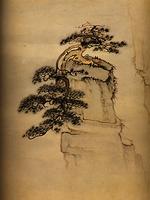
View of Mount Huang
Shitao
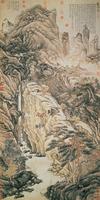
Lofty Mount Lu
Shen Zhou
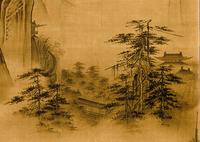
Dancing and Singing (Peasants Returning from Work) (detail 1)
Ma Yuan
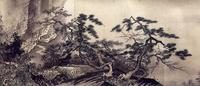
Sansui chokan, detail
Sesshu Toyo
The drunk poet
Shitao
Village at the foot of the mountains
Shitao
Tomioka Tessai Encountering with Immortal Women
Tomioka Tessai
A friend of solitary trees
Shitao
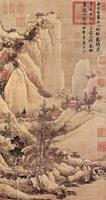
Clearing after Snow on a Mountain Pass
Tang Yin
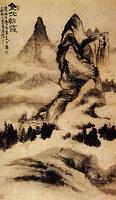
Light of dawn on the monastery
Shitao
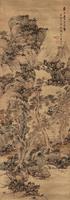
Autumn Mountains after Wang Meng
Lan Ying
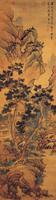
Untitled
Lan Ying
Landscape
Lan Ying
In meditation, at the foot of the mountains impossible
Shitao