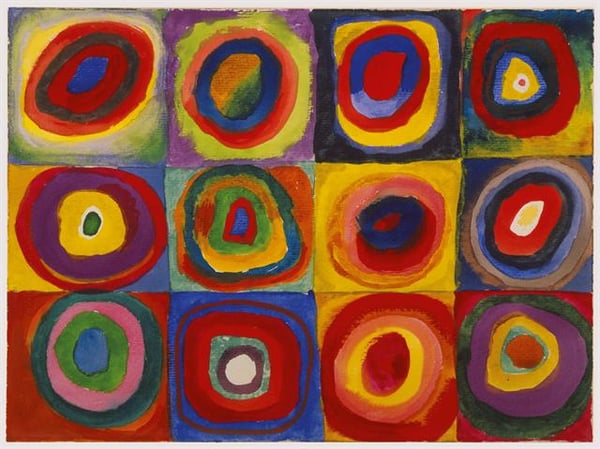
Expert analysis of Wassily Kandinsky’s Color Study: Squares with Concentric Circles
Style: Abstract Art · Genre: abstract
Expert Analysis of "Color Study: Squares with Concentric Circles" by Wassily Kandinsky
This work stands as a seminal exploration of pure abstraction, where Kandinsky systematically investigates the emotional and visual interplay of color and form. Painted during a pivotal period in the evolution of abstract art, the piece strips away all representational content, focusing instead on a grid of squares—each containing a series of concentric circles in carefully chosen color combinations.
Significance within Abstract Art
Kandinsky was a pioneer of non-objective painting, and this study crystallizes his theoretical belief that color and shape could evoke spiritual and psychological responses independent of subject matter. By arranging the circles in a simple geometric framework, he creates a kind of visual laboratory: the viewer’s eye moves across the grid, comparing how different hues interact within the same compositional structure. For instance, a yellow-on-blue circle yields a different emotional resonance than a red-on-green one, demonstrating Kandinsky’s synesthetic approach—where colors are linked to sounds, moods, and even spiritual states.
Context in Kandinsky’s Evolution
Created during his tenure with the Blue Rider group and his time at the Bauhaus, this work reflects his shift from expressive, organic abstraction toward a more analytical, geometric language. The systematic repetition of the circle—a symbol of cosmic harmony and spiritual unity—underscores his desire to create a universal visual language. The painting is not merely a study but a manifesto of abstract art’s potential: it shows that meaning can arise from pure relationships of color and form, without reference to the visible world.
Why It Matters
"Color Study: Squares with Concentric Circles" remains significant because it codifies the principles that would define 20th-century abstraction. It demonstrates how a seemingly simple arrangement can generate infinite perceptual and emotional variations, laying groundwork for Color Field painting and Op Art. Moreover, it captures Kandinsky’s core idea that art must transcend material representation to access the spiritual, a revolutionary stance that forever changed how we understand painting.
Museum / Gallery
Visually similar
20 works with related composition and palette
Story Place: My Father's Country
Sally Gabori
Orchard Tambourine B Complete Portfolio
Terry Frost
Diminishing Circles
Jennifer Bartlett
Mangrove Jack
Sally Gabori
April 2000 - nr. 3. - abstract painting on canvas
Fons Heijnsbroek
Abstract Pointillism / Puntillismo Abstracto
Gabino Amaya Cacho
Abstract Pointillism
Gabino Amaya Cacho
Puntillismo Abstracto
Gabino Amaya Cacho
Untitled, #1
Larry Poons
Early Morning Sky
Tihamer Gyarmathy

The Ngarrawurda (Bluefish)
Sally Gabori
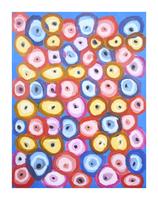
Plenty Fish 3
Sally Gabori
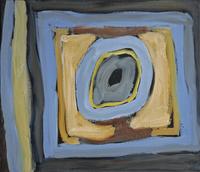
April 1999 - nr. 1.
Fons Heijnsbroek
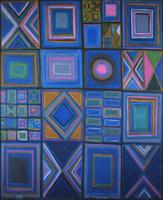
Sem Título
Manuel Cargaleiro
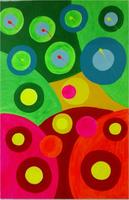
Puntillismo Abstracto por Gabino Amaya Cacho
Gabino Amaya Cacho

All the Fish
Sally Gabori
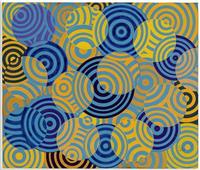
Interférences en bleu et jaune (No. 642)
Antonio Asis

Mullet and Bluefish
Sally Gabori
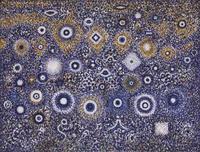
Night Landscape
Richard Pousette-Dart
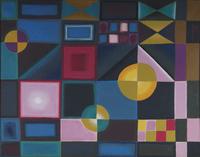
FAG – 16 69
Manuel Cargaleiro