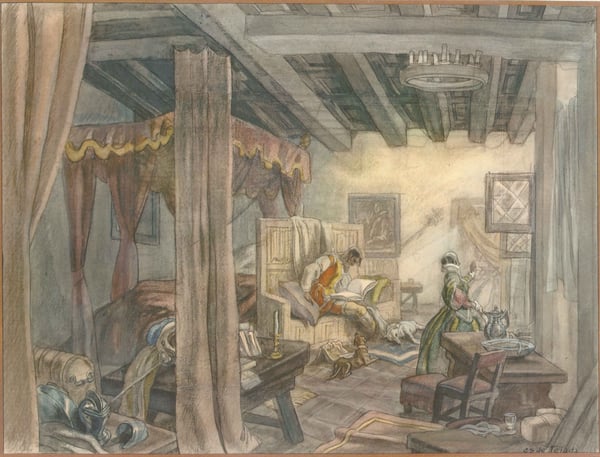
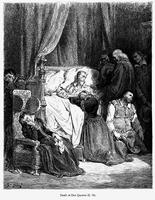
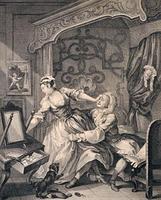
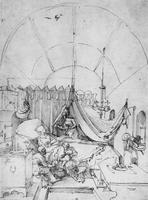
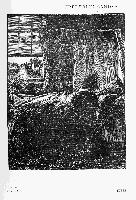
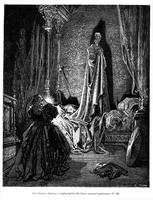
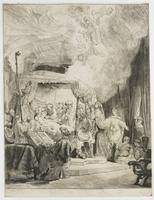
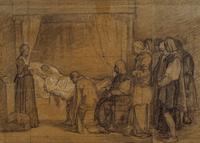
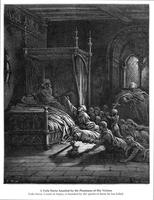
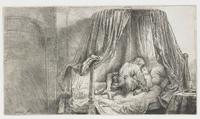
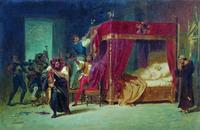
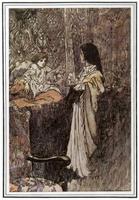
This artwork by Carlos Saenz de Tejada is a striking integration of sacred narrative with the decorative dynamism of Art Nouveau. As a history painting, it depicts the pivotal moment of St. Ignatius Loyola's convalescence—the spiritual turning point that led to the founding of the Jesuit order. What makes the work significant within its style and period is the artist’s ability to infuse a traditional religious subject with the modern, organic aesthetic of Art Nouveau.
Rather than a static, academic portrayal, Saenz de Tejada employs the hallmark traits of Art Nouveau: sinuous, flowing lines, a flattened pictorial space, and a strong emphasis on rhythm and pattern. The composition likely directs the eye in a graceful, serpentine motion around the wounded saint, echoing the period’s fascination with natural forms and movement. The treatment of fabric, architecture, or landscape elements would be stylized into elegant curves, transforming a scene of illness and recovery into a lyrical, almost decorative tableau.
This work is significant because it represents a modern reinterpretation of hagiography—the biography of a saint—at a time when Art Nouveau was often associated with secular, worldly decoration. By applying this sophisticated, turn-of-the-century visual language to a religious drama, Saenz de Tejada bridges the gap between the spiritual and the avant-garde, demonstrating that modernist style could still convey timeless narrative and emotional depth. The plate is thus a key example of how early 20th-century artists revitalized historical and religious themes through contemporary form.