
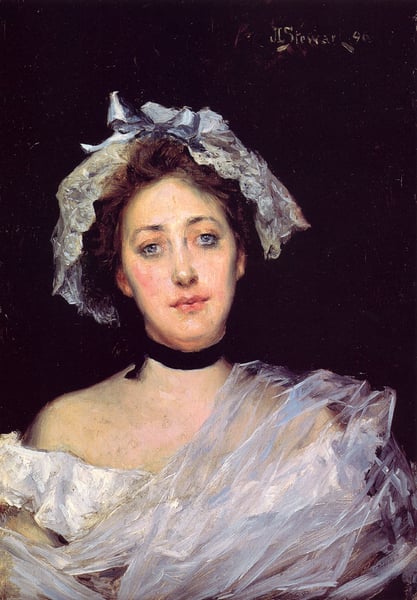
Analisi esperta di An English Lady di Julius LeBlanc Stewart
Stile: Realism · Genere: portrait
Expert Analysis of "An English Lady" by Julius LeBlanc Stewart
Context & Significance
Julius LeBlanc Stewart (1855–1919) was an American expatriate painter who became a prominent figure in Parisian high society during the Belle Époque. His work is firmly rooted in Realism, a movement that rejected idealized or romanticized depictions in favor of truthful, often unembellished representation of subjects. In portraiture, Realism demanded meticulous attention to the sitter’s physical likeness, posture, costume, and psychological presence, while also reflecting their social station and character.
What Makes This Work Significant
As a portrait titled "An English Lady", Stewart’s painting exemplifies the Realist commitment to capturing the sitter without overt flattery or theatricality. The significance lies in how the work likely balances three key Realist concerns:
-
Precision of Observation – Stewart was celebrated for his ability to render fabrics, textures, and light with near-photographic accuracy. In this portrait, the English lady’s attire, hair, and accessories would be depicted with exacting detail, from the sheen of silk to the subtle folds of lace, grounding the image in tangible reality.
-
Psychological Depth – Unlike the stiff, formulaic portraits of earlier academic traditions, Realist portraiture sought to hint at the sitter’s inner life. Stewart’s composition—the lady’s direct or averted gaze, the set of her jaw, the slight tension in her hands—would communicate a quiet dignity or self-possession typical of English aristocratic bearing.
-
Cultural Markers – The title specifies “English,” which carries significance in Stewart’s Parisian context. The portrait likely emphasizes subtle distinctions—such as understated elegance versus French flair—that define the sitter’s national identity. This aligns with Realism’s interest in the specific details that convey a person’s place in society.
Within Realism and Its Period
Stewart’s work stands alongside contemporaries like John Singer Sargent (also an American expatriate) and Carolus-Duran in elevating the Realist portrait to a vehicle for both social record and artistic virtuosity. "An English Lady" would be significant for its demonstration that Realism could transcend mere documentation; it could subtly narrate class, gender, and nationality through the disciplined study of a single face and figure. The painting thus serves as a historical artifact of how Anglo-American artists in Europe used Realist principles to define identity—both of the sitter and of the artist’s own cultural perspective.
Museum / Gallery
Visivamente simili
20 opere con composizione e palette affini

Actress Antonia Zarate
Francisco Goya
Marguerite de Conflans Wearing Hood
Edouard Manet
Portrait of a Young Woman
Pere Borrell del Caso
Portrait
Konstantin Makovsky
Portrait of Maria Bicknell
John Constable
Portrait of the artist's wife
Rupert Bunny
A BELLE EPOQUE LADY WEARING A BEJEWELLED CROSS
Norbert Schrodl

A Woman in Blue (Portrait of the Duchess of Beaufort)
Thomas Gainsborough
Portrait of the Young Lady with Pink Bow
Konstantin Makovsky
Mrs. Gardiner Greene Hammond (Esther Fiske Hammond)
John Singer Sargent
Elsie Woodbury Brown
Raimundo de Madrazo

Portrait of Olga Afanasiyevna Raftopulo
Ivan Kramskoy
Mrs Mary Robinson, 'Perdita'
George Romney
Elegant Lady
Eugene de Blaas
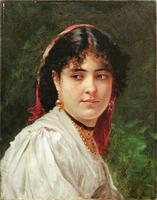
Portrait of a young Italian woman, also said of a Bohemian
Alexandre Cabanel
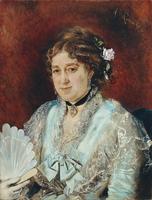
Babette Tapecierer
Anton Romako
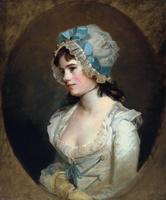
Portrait of Mrs Williams
John Hoppner
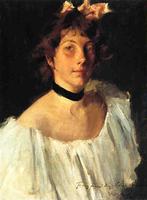
Portrait of a Lady in a White Dress (aka Miss Edith Newbold)
William Merritt Chase
The Pearl Necklace
Eugene de Blaas
Portrait of Madeleine Brohant
Louise Abbéma