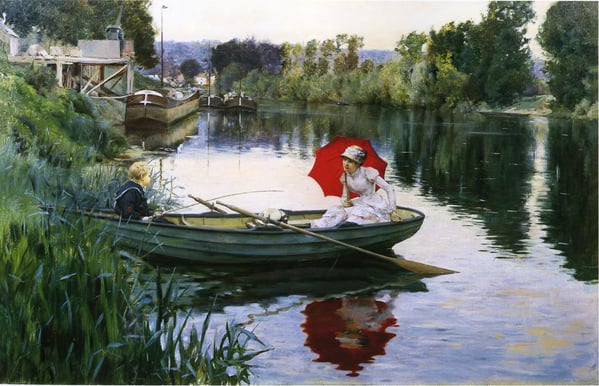
Artwork: Quiet Day on the Seine by Julius LeBlanc Stewart
Style: Realism
Genre: Genre painting
Expert Analysis
As a Realist genre painting, Quiet Day on the Seine derives its significance from its unwavering commitment to depicting contemporary, unidealized everyday life—a core tenet of the Realist movement. The title itself emphasizes a "quiet" moment, suggesting a mundane, tranquil scene rather than a dramatic or heroic event. This ordinariness is precisely what makes the work noteworthy: it elevates the casual, fleeting experience of a day by the river to the status of fine art.
By situating the scene on the Seine, Stewart roots the work in a specific, recognizable locale, grounding it in the present reality of 19th-century urban or suburban leisure. The genre painting tradition allows him to focus on human activity and social observation—likely depicting ordinary people enjoying a peaceful afternoon, without moralizing or sentimental exaggeration. In the context of Realism, this rejection of romanticized or historical subjects in favor of a snapshot of modern life aligns with the movement’s broader project to represent the world as it is.
The work’s significance also lies in its quiet defiance of academic hierarchy: Realist genre paintings like this one challenged the primacy of history painting by asserting that the here and now—however trivial—deserves artistic attention. Stewart’s Quiet Day on the Seine thus stands as a testament to how Realism transformed everyday observation into a meaningful artistic statement.