
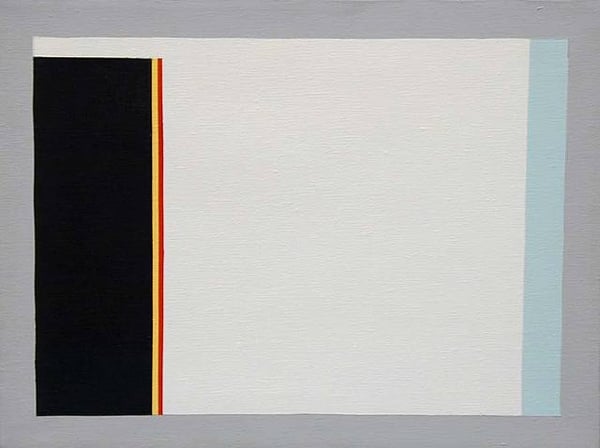
Expertenanalyse zu Gene Daviss Untitled
Stil: Color Field Painting · Genre: abstract
Expert Analysis: "Untitled" by Gene Davis
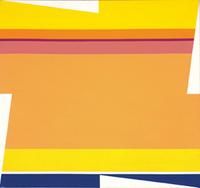
Gene Davis’s Untitled exemplifies the core tenets of Color Field Painting, a movement that emerged in the 1950s–60s as a radical departure from Abstract Expressionism’s gestural brushwork. Davis is best known for his signature “stripe” paintings—vertical bands of saturated color that span the entire canvas edge to edge. While the specific composition of this Untitled work is not detailed, its significance within the genre can be understood through Davis’s established practice and the broader Color Field aesthetic.
Formal Characteristics and Technique
In a typical Davis stripe painting, the canvas is divided into narrow, parallel vertical stripes of unmodulated color, applied with a smooth, even application that eliminates any trace of the artist’s hand. The stripes are meticulously planned to create rhythmic sequences, optical vibrations, and a sense of flat, shallow space. Color—not line, form, or texture—is the sole vehicle for expression. Davis often used dozens of hues in a single work, ranging from vivid primaries to subtle pastels, arranged in unpredictable patterns that seem to shimmer or push against the picture plane.
Significance Within Color Field Painting
Davis’s work is significant for its radical reduction of painting to a single, repeated element: the stripe. This aligns with Color Field’s emphasis on color as an autonomous, non-representational force. Unlike earlier Color Field painters such as Mark Rothko, who used soft-edged rectangles to evoke sublime emotion, Davis employed hard, precise edges and repetitive structure, introducing a systematic, almost serial approach. His stripes reject both narrative and illusionistic depth, insisting on the canvas as a literal, two-dimensional surface. The result is a “dematerialized” painting where color seems to float in an ambiguous optical space, engaging the viewer’s perception rather than their emotions.
Contribution to Abstract Art
Davis’s Untitled works, often monumental in scale, force the viewer to confront color as a physical and perceptual phenomenon. The repetition creates a rhythmic pulse that can feel both meditative and disorienting—a deliberate challenge to traditional composition. By eliminating any central focal point, Davis treats every inch of the canvas with equal importance, anticipating later Minimalist and Op Art concerns. His stripes also play with afterimages and retinal vibration, making Untitled an active, temporal experience that shifts with the viewer’s distance and angle.
In essence, Untitled by Gene Davis is significant not for what it depicts, but for how it makes color behave—stripping painting to its most elemental component and proving that a single, relentless motif can yield infinite visual complexity. It stands as a landmark of Color Field’s ambition to purify art into an encounter between pure hue and pure perception.
Visuell ähnlich
20 Werke mit ähnlicher Komposition und Farbpalette
White, Black, Yellow, and Red
Ilya Bolotowsky
"Cool" Series No. 1 (Red over White)
Perle Fine
Untitled, 26.11.2011
Joachim Bandau
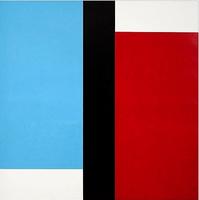
Adam and Eve (#2)
Frederick Hammersley
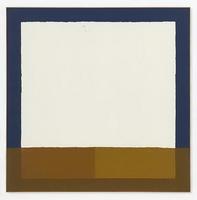
Other Colors
James Bishop
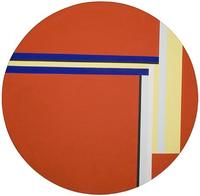
Red Tondo
Ilya Bolotowsky
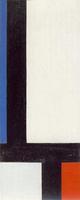
Contra-Composition VII
Theo van Doesburg
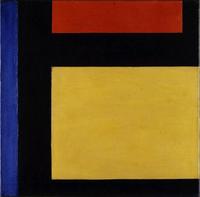
Counter composition X
Theo van Doesburg
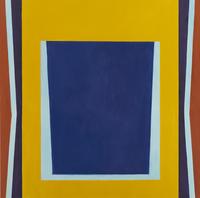
Blockade
Jo Baer
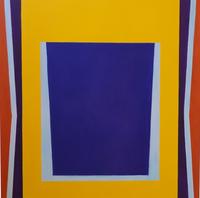
Blockade
Jo Baer
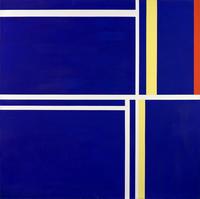
Blue Abstraction in a Square
Ilya Bolotowsky
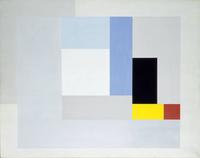
June 1937 (painting)
Ben Nicholson
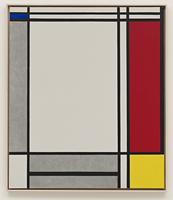
Non Objective I
Roy Lichtenstein
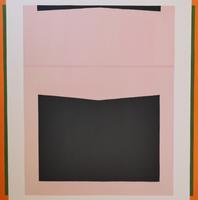
Big-Belly
Jo Baer
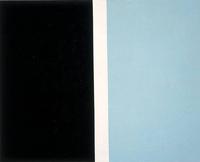
Number 14
John McLaughlin
28.5.66
John Hoyland
"Cool" Series No. 7 (Square Shooter)
Perle Fine
Composition with Red, Yellow and Blue
Piet Mondrian
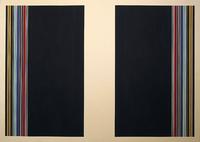
Untitled
Gene Davis
Rotation B
Larry Zox