Analisi esperta di Initiation Into Liberty di Victor Brauner
Stile: Surrealism · Genere: animal painting
Expert Analysis of Initiation Into Liberty by Victor Brauner
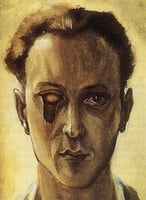
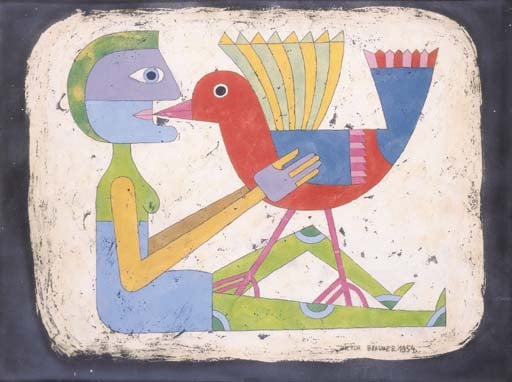
Victor Brauner’s Initiation Into Liberty stands as a compelling example of Surrealist animal painting, a genre that the artist used to explore themes of transformation, the subconscious, and esoteric ritual. Within the Surrealist movement, Brauner was distinct for his deep engagement with alchemy, mythology, and the occult—concerns that surface powerfully in this work.
Significance within Surrealism and the Animal Genre
While Surrealism often deployed animal imagery to evoke primal instincts or dreamlike metamorphosis (as seen in Max Ernst or Leonora Carrington), Brauner’s treatment here is particularly charged with symbolic initiation—a rite of passage into a liberated, transcendent state. The title itself suggests that the animal subject is not merely a creature but a vehicle for spiritual or psychological awakening. Brauner’s animals are rarely naturalistic; they are hybrid, totemic beings that bridge the human and the bestial, the conscious and the unconscious. Initiation Into Liberty likely depicts a creature undergoing a transformation—perhaps a bird, fish, or chimera—that embodies the surrealist ideal of freeing the mind from rational constraints.
Stylistic and Thematic Focus
Brauner’s palette and draftsmanship in this work would typically be characterized by flat, saturated colors and a precise, almost hieratic line, drawing on his interest in Romanian folk art, Byzantine icons, and primitive masks. The animal’s form may be fragmented or fused with symbolic objects (eyeballs, claws, geometric patterns), reflecting his belief in the “painting of the invisible” where inner realities become visible. The “initiation” theme aligns with Brauner’s own career-long fascination with thresholds—between life and death, sight and blindness (he famously lost an eye in 1938), and the tangible and the psychic.
Art-Historical Context
Created during Brauner’s mature Surrealist phase (circa 1940s–1950s), this work exemplifies how he pushed the animal genre beyond mere depiction into a personal mythology. It stands as a testament to Surrealism’s capacity to use non-human subjects to probe the deepest layers of the psyche, while also reflecting Brauner’s unique synthesis of European avant-garde techniques with ancient, folkloric symbolism. In Initiation Into Liberty, the animal becomes a cipher for liberation from societal and artistic norms—a core Surrealist ambition rendered through the lens of esoteric ritual.
Visivamente simili
20 opere con composizione e palette affini
Anagogy
Victor Brauner
Blue bird pumpkin
Paul Klee
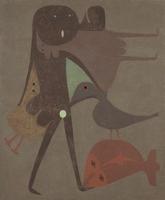
Détermination d'un espace
Victor Brauner
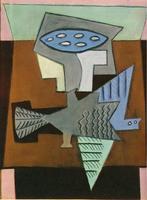
Wounded bird
Pablo Picasso
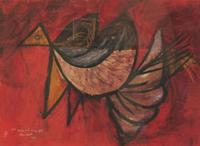
Bird
Jean David
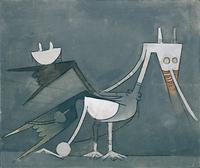
Coq caraïbe
Wifredo Lam
Cosmogonie d'un visage
Victor Brauner
La Passivite Comblee
Victor Brauner
Two birds
Corneille
Career Bird
Walter Battiss
Untitled
Wassily Kandinsky
Animaux claniques hominisés
Victor Brauner
The album "Circus"
Fernand Leger
Untitled
Grace Pailthorpe
Birds of a Feather
Pablo Picasso
Irschou
Victor Brauner
Consciousness of Shock
Victor Brauner
The Dreamer
Norval Morrisseau
Septième sens
Victor Brauner
New Angel
Paul Klee