
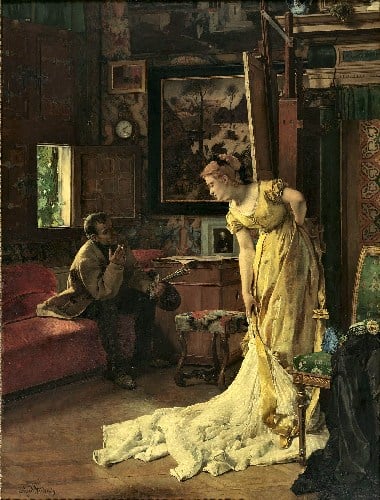
Alfred Stevens sanatçısının The Studio eseri hakkında uzman analizi
Tarz: Realism · Tür: genre painting
Expert Analysis: The Studio by Alfred Stevens
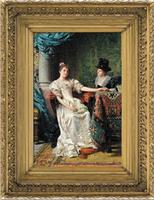
Alfred Stevens’ The Studio stands as a compelling example of Realist genre painting, capturing a moment of quiet, everyday life with meticulous attention to the textures and atmospheres of the modern world. The work’s significance lies in how it embodies the Realist ambition to elevate scenes of contemporary existence—particularly those of the urban, middle-class sphere—to the level of high art.
Key Elements of Significance
-
Realism’s Core Principle: Rather than depicting historical, mythological, or idealized subjects, Stevens focuses on a plausible, unheroic moment: an artist’s studio. This aligns with Realism’s rejection of academic conventions in favor of truthful, observable reality. The scene invites the viewer to peer into a private, professional space, emphasizing the artist’s role as a chronicler of his own time.
-
Genre Painting as Social Observation: As a genre painting, The Studio uses an ordinary activity—perhaps a model posing or an artist at work—to explore broader societal themes. Stevens was renowned for his depictions of elegant, contemplative women, and here the female figure (likely a model or visitor) becomes a focal point for studying both the material culture of the studio and the subtle dynamics of artistic creation. The work is significant for its quiet narrative: it does not tell a dramatic story, but rather invites speculation about the relationship between artist, subject, and space.
-
Technical Mastery in the Service of Realism: Stevens’ skill in rendering fabrics, light, and interior details reinforces the Realist aim of verisimilitude. The careful play of shadow and illumination across the canvas—perhaps from a window or lamp—demonstrates how the artist captures the specific atmosphere of a studio. This attention to sensory detail makes the scene feel immediate and tangible, a hallmark of Stevens’ contribution to the movement.
-
Context within Stevens’ Oeuvre: Alfred Stevens was a leading figure in Belgium’s Realist school, often compared to his French contemporaries like Courbet and Manet. The Studio is significant because it encapsulates his fascination with the intersection of private, feminine spaces and the artistic process. By foregrounding the studio itself, the painting becomes a meta-commentary on the act of painting, aligning with a broader 19th-century interest in depicting the artist’s world.
Conclusion
The Studio is a quintessential Realist genre work that uses the everyday setting of an artist’s workspace to explore themes of observation, materiality, and modern life. Its significance lies in its refusal to idealize—instead, it offers a nuanced, affectionate glimpse into a moment of quiet creativity, grounded in the tangible details of the era. For Stevens, and for Realism as a whole, this painting demonstrates that even the most unassuming scene can carry profound artistic weight.
Görsel olarak benzer
İlişkili kompozisyon ve renk paletine sahip 20 eser
Paris Interior
Mihaly Munkacsy

An antiquarian
Gerolamo Induno

Two young women in a cabinet
Charles Victor Thirion

The Love Letter
Alfred Stevens
Poor Congratulations
Ferdinand Georg Waldmüller

A tune of the lute
Johann Hamza

Gallant scene
Alexis Van Hamme
The Toilet
Francois Boucher

The finishing touch
Wladyslaw Czachorski

Poor wishers
Ferdinand Georg Waldmüller

Lovelorn
Alfred Stevens

The Modiste
Francois Boucher

The letter
Vaclav Brozik

The model
Domenico Induno

The finishing touch
Wladyslaw Czachorski

The first earring
David Wilkie

Seamstress in Interior
Paul Edouard Deligny

Watching Jewels
Wladyslaw Czachorski

Ladies with jewels
Wladyslaw Czachorski
Wedding wreath
Wladyslaw Czachorski