
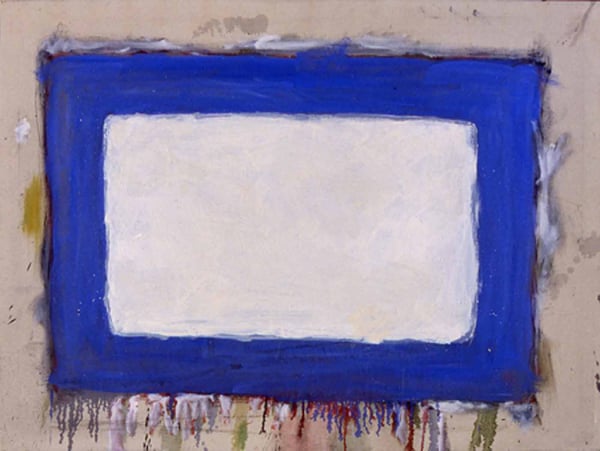
Expertenanalyse zu Gene Daviss Blue Rectangle II
Stil: Abstract Expressionism · Genre: abstract
Expert Analysis of "Blue Rectangle II" by Gene Davis
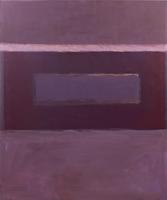
Gene Davis’s Blue Rectangle II is a significant work within the Abstract Expressionist movement, specifically aligning with the Color Field wing that emerged in the 1950s and 1960s. Davis is renowned for his radical reduction of pictorial elements, and this painting exemplifies his commitment to pure abstraction through the primacy of color and form.
Formal Innovation and Color Field Roots
The painting’s central motif—a singular, dominant blue rectangle against a contrasting ground—demonstrates Abstract Expressionism’s shift away from gestural brushwork toward flat, unmodulated fields of color. Davis suppresses any illusion of depth, making the rectangle appear to float on the canvas surface. This directness forces the viewer to engage with color itself as the subject. The intense, saturated blue (a hallmark of Davis’s palette) generates a powerful optical vibration, pushing the rectangle forward while the background recedes, creating a dynamic tension without narrative or representational reference.
Emphasis on Seriality and Minimalist Tendencies
Blue Rectangle II belongs to a series of works in which Davis explored the same compositional structure with variations in hue and scale. This serial approach—reducing form to a single shape and focusing on color relationships—anticipates the Minimalist concerns of the 1960s, yet retains the expressive, non-objective impulses of Abstract Expressionism. The work’s strength lies in its economy: a bold, declarative geometry that achieves emotional impact through chromatic intensity and compositional balance.
Significance within Abstract Expressionism
While Abstract Expressionism is often associated with the heroic gestures of Pollock or de Kooning, Davis’s Blue Rectangle II represents the movement’s quieter, meditative pole. It proves that abstraction can be equally powerful when reduced to elemental components. The painting’s refusal to depict anything beyond a colored shape aligns with the modernist goal of art’s self-definition—a painting that is about painting, about the physical properties of pigment and canvas. In this, Davis contributes to the legacy of Abstract Expressionism by expanding its formal vocabulary, showing that emotional resonance can be achieved through color alone, without gesture or figure.
Conclusion
Blue Rectangle II is a masterful distillation of Abstract Expressionist ideals: it is immediate, self-referential, and deeply affective. Its significance lies in how Davis uses a minimal visual grammar to produce maximum perceptual and emotional impact, reinforcing the movement’s belief that abstraction is a valid vehicle for sublime experience.
Visuell ähnlich
20 Werke mit ähnlicher Komposition und Farbpalette
"Cool" Series No. 26 (First Love)
Perle Fine
No.10
Mark Rothko
"Cool" Series No. 36 (Rough-Hewn)
Perle Fine
No. 16
Mark Rothko
Untitled
Ray Parker
Untitled
Giorgio Cavallon
Magus
Pat Lipsky
Nuvol Rosa (2)
Joan Hernandez Pijuan
"Cool" Series No. 1 (Red over White)
Perle Fine
Tembi
John Hoyland
"Cool" Series (Blue over Red)
Perle Fine
Blue Space
Thomas Downing
Full House
William Scott
Untitled
Al Held
De la serie Señales, B
Cesar Paternosto
Yellow, Cherry, Orange
Mark Rothko
Beauty Mouth-7
Jules Olitski
No.18
Mark Rothko
Summer
Joe Tilson
"Cool" Series No. 12 (Fiercely Remote)
Perle Fine