
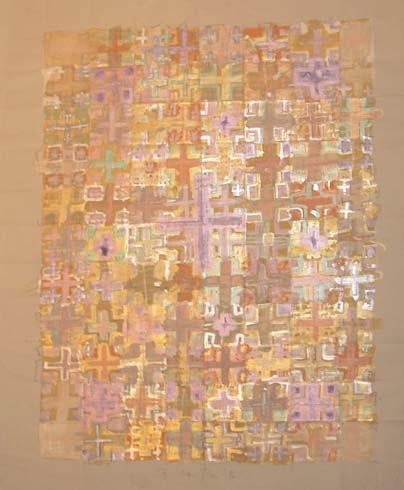
Analisi esperta di Garden of Signs (6) di Silviu Oravitzan
Stile: Neo-Orthodoxism · Genere: abstract
Expert Analysis: Garden of Signs (6) by Silviu Oravitzan (Neo-Orthodoxism, Abstract)
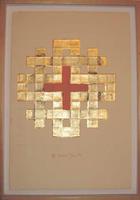
Silviu Oravitzan’s Garden of Signs (6) stands as a compelling example of Neo-Orthodoxism, a Romanian movement that emerged in the 1990s as a deliberate counterpoint to both socialist realism and Western secular abstraction. In this work, Oravitzan synthesizes the spiritual vocabulary of Byzantine iconography—such as flattened gold-leaf-like fields, geometric mandorlas, and the “uncreated light” of Orthodox mysticism—with the formal austerity of mid-century abstract painting. The “garden” of the title is not a natural landscape but a coded symbolic space where marks, glyphs, and quasi-Cyrillic or runic gestures become signs of a transcendent order.
What makes Garden of Signs (6) significant within its period is its radical reassertion of the sacred in an age of materialist art. At a time when the art world largely equated abstraction with pure formalism or self-referentiality, Oravitzan insists that abstract form can become a conduit for religious experience. The work deliberately rejects narrative iconography while retaining the temenos (sacred enclosure) of the icon—a space set apart from ordinary vision. By reducing Orthodox motifs to their abstract essences (a halo becomes a circle of pure color; a cross becomes a cruciform line floating in white), the artist invites viewers to contemplate the scriptural idea of the “word made flesh” through the language of painting itself.
In the context of the post-communist cultural reconstitution of Eastern Europe, Oravitzan’s Garden of Signs (6) is also a political gesture: it reframes Orthodox tradition not as folkloric nostalgia but as a living, critical force that could reinvigorate contemporary art. The work’s quiet luminosity and deliberate ambiguity—signs that signify without being legible—point to a paradox central to Neo-Orthodoxism: the possibility of the absolute glimpsed through the veil of abstraction.
Visivamente simili
20 opere con composizione e palette affini
Garden of Signs (7)
Silviu Oravitzan
Garden of Signs
Silviu Oravitzan
Garden of Signs (2)
Silviu Oravitzan
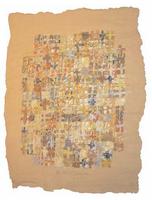
Garden of Signs (4)
Silviu Oravitzan
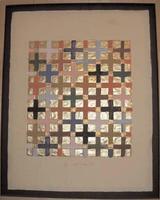
Archangelic Field
Silviu Oravitzan
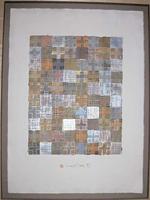
Garden of Signs (3)
Silviu Oravitzan
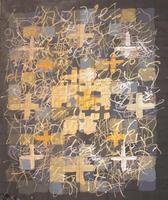
Garden of Signs (5)
Silviu Oravitzan
Archangelic Field (2)
Silviu Oravitzan
The Robe of Christ
Silviu Oravitzan
Untitled
Francois Rouan
Hidden Chambers
Joyce Kozloff
Etude pour un coffret No. I
Francois Rouan
Black-White-Gray
Anni Albers
Labyrinth 1
Silviu Oravitzan
Laberint clos
Carles Delclaux Is
Field of Crosses (Red & Black)
Silviu Oravitzan
Toile tamponnée
Louis Cane
Appearance of Crosses
Ding Yi
Mad Russian Blanket
Joyce Kozloff
Sign and Light (A)
Silviu Oravitzan