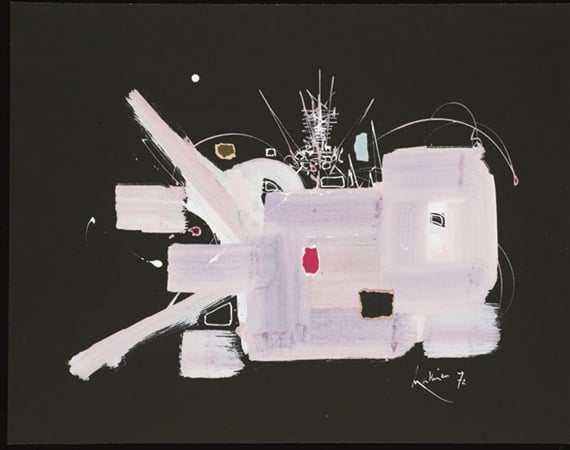
Analisi esperta di Beville di Georges Mathieu
Stile: Tachisme · Genere: abstract
Expert Art Historical Analysis: Beville by Georges Mathieu
Context:
Georges Mathieu (1921–2012) was a pioneering French painter and a leading figure of Tachisme (from the French tache—stain or blot), a post-war European movement that paralleled American Abstract Expressionism. Tachisme rejected geometric abstraction in favor of gestural, impulsive, and highly personal mark-making. Mathieu’s practice was radical for its time: he often painted in public, using industrial paints, squeezing tubes directly onto the canvas, and wielding brushes, palette knives, or even his hands to create explosive, calligraphic compositions. Beville exemplifies these core principles.
1. Formal and Technical Significance
- Spontaneity as Structure: Beville is not pre-planned; its composition arises from immediate, unmediated gestures. The painting’s energy depends on the physical act of painting—the speed, pressure, and rhythm of Mathieu’s hand. This aligns with Tachisme’s emphasis on l’action picturale (the pictorial act) over representational or symbolic content.
- Color and Texture: Mathieu likely employed bold, saturated hues in Beville, applied in dense, swirling bands or flying drips. The canvas becomes a record of materiality: splatters, smears, and incised lines create a tactile surface that invites close viewing.
- Calligraphic Line: Mathieu was deeply influenced by East Asian calligraphy and Zen brushwork. In Beville, the sweeping arcs and sharp, angular marks function as a personal “writing”—a direct transcription of emotion and energy, not as language but as pure visual sensation.
2. Significance Within Tachisme and 20th-Century Abstraction
- Breaking with Cubism and Geometric Abstraction: In the late 1940s, Mathieu and fellow Tachistes (e.g., Hans Hartung, Pierre Soulages) rejected the still-dominant rationalism of Cubism and Mondrian’s Neoplasticism. Beville asserts that meaning is not found in pre-conceived forms but in the artist’s existential encounter with the canvas. This aligns with Jean-Paul Sartre’s existentialist philosophy, which was influential in post-war Paris.
- European Counterpart to Action Painting: While Jackson Pollock was pouring paint on the floor in New York, Mathieu was developing a similarly radical approach in Europe. Beville embodies the same gestural freedom, but Mathieu’s marks tend to be more angular, calligraphic, and rhythmically organized than Pollock’s all-over webs. This makes the work a key document of the transatlantic dialogue between Abstract Expressionism and Lyrical Abstraction (the French term often used interchangeably with Tachisme).
- Performance and Spectacle: Mathieu was among the first artists to conceive of painting as a public performance. Although Beville is a static object, its creation would have been a rapid, theatrical event—sometimes lasting only minutes. This performative aspect, now standard in contemporary art, was revolutionary in the 1950s and directly influenced the Gutai group in Japan and later Actionism in Europe.
3. Intellectual and Philosophical Dimensions
- Rejection of the “Masterpiece”: Mathieu argued that a work should not be judged by finish or perfection but by its authenticity and energy. Beville therefore resists traditional notions of “composition” (balance, focal points). Instead, the viewer experiences a direct, almost confrontational transmission of the artist’s state of mind.
- Symbolism Without Symbols: The title Beville (possibly a reference to a place or a personal cipher) does not explain the image. For Mathieu, titles were poetic provocations, not clues. The painting’s meaning is its event—the frozen trace of a moment of creative fury.
4. Legacy and Influence
Beville stands as a testament to Mathieu’s role in liberating European painting from rigid formalism. It anticipates later developments in Arte Informale, Lyrical Abstraction, and even Neo-Expressionism (e.g., Baselitz, Kiefer). By elevating spontaneity and the artist’s physical gesture to primary importance, Mathieu helped define the trajectory of abstract art in the second half of the 20th century. In Beville, the canvas is not a window onto the world but a stage for the act of painting itself—an act that, for Mathieu, was a form of spiritual and existential declaration.
Conclusion: Beville is quintessential Tachisme: a work where method and meaning are one. Its significance lies in its radical insistence that art is not made from ideas but from raw, visceral action—a direct channel from impulse to image, untouched by convention.
Visivamente simili
20 opere con composizione e palette affini
Composição
Rodrigo Gontijo
Esfinge
eDgar gRau
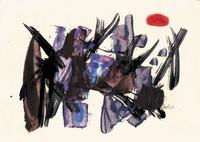
Komposition mit rotem Fleck
Fritz Winter
Komposition
Gosta Adrian-Nilsson
Magician’s Hand
Gary Wragg
Univers lyrique
PR-Monsar
Sans titre
DIDIER DOIGNON
Free Simulation Consciousness #5050W3
SHIH,SIAO-MO
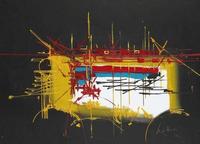
Vossius
Georges Mathieu
Utan titel. (d)
Georges Mathieu
Number 14
Bradley Walker Tomlin
Untitled [red, blue]
Edward Avedisian
Le seuil monotone
Georges Mathieu
City
Basil Beattie
Transparent Shadow
Toko Shinoda
Broken Blue
John Ferren
Dibirdibi Country
Sally Gabori
Single Lotus
Gary Wragg
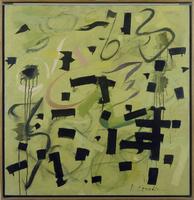
Number 12
Bradley Walker Tomlin
Play of Planes
Karl Knaths