Analisi esperta di Café Concert di Marcel Janco
Stile: Cubism · Genere: genre painting
Expert Analysis: "Café Concert" by Marcel Janco
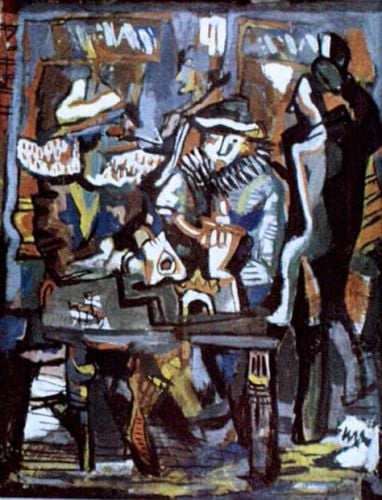
Marcel Janco’s Café Concert exemplifies the Cubist reimagining of everyday urban leisure, a hallmark of early 20th-century avant-garde painting. As a genre scene, it captures the vibrant atmosphere of a Parisian café-concert—a popular venue for music, performance, and social interaction. Janco, a Romanian-born artist who later became a key figure in the Dada movement, here applies Cubist principles of fragmentation, multiple viewpoints, and geometric simplification to a subject rooted in modern life.
The painting is significant for several reasons. First, it demonstrates how Cubism expanded beyond still lifes and portraits to embrace dynamic social spaces, aligning with the movement’s interest in depicting contemporary experience. Janco’s treatment of the café interior—with its interlocking planes of tables, chairs, figures, and stage—creates a rhythmic, almost architectural composition that collapses depth into a flat, mosaic-like surface. The use of muted earth tones punctuated by brighter accents recalls the Synthetic Cubist palette of Picasso and Braque, yet Janco introduces a more expressive, almost rhythmic energy through sharp angular lines and layered forms.
Second, Café Concert occupies a transitional moment between Cubism and Dada. Janco would soon co-found the Cabaret Voltaire in Zurich, using similar fractured forms to create Dadaist performances and masks. Here, the café itself becomes a stage—not only for the singer but for the audience, whose fragmented faces and bodies suggest the psychological dislocation of modern urban life. This blending of formal innovation with social commentary places the work at the intersection of Cubist analysis and proto-Dada absurdity, underscoring Janco’s role as a bridge between these movements.
Ultimately, the painting’s significance lies in its fusion of high modernist structure with popular culture, proving that Cubism could capture the ephemeral, chaotic energy of a night out—a subject that would later become central to Expressionist and Dadaist sensibilities.
Genere
Stile
Visivamente simili
20 opere con composizione e palette affini
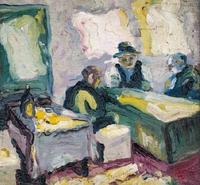
Scheiber Hugó, Művész És Barátai
Scheiber Hugó
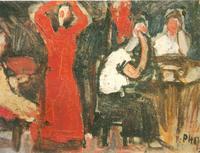
Cheo
Bui Xuan Phai
Giocatori di carte (Amici all'osteria)
Renato Guttuso
The prodigal son
Max Beckmann
Scheiber Hugó Kocsmában
Scheiber Hugó
The Brothel
Vincent van Gogh
Sereia
Joaquim Rodrigo
sketch for The Conquest of the Air
Roger de La Fresnaye
Le Bar
Theophile Steinlen
The Card Players, after Cézanne (Pictures of Magazines 2)
Vik Muniz
Nude in Garden
Richard Gerstl
El sueno de Dona Marina 2
Alberto Gironella
Family Reunion
Max Weber
Orchard Street #2
Grace Hartigan
Luncheon on the grass
Pablo Picasso
Le Bar
Theophile Steinlen
Piac Sarka
Bela Czobel
Untitled
Fikret Mualla Saygi
Berény Róbert, Látogatás a Műteremben
Berény Róbert
La famille
Paul Guiragossian