Expertenanalyse zu Robert Mangolds 1/2 Manilla Curved Area
Stil: Minimalism · Genre: abstract
Expert Analysis: 1/2 Manilla Curved Area by Robert Mangold
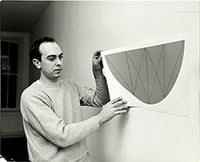
Robert Mangold’s 1/2 Manilla Curved Area stands as a refined and quietly radical example of Minimalist abstraction. Created within a movement that stripped art to its essential formal elements, this work exemplifies Mangold’s lifelong investigation of line, color, and the physicality of the painted surface.
Formal Significance:
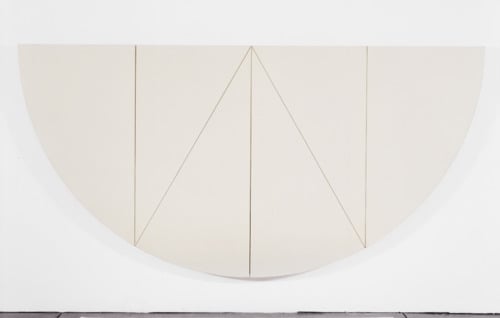
The painting’s title directs attention to its key formal decision: a single, gentle curve (the “curved area”) set against a field of muted, earthy manilla – a warm, tan-brown hue. By reducing the composition to a half-arc on a flat, monochrome ground, Mangold challenges the viewer to experience shape and space without narrative or symbolic distraction. The curve is not rigidly geometric but slightly organic, introducing a subtle tension between the manual mark and the ideal geometry. This deliberate simplicity pushes Minimalism beyond pure industrial repetition, injecting a human, hand-wrought quality.
Contribution to Minimalism:
While many Minimalists favored hard-edged, modular forms and industrial materials, Mangold consistently engaged with the act of drawing and the modulation of color. 1/2 Manilla Curved Area embodies his signature approach: a single, continuous line – often painted directly onto the panel – that defines the work’s structure. The “half” in the title suggests incompleteness or a fragment, inviting contemplation of the relationship between the depicted shape and the larger, implied whole. This gesture toward the unfinished or partial distinguishes Mangold from contemporaries who sought total, self-sufficient objects. Here, the work opens rather than closes meaning, asking the viewer to complete the form mentally.
Material and Spatial Presence:
Mangold typically works on Masonite or wood panels, leaving the surface unprimed or thinly painted to allow the ground’s texture to show. The manilla hue, suggestive of paper or natural fiber, reinforces the sense of material honesty. The curved area itself is often rendered with a slight, visible outline – a drawing that both defines the shape and remains part of the painting’s surface. This blurs the line between painting and drawing, a key concern for Mangold, and roots the work in the legacy of American abstraction from Rothko to Newman while pushing toward a more analytical, quiet formalism.
Legacy:
1/2 Manilla Curved Area encapsulates Mangold’s contribution to Minimalism: an art of extreme reduction that never loses touch with intimacy, touch, and the expressive potential of a single line. It demonstrates that less is not merely a stylistic choice but a philosophical stance – one that values attention over spectacle, and presence over representation. In this work, the curve becomes a world unto itself.
Visuell ähnlich
20 Werke mit ähnlicher Komposition und Farbpalette
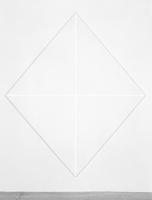
Untitled (White Diamond)
Mary Corse
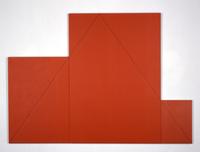
A triangle within three rectangles
Robert Mangold
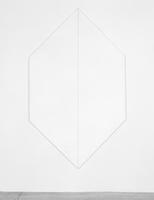
Untitled (White Hexagon)
Mary Corse
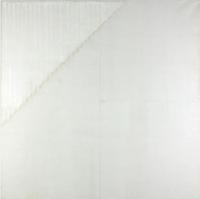
Untitled
Jean Degottex
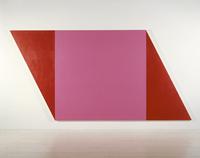
Pink Square
Olivier Mosset
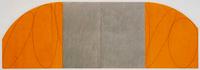
Curved Plane Figure VIII
Robert Mangold
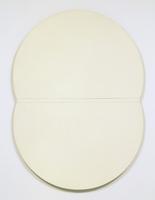
White Plaque. Bridge Arch and Reflection
Ellsworth Kelly
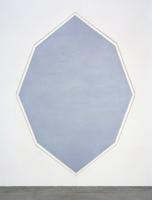
Untitled (Blue Octagon)
Mary Corse
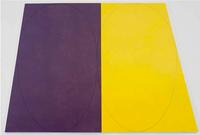
Plane-Figure Series D (Double Panel)
Robert Mangold
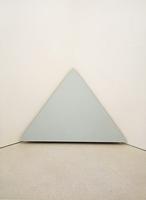
Untitled (Corner Piece)
Robert Morris
Exposed White Painting No.3
Callum Innes
Untitled (White Octagon)
Mary Corse
White Curve
Ellsworth Kelly
Yellow-Black Zone Painting IV
Robert Mangold
Untitled (White Light - Beveled Edges)
Mary Corse
dé-finition/méthode #496: exposition-suicide 1
Claude Rutault
Exposed Painting, Payne’s Grey
Callum Innes
Pale Yellow and Blue Tondo
Ilya Bolotowsky
Yellow Rose #1
Walter Darby Bannard
Pointing Inside
Jan Maarten Voskuil