Analisi esperta di Messenger from the Three Poles di Wolfgang Paalen
Stile: Abstract Art · Genere: abstract
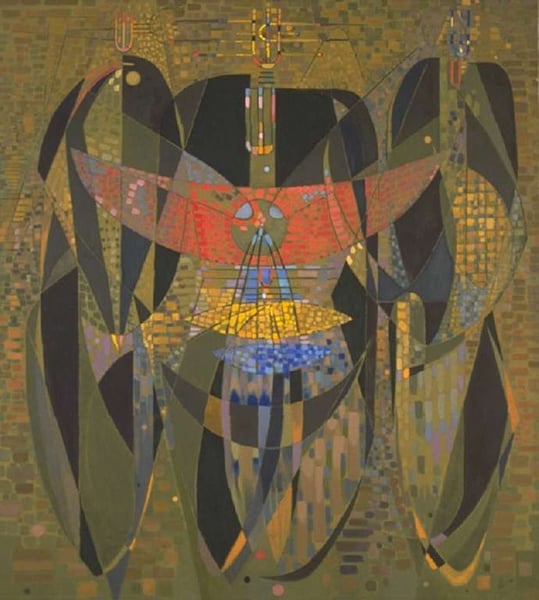
"Messenger from the Three Poles" by Wolfgang Paalen (c. 1940s) stands as a pivotal work within the trajectory of Abstract Surrealism and the broader development of mid-century abstract art. Paalen, a key figure who bridged European Surrealism and the emergent Abstract Expressionist movement, infused his canvases with a profound sense of biomorphic abstraction—an organic, non-geometric vocabulary drawn from natural forms, totemic imagery, and the subconscious.
The painting’s title evokes a synthesis of cosmic and geographic forces: the "Three Poles" likely allude to the North, South, and magnetic poles, or perhaps to a metaphysical triad of earth, sky, and spirit. The "Messenger" is the abstracted entity that navigates these realms. In execution, Paalen would have employed his signature technique of “fumage” (using candle smoke to create ethereal, drifting forms) combined with spontaneous, gestural brushwork. The result is a luminous, shifting composition where floating, cellular shapes and delicate, wire-like lines seem to pulse against a deep atmospheric ground—a quality that foreshadows the all-over, non-objective painting of the 1950s.
What makes this work significant within Abstract Art is its role in the shift from Surrealism's literary, representational dreamscapes to a purely visual, abstract language of energy and transformation. Paalen co-founded the journal DYN and advocated for a "totem art" that reconnected modern abstraction with primal, mythic consciousness. Messenger from the Three Poles embodies that synthesis: it is neither fully automatic nor purely geometric, but a deliberate, meditative arrangement of vibrant organic forms that function as signs or symbols—an abstract herald of the artist’s quest to express the ineffable forces of nature and the cosmos.
In this work, Paalen achieves a rare equilibrium between spontaneity and structure, making it a precursor to the lyrical abstraction of artists like Mark Rothko and the gestural fields of Hans Hofmann. It remains a testament to Paalen’s conviction that abstract art could carry profound existential and metaphysical meaning, long before such ideas became central to the post-war avant-garde.
Genere
Stile
Visivamente simili
20 opere con composizione e palette affini
Tripolar
Wolfgang Paalen
Scheiber Hugó, Varieté
Scheiber Hugó
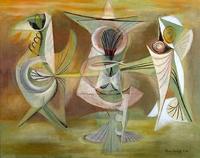
Three Figures
Elmer Bischoff
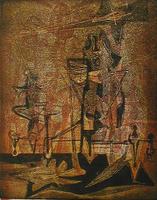
Dancers
Boris Margo
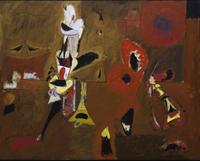
Agony
Arshile Gorky
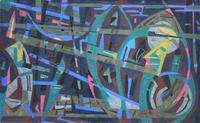
Neon
Jean Bertholle
From Thoughts of Alchemy
Boris Margo
Instrument de la passion
Jean Bertholle
Violin
Pablo Picasso
Feast of the God
Max Ernst
Pink Vine Pergola
Graham Sutherland
Vertical figure
Gosta Adrian-Nilsson
Untitled
Artin Demirci
Composition Cubiste
Leopold Survage
Love on the Yangtse
Seong Moy
La lanterne et le petit haricot
Le Corbusier
Rites of Lilith
Mark Rothko
Large Vine Pergola No. 2
Graham Sutherland
Untitled (Abstract Composition)
Alexander Boghossian
The Alchemist
Boris Margo