Analisi esperta di Forestine di Jean-Paul Riopelle
Stile: Abstract Expressionism · Genere: abstract
Expert Analysis of "Forestine" by Jean-Paul Riopelle
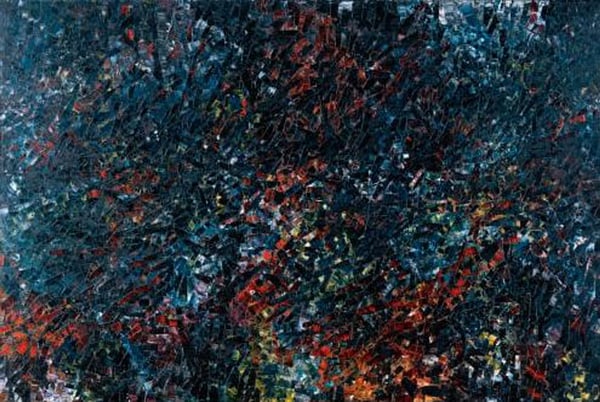
Jean-Paul Riopelle’s "Forestine" exemplifies the artist’s distinctive contribution to Abstract Expressionism, merging the spontaneous energy of the movement with a disciplined, mosaic-like technique. Riopelle, a Canadian painter associated with the Montreal-based Automatistes and later the New York School, is celebrated for his use of the palette knife to build dense, all-over compositions of small, vibrant color patches. This method creates a surface that is at once explosive and meticulously structured, embodying the tension between chaos and order that defines his work.
Significance within Abstract Expressionism:
-
Materiality and Texture: Riopelle’s signature impasto—layered blocks of oil paint applied with a palette knife—gives "Forestine" a sculptural, almost topographical quality. This tactile approach distinguishes him from more gestural Abstract Expressionists like Jackson Pollock or Willem de Kooning, emphasizing the physicality of paint as an end in itself.
-
All-Over Composition: True to Abstract Expressionist principles, the work avoids a central focal point, instead spreading color and form evenly across the canvas. The title "Forestine" (a feminine diminutive related to “forest”) hints at natural inspiration—perhaps a memory of dappled light or dense foliage—but any representational reading is subsumed into pure abstraction, inviting viewers to experience rhythm, hue, and texture without narrative.
-
Transatlantic Bridge: Riopelle uniquely bridged European and American abstraction. While his early work was influenced by Surrealist automatism (reflected in the spontaneous placement of color blocks), his mature style aligned with the New York School’s emphasis on scale and material presence. "Forestine" likely dates from his most productive period (1950s–60s), when he was a key figure in the Paris–New York dialogue, exhibiting alongside Pollock and Mark Rothko yet retaining a distinctly personal vocabulary.
-
Lyrical Dynamism: Unlike the darker, more existential tones of some Abstract Expressionists, Riopelle’s palette in works like "Forestine" tends toward high-key, jewel-like colors—greens, blues, yellows, and reds—arranged in an energetic patchwork. This creates a sense of motion and light, as if the painting itself is in constant flux, a frozen moment of kinetic color.
Conclusion: "Forestine" is significant as a masterful synthesis of European modernist traditions (Cubist facetation, Surrealist chance) and American postwar abstraction’s scale and physicality. Riopelle’s unique mosaic impasto, his all-over design, and his ability to evoke landscape without illustration make this work a standout example of how Abstract Expressionism could be both wildly expressive and meticulously crafted. It remains a testament to the artist’s role in redefining the possibilities of non-representational painting.
Genere
Visivamente simili
20 opere con composizione e palette affini
Eclactique éclaté
Camille Bryen
Untitled
Princess Fahrelnissa Zeid
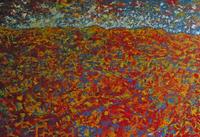
Red #54.4
Carlos Lagos
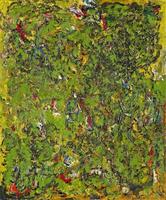
Composition
Alexandre Istrati
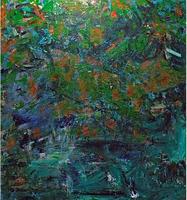
Composition #23
Carlos Lagos
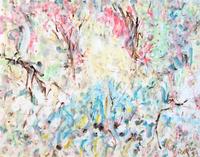
Untitled Landscape, Bellport (No.1168)
Arthur Pinajian
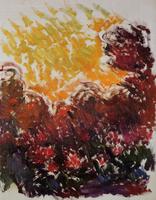
The Garden at Giverny
Claude Monet
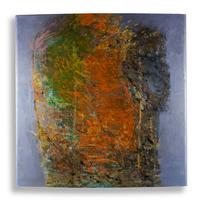
PULSE I
Rashid Al Khalifa
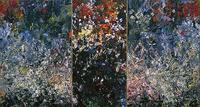
Pavane
Jean-Paul Riopelle
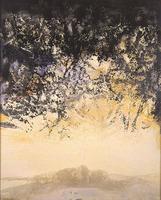
11-11-1996
Zao Wou-Ki
Tilleul
Joan Mitchell
Forest (Autumn)
George Stefanescu
Roseland
Milton Resnick
Composition
Jean-Paul Riopelle
Untitled #6
Milton Resnick
White Venus
Eugene Leroy
Abstraction
Milton Resnick
Peuplier clairs
Olivier Debre
Abstract Composition
Gillian Ayres
Composition
Jean Le Moal