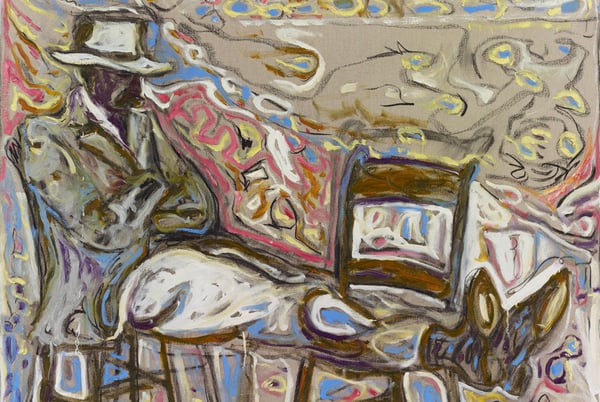
Expert analysis of Billy Childish’s Man Sat on Chairs
Style: Expressionism, Stuckism · Genre: genre painting
Expert Analysis of "Man Sat on Chairs" by Billy Childish
Billy Childish’s Man Sat on Chairs operates at the intersection of Expressionism and Stuckism, two movements that privilege raw emotional immediacy over polished formalism or conceptual detachment. As a co-founder of the Stuckist movement in 1999, Childish deliberately championed figurative painting, narrative content, and a direct, almost confrontational sincerity—a direct rebuttal to the then-dominant Young British Artists’ conceptual and media-driven works.
Significance within Expressionism:
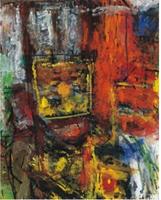
The work’s title and genre—a simple genre scene of a man seated on chairs—might initially seem banal, but Childish infuses it with the hallmarks of Expressionist distortion: exaggerated contours, clashing colors, and heavy, gestural brushwork. The repetition of “chairs” (plural) hints at a destabilized, uneasy composition. The figure likely appears flattened or slightly off-kilter, emphasizing psychological tension rather than physical accuracy. This aligns with classic Expressionism’s goal to externalize inner states through formal exaggeration.
Significance within Stuckism:
Stuckism’s manifesto—created by Childish and Charles Thomson—asserts that art must “stuck” to authentic human experience, rejecting irony, shock value, and the tyranny of the art market. Man Sat on Chairs embodies this by focusing on a mundane, everyday moment. There is no clever postmodern deconstruction; instead, the painting invites viewers into a raw, unglamorous encounter with a solitary figure. The very awkwardness of the scene (a man on multiple chairs) suggests discomfort, alienation, or the search for stability—themes Stuckism insists are central to genuine art.
Genre Painting Reimagined:
Traditionally, genre painting depicted scenes of ordinary life with moral or sentimental undercurrents. Childish subverts this by stripping away anecdotal charm, leaving only the stark, painterly presence. The work’s significance lies in its defiant refusal to be “important” in a conceptual sense. Instead, it reclaims painting’s power to convey emotion through materiality—the physicality of paint, the direct mark of the hand—and to elevate the overlooked moment to a site of profound expression.
In sum, Man Sat on Chairs is a manifesto in paint: it asserts that authenticity, emotion, and the simple act of seeing and representing can be more radical than any conceptual stunt. It stands as a key example of how Stuckism revived Expressionist energy for the 21st century, arguing for art’s fundamental role as a human, not intellectual, endeavor.
Genre
Visually similar
20 works with related composition and palette
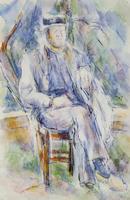
Peasant in a Straw Hat
Paul Cezanne
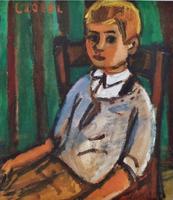
Ülő Fiu
Bela Czobel
Prosecutor's death
Marc Chagall
After Paul Cézanne
Otto Muehl
The Young Sailor I
Henri Matisse
Boy In Red Jacket
Louay Kayyali
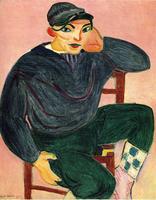
The Young Sailor II
Henri Matisse
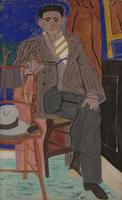
Dark-haired youth seated, with a topcoat
Yiannis Tsaroychis
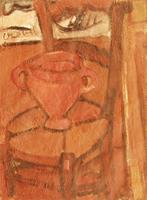
Vase on a Chair (Italian Jar)
Bela Czobel
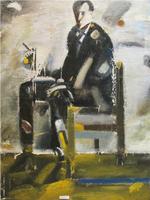
Portrait of David Oistrakh
Oleg Holosiy
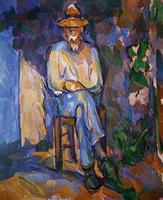
The Old Gardener
Paul Cezanne
Bela Czobel Still Life Wih Flowers
Bela Czobel
Portrait of Frederick Kiesler
Hedda Sterne
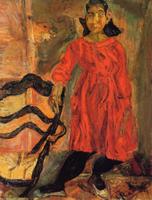
Girl in Red
Chaim Soutine
Portrait of Peasant
Paul Cezanne
Portrait de Max Jacob
Christopher Wood
Spanish boy
Pyotr Konchalovsky
La Table De Travail
Bela Czobel
Bela Czobel Festő Műterme
Bela Czobel
Sheet with People Sitting on Chairs
Vincent van Gogh